
Online financial scams have grown fast, and India has been a major target because of how many people use digital payments every day. DigiKavach is Google's answer to that threat. It is an early warning program built to spot new scam patterns and stop them before they spread. In this guide you will learn what DigiKavach is, how it works behind the scenes, and the everyday habits that keep you safe from UPI fraud and lending traps.
What is DigiKavach?
DigiKavach is a threat intelligence and protection initiative from Google focused on financial fraud in India. Rather than reacting after people lose money, it studies how scams operate, identifies the tactics fraudsters use, and feeds that knowledge into protections across Google's products. The name signals its purpose, a digital shield for users. It is less a single button you press and more an ongoing system that works quietly to reduce the reach of scams.
Because scams evolve constantly, DigiKavach is designed around early detection. The faster a new fraud pattern is recognized, the fewer people it can harm.
How DigiKavach Works
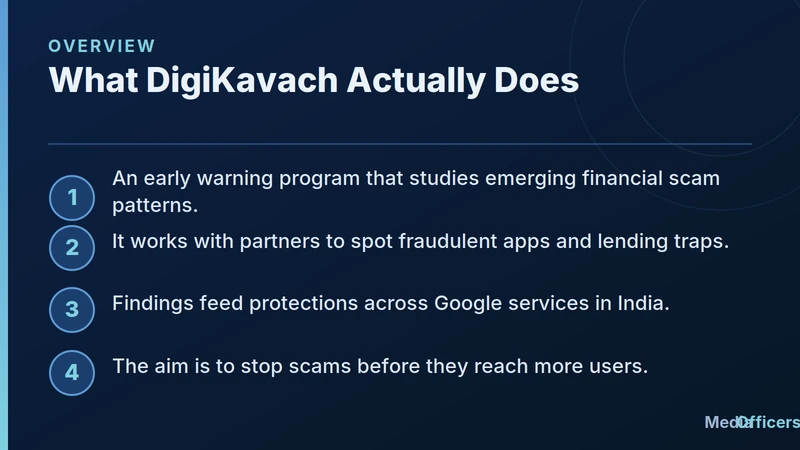
Infographic explaining what DigiKavach does to detect and stop financial scams
The program follows a simple cycle. It studies emerging financial scam patterns, often working with partners and researchers who see fraud attempts in the wild. It then uses those insights to identify fraudulent apps, deceptive lending schemes, and other traps. Finally, the findings strengthen protections across Google services, so risky apps and behaviors are harder for scammers to push to users. The goal throughout is to intervene early, before a scam reaches a large audience.
This intelligence led approach matters because many scams rely on speed and scale. If a fraudulent lending app can be flagged quickly, its window to trick people shrinks dramatically.
The Scams DigiKavach Targets
Financial fraud in India takes many shapes, and DigiKavach focuses on the most damaging ones. Predatory lending apps that trap people with hidden fees and harassment are a common target. So are UPI based tricks that try to pull money out of accounts under the guise of receiving it. Fake investment and reward schemes, phishing links dressed up as KYC updates, and cloned apps all fall within the same problem space. By studying how these operate, the program helps limit how far they can spread.
Simple Habits to Avoid UPI Scams
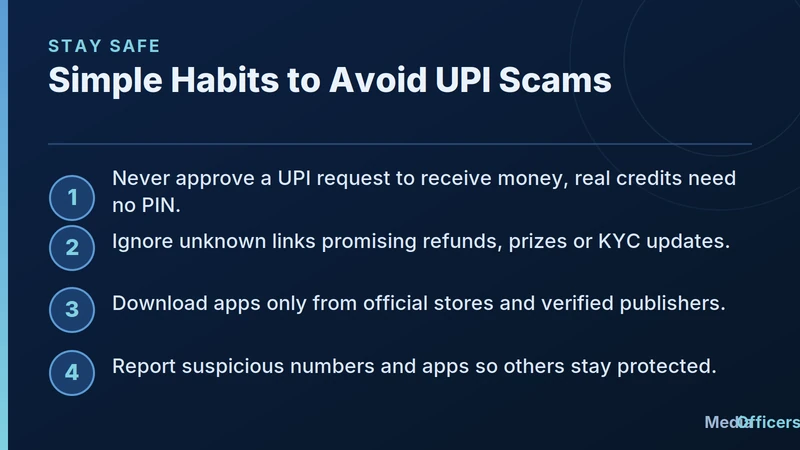
Infographic listing simple habits to avoid UPI scams and financial fraud
No system replaces your own caution. These habits stop the most common scams cold.
- Never enter your PIN to receive money. Real incoming payments never ask for your UPI PIN. If a request does, it is trying to take money, not send it.
- Ignore urgent links. Messages promising refunds, prizes, or KYC deadlines are classic bait. Do not tap them.
- Install only trusted apps. Download from official stores and verified publishers, and avoid loan apps that arrive through random links.
- Report and share. Report suspicious numbers, apps, and messages so others are warned too.
Scammers rely on panic and speed. Slowing down for a few seconds to check a request is usually all it takes to see through the trick.
Why This Matters for Everyday Users
Digital payments are convenient, but that convenience is exactly what fraudsters exploit. Programs like DigiKavach reduce the overall pressure by catching scams earlier, yet the last line of defense is always the user. When you combine platform level protection with a few careful habits, the odds shift firmly in your favor. Understanding how scams work is itself a form of protection, because a scam that you recognize is a scam that cannot succeed.
How DigiKavach Fits Into Wider Online Safety
DigiKavach does not work alone. It sits alongside other protections such as app store review, safe browsing warnings, and account security tools, all aimed at reducing harm before it reaches you. The value of an intelligence led program is that it feeds fresh knowledge into those defenses. When researchers spot a new lending scam or a fresh phishing tactic, that understanding can strengthen the systems that flag risky apps and links. For everyday users, the practical result is that many scams are quietly stopped or slowed before they ever appear on your screen, even though you never see the work happening.
What to Do If You Are Scammed
If you think you have been defrauded, act quickly, because speed improves your chances of limiting the damage. Contact your bank right away to report the transaction and ask about freezing further activity. Report the incident through the national cyber crime and financial fraud channels so the fraudulent account can be investigated. Change any passwords or PINs that may have been exposed, and remove any suspicious app you were asked to install. Finally, warn friends and family about the specific trick, since scammers often reuse the same script on many people. Fast reporting protects both you and the next potential target.
A Closer Look at Loan App Traps
Predatory lending apps are one of the most harmful scams DigiKavach works against, so they are worth understanding. These apps often promise instant money with almost no paperwork, then demand access to your contacts and photos, and pile on hidden fees. When repayment falls behind, some resort to harassment or threats using the data they collected. The safest defense is to borrow only from recognized, regulated lenders, to read the permissions an app requests before installing it, and to walk away from any loan offer that arrives through a random link or message. If an offer feels too easy, that ease is usually the trap.
Frequently Asked Questions
Is DigiKavach an app I need to install?
No. It is a protection program that works across Google services rather than a separate app you download.
Does DigiKavach only work in India?
Its focus is financial fraud affecting users in India, where digital payment scams are widespread.
Can DigiKavach recover money I already lost?
It is built to prevent scams, not to reverse transactions. Report any fraud to your bank and the authorities immediately.
What is the single best way to avoid UPI fraud?
Remember that receiving money never requires your PIN. Any request that asks for it is trying to take funds.
Bottom line: DigiKavach is Google's digital shield against financial scams in India, working early to spot and limit fraud. Pair that protection with careful habits, especially never sharing your UPI PIN to receive money, and you make yourself a very hard target.

Written by
Rudhrah KeshavCo-Founder & Chief Revenue Officer (CRO)
Rudhrah Keshav is the Co-Founder & CRO at MediaOfficers. 16+ years SEO architect, published author of "AI Marketing for Indian Businesses" and "Local SEO" (Google Books / Amazon), featured in Yahoo Finance.


