
Generative Engine Optimization (GEO) is the practice of optimizing your website and brand so that AI search engines - ChatGPT, Perplexity, Google AI Overviews, Gemini, and Claude - cite you as a source when they answer user questions. Where traditional SEO fights for a ranking position, GEO fights for a citation inside the answer itself. Organizations looking to operationalize these strategies across their web properties can partner with our specialized generative engine optimization services to audit entity graphs, format extractable knowledge, and capture high-intent AI answer share.
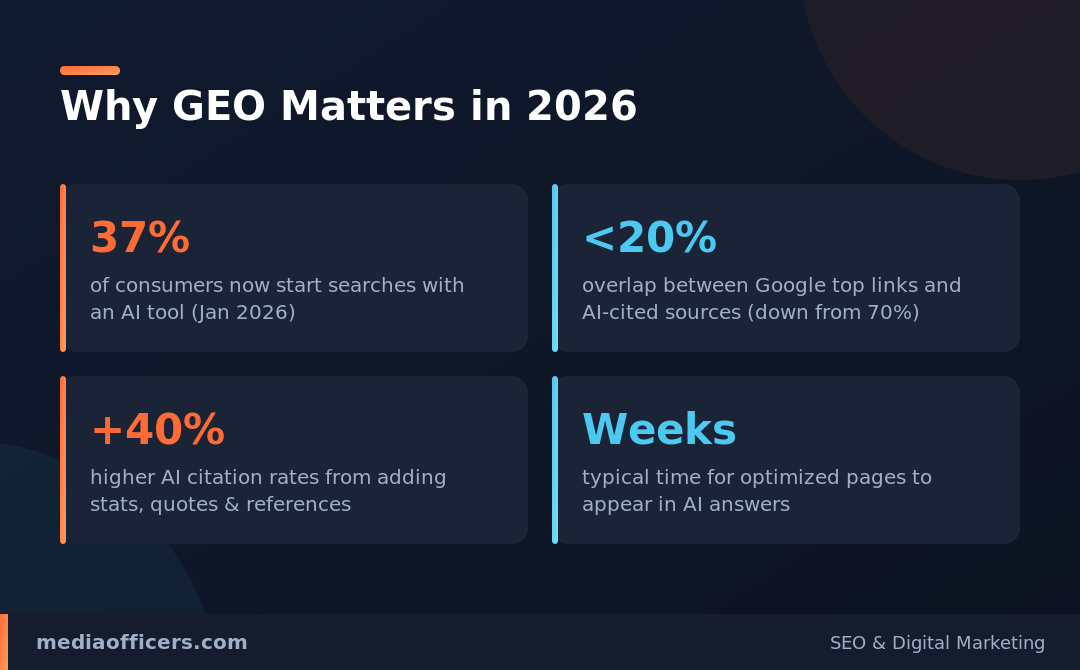
If your business depends on being found online, this is no longer optional. As of January 2026, roughly 37% of consumers start their searches with an AI tool instead of a classic search engine. And here is the uncomfortable part: ranking #1 on Google no longer guarantees AI engines will mention you. Industry research shows the overlap between Google's top results and AI-cited sources has dropped from around 70% to below 20%.
That gap is the opportunity. GEO is a young discipline, which means businesses that move in 2026 can win citations that will be much harder to earn in 2027.
GEO vs SEO: What's Actually Different?
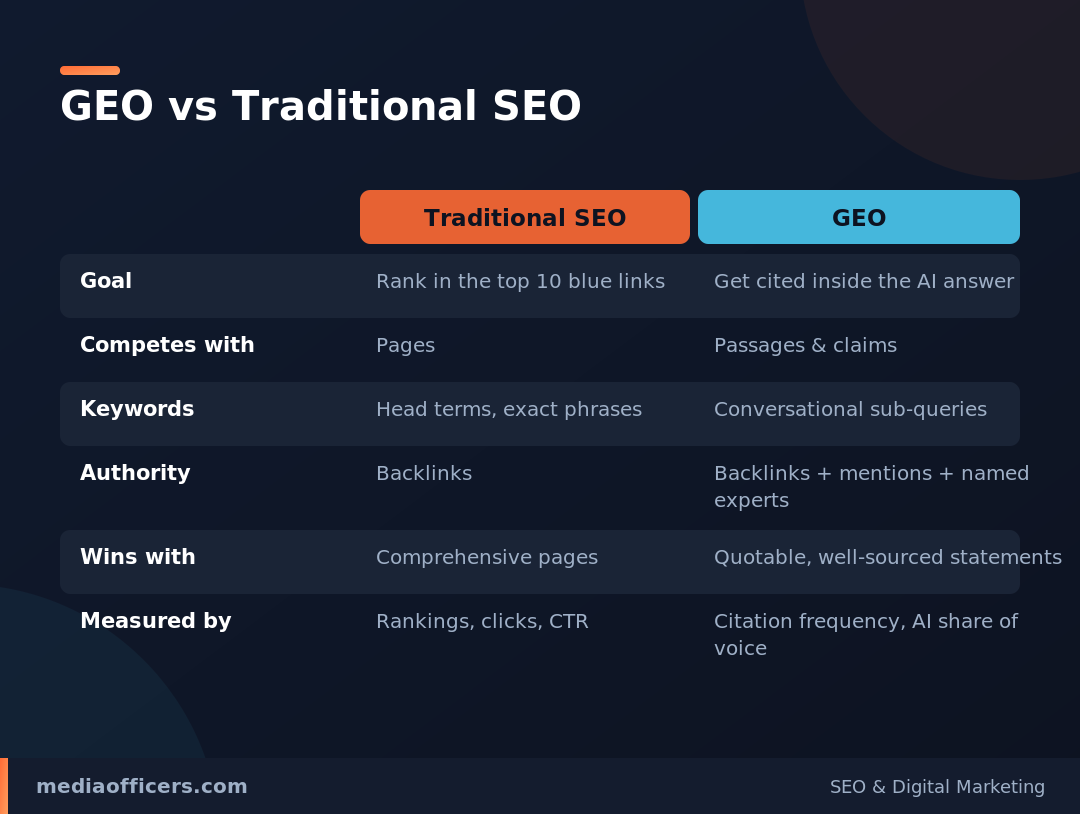
GEO doesn't replace SEO - it sits on top of it. You still need crawlable pages, fast load times, and quality content. But the scoring system changes.
| Factor | Traditional SEO | GEO |
|---|---|---|
| Goal | Rank in the top 10 blue links | Get cited inside the AI answer |
| Unit of competition | The page | The passage / the claim |
| Keyword focus | Head terms and exact phrases | Conversational questions and sub-queries |
| Authority signal | Backlinks | Backlinks + brand mentions + named experts |
| Winning format | Long-form comprehensive pages | Clear, quotable, well-sourced statements |
| Measurement | Rankings, clicks, CTR | Citation frequency, share of voice in AI answers |
The biggest mental shift: AI engines break a user's question into multiple smaller sub-queries, search for each one, then assemble an answer. If someone asks "best SEO agency for a dental clinic in India," the engine may separately search "dental SEO," "SEO agency India reviews," and "SEO cost dental clinic." Your content needs to be the best answer to those fragments, not just the full phrase.
How AI Engines Decide Whom to Cite
From published research and our own client testing, five signals consistently drive citations:
1. Quotable, self-contained answers
AI systems lift passages, not pages. A paragraph that defines a term, states a number, or gives a verdict in 2 - 3 sentences is far more citable than the same information scattered across 800 words.
2. Statistics, sources, and named experts
A joint study by Princeton, Georgia Tech, and IIT Delhi found that adding statistics, quotations, and authoritative references increased AI citation rates by up to 40%. Anonymous "Editorial Team" bylines work against you - engines increasingly weight named authors with verifiable credentials.
3. Structured content
Clean H2/H3 hierarchies, tables, FAQs, and definition-style openings map directly onto how language models chunk and retrieve text.
4. Third-party brand mentions
LLMs learn who you are from the whole web, not just your site. Reviews, directory listings, press coverage, and mentions on trusted industry sites all raise the probability the model "knows" your brand and trusts it.
5. Crawl access
The simplest and most-missed step. Many sites unknowingly block GPTBot, PerplexityBot, ClaudeBot, or Google-Extended in robots.txt - and Cloudflare now blocks AI crawlers by default on many plans. Verify your DNS and bot directives using our domain technical readiness checker. If the bots can't read you, you can't be cited.
A Practical GEO Starter Checklist
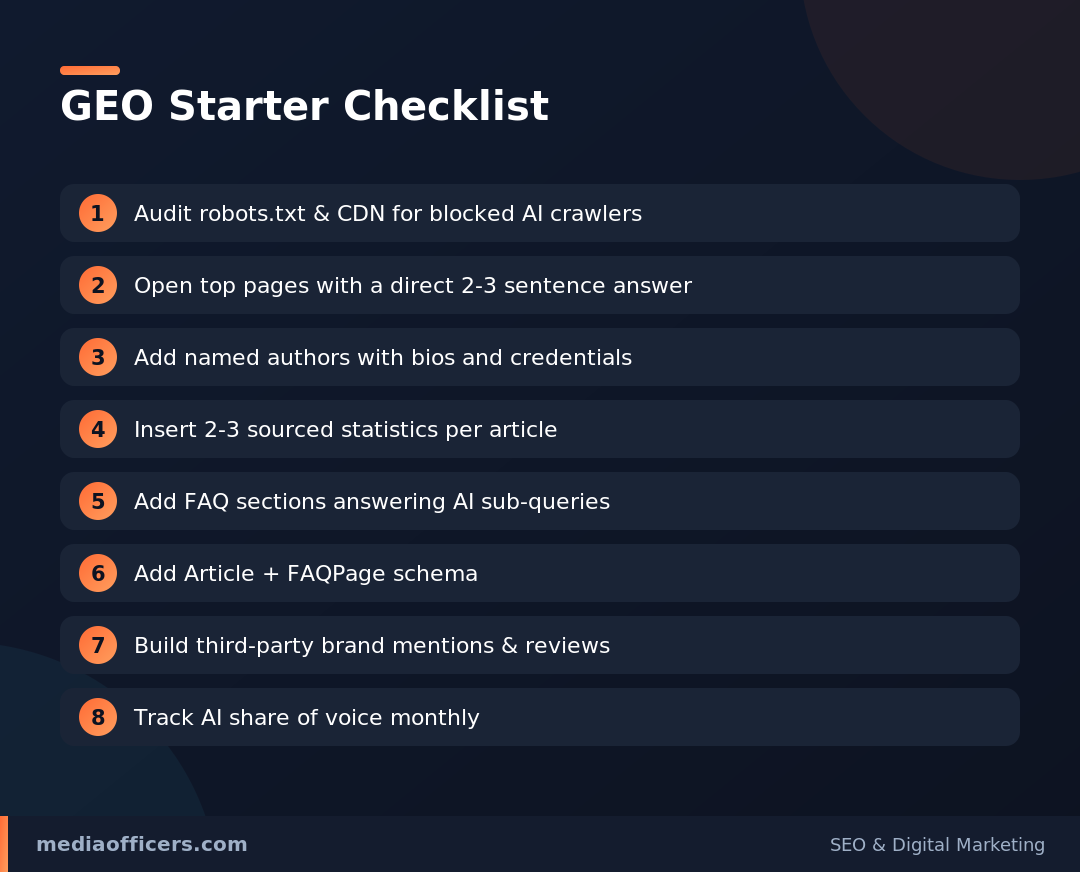
- Audit robots.txt and your CDN/firewall for blocked AI crawlers.
- Rewrite your top 10 pages so each opens with a direct 2 - 3 sentence answer.
- Add named authors with bios and credentials to every article.
- Insert at least 2 - 3 sourced statistics per article.
- Add an FAQ section that answers the sub-questions AI engines will fan out into.
- Add Article and FAQPage schema, or build a unified entity-based schema graph.
- Build brand mentions: reviews, directories, guest features, digital PR.
- Track your share of voice by asking ChatGPT, Perplexity, and Gemini your money questions monthly and logging who gets cited.
One caution: Google's own 2026 guidance confirmed that special "AI schema," content chunking tricks, and llms.txt files are not required for generative search features. Solid fundamentals plus citable, expert content remain the reliable path - treat anyone selling secret GEO hacks with suspicion.
Where GEO Fits in Your Strategy
Think of it as three layers: technical SEO gets you crawled, classic SEO gets you ranked, GEO gets you quoted. Businesses that do all three own both the click and the conversation. That's exactly how we structure campaigns at MediaOfficers - our SEO services now include AI-visibility tracking for every client, because the leads increasingly say "I found you through ChatGPT" instead of "I Googled you."
FAQs
What does GEO stand for in marketing? GEO stands for Generative Engine Optimization - optimizing content so generative AI search engines like ChatGPT, Perplexity, and Google AI Overviews cite your brand in their answers.
Is GEO replacing SEO? No. GEO builds on SEO. Pages still need to be crawlable, fast, and high quality; GEO adds citation-focused signals like quotable passages, sourced statistics, named authors, and brand mentions.
How long does GEO take to show results? Faster than classic SEO in many cases. Because AI engines re-retrieve sources frequently and competition is still low, well-optimized pages can appear in AI answers within weeks, while competitive Google rankings typically take 3 - 6 months.
How do I check if AI engines cite my website? Ask ChatGPT, Perplexity, Gemini, and Google (with AI Overviews) the questions your customers ask, and record which brands and URLs appear. Do this monthly to track share of voice; dedicated GEO tracking tools can automate it.
Does blocking AI crawlers protect my content? It prevents citation, not competition. If GPTBot or PerplexityBot can't crawl your site, AI engines will simply cite your competitors instead.
Next in this series: How to Get Your Brand Cited by ChatGPT, Perplexity & Google AI Overviews
For more detailed strategies on optimizing your brand across conversational search engines and leveraging user communities, explore our complete guide to Reddit SEO, or follow our actionable Google AI Overviews optimization checklist.
💡 Related Reading: To understand how vector ranking differs from standard SERPs, read AI SEO vs Traditional SEO.
💡 Related Reading: Bing powers ChatGPT search results - learn more in our Bing SEO 2026 master guide.
💡 Related Reading: Explore the fundamental transformations in our 7 AI Search SEO Shifts report.

Written by
Rudhrah KeshavCo-Founder & Chief Revenue Officer (CRO)
Rudhrah Keshav is the Co-Founder & CRO at MediaOfficers. 16+ years SEO architect, published author of "AI Marketing for Indian Businesses" and "Local SEO" (Google Books / Amazon), featured in Yahoo Finance.


