
ChatGPT Search SEO comes down to one gate and one game. The gate is OAI-SearchBot, the crawler that decides whether your pages are eligible to appear in ChatGPT's search results at all. The game is entity clarity: ChatGPT cites far fewer sources per answer than Perplexity does, so it defaults to the domains it already recognises as authoritative on a subject. MediaOfficers provides tailored AI SEO services to audit crawler accessibility, optimize robots.txt directives, and align content for OpenAI's search index.
That scarcity is the whole story. Brand citation rate on ChatGPT sits at roughly 0.59% versus around 13% on Perplexity, a 22-fold gap. Getting cited here is harder, which is precisely why it is worth doing properly.
This guide covers the crawler configuration first (because a misconfigured robots.txt or WAF makes everything else pointless), then the content and entity work that earns the citation.
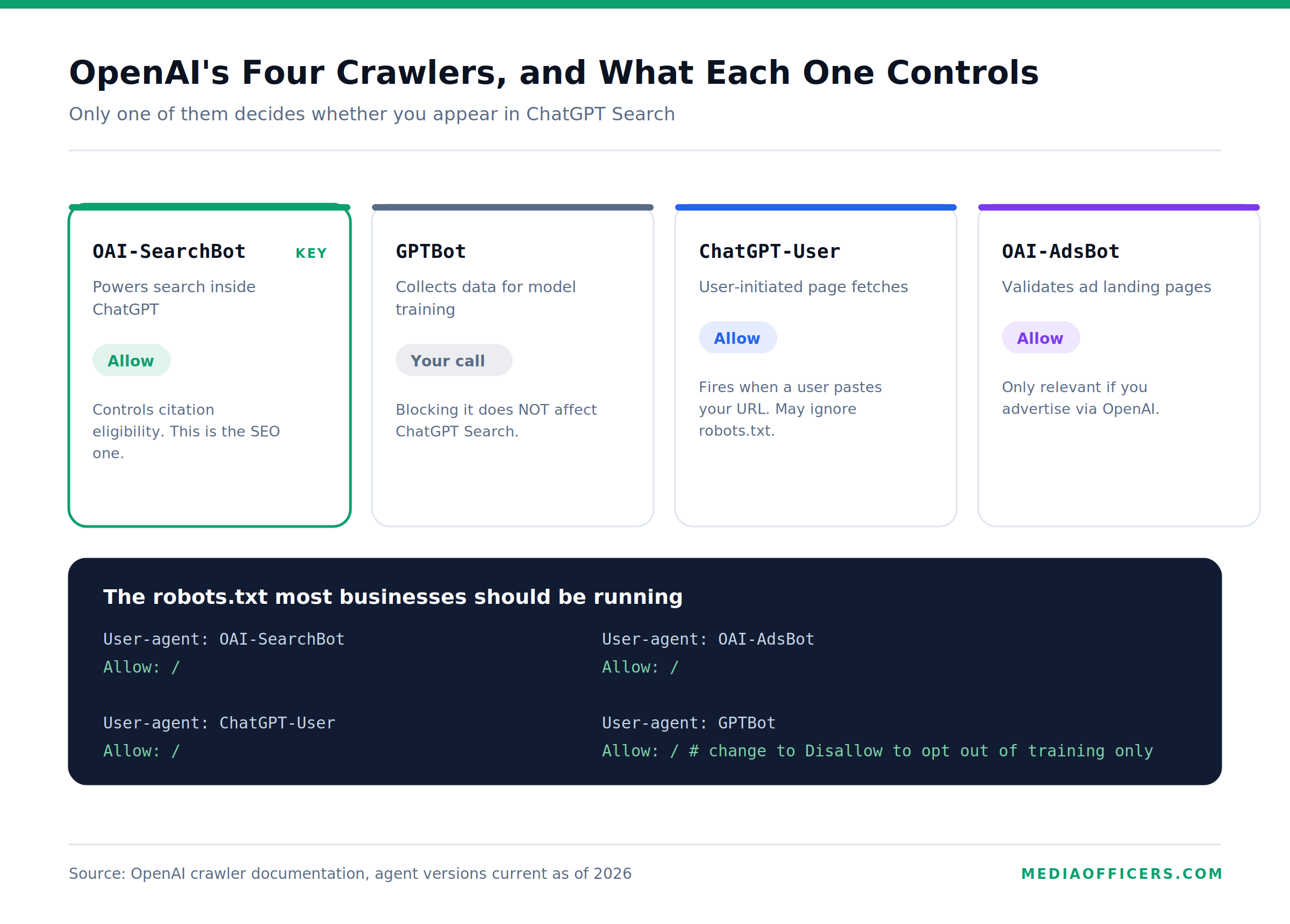 OpenAI runs four distinct crawlers. Only OAI-SearchBot controls whether you appear in ChatGPT Search. Confusing it with GPTBot is the most expensive mistake in this guide.
The One Thing Most Sites Get Wrong
In 2023 and 2024, a lot of publishers added User-agent: GPTBot / Disallow: / to protect their content from model training. Reasonable decision at the time.
The problem is that many of those same sites then added a blanket block for every OpenAI agent, or used a wildcard rule, and quietly removed themselves from ChatGPT Search. Blocking GPTBot keeps you out of training data. Blocking OAI-SearchBot keeps you out of the answers your customers are reading right now. These are separate decisions with separate agents. Treat them separately.
OpenAI's Crawlers Explained
There are four agents, and each does a different job across OpenAI's infrastructure:
| Crawler | Purpose | Respects robots.txt | Recommended Directive |
|---|---|---|---|
| OAI-SearchBot | Powers search in ChatGPT Search (SearchGPT) | Yes | Allow |
| GPTBot | Collects content for foundation model training | Yes | Your call (Disallow to opt out of training) |
| ChatGPT-User | Executes live user-initiated fetches inside ChatGPT | User-initiated (often bypasses) | Allow |
| OAI-AdsBot | Checks safety and relevance of ad landing pages | Yes | Allow if you advertise |
OAI-SearchBot
This is the primary agent that matters for ChatGPT Search SEO. Its user-agent string is identified as:
Mozilla/5.0 (Macintosh; Intel Mac OS X 10_15_7) AppleWebKit/537.36 (KHTML, like Gecko) Chrome/131.0.0.0 Safari/537.36; compatible; OAI-SearchBot/1.4; +https://openai.com/searchbot
Published IP ranges live at openai.com/searchbot.json. Allowing this agent is what makes your content eligible to surface in ChatGPT Search results with an interactive citation link.
GPTBot
The training crawler. Blocking it excludes your content from foundation model training. It does not affect ChatGPT Search visibility. Allowing GPTBot means your brand and terminology can end up baked into the model's parametric knowledge, which pays off in answers where no live search happens at all. Most service businesses benefit from allowing it; publishers with paywalls usually disallow it.
Your robots.txt Configuration
Here is the configuration most businesses should be running in their robots.txt file:
# Allow ChatGPT Search visibility
User-agent: OAI-SearchBot
Allow: /
# Allow user-initiated fetches
User-agent: ChatGPT-User
Allow: /
# Allow ad landing page validation
User-agent: OAI-AdsBot
Allow: /
# Training crawler: allow or disallow per your content policy
User-agent: GPTBot
Allow: /
If you want out of training but in on search, change only the last block to Disallow: /. Leave the rest allowed.
Verifying crawler access in your logs
Robots.txt is necessary but not sufficient. Verify at the log level:
Grep your access logs for
OAI-SearchBotover the last 30 days.If there are zero hits, your WAF or Cloudflare bot protection is blocking it.
Cross-reference hitting IPs against
openai.com/searchbot.jsonto confirm legitimacy.Ensure your CDN does not trigger challenge Captchas for verified OpenAI IP blocks.
Always verify server log access to confirm crawler user-agents can fetch your primary HTML without encountering challenge interstitials.
How ChatGPT Search Selects and Ranks Sources
Retrieval, not ranking
ChatGPT Search does not maintain a classical 10-blue-link ranked index. When a query requires live web retrieval, it fetches candidate documents, processes them through an extraction pipeline, and synthesises an answer with direct footnotes citing the sources it actually used.
The selection is driven by two factors: is this document retrievable under 500ms, and does it contain a self-contained passage that directly answers the user's prompt?
Citation scarcity changes the strategy
ChatGPT cites roughly a third as many sources per answer as Perplexity (often only 2 to 4 sources vs 8 to 10 on Perplexity). With fewer slots, the model leans heavily on recognised entity anchors with consistent signals across the web. For cross-engine comparison, read our companion guides on Perplexity SEO Optimization and GEO for Grok & Gemini.
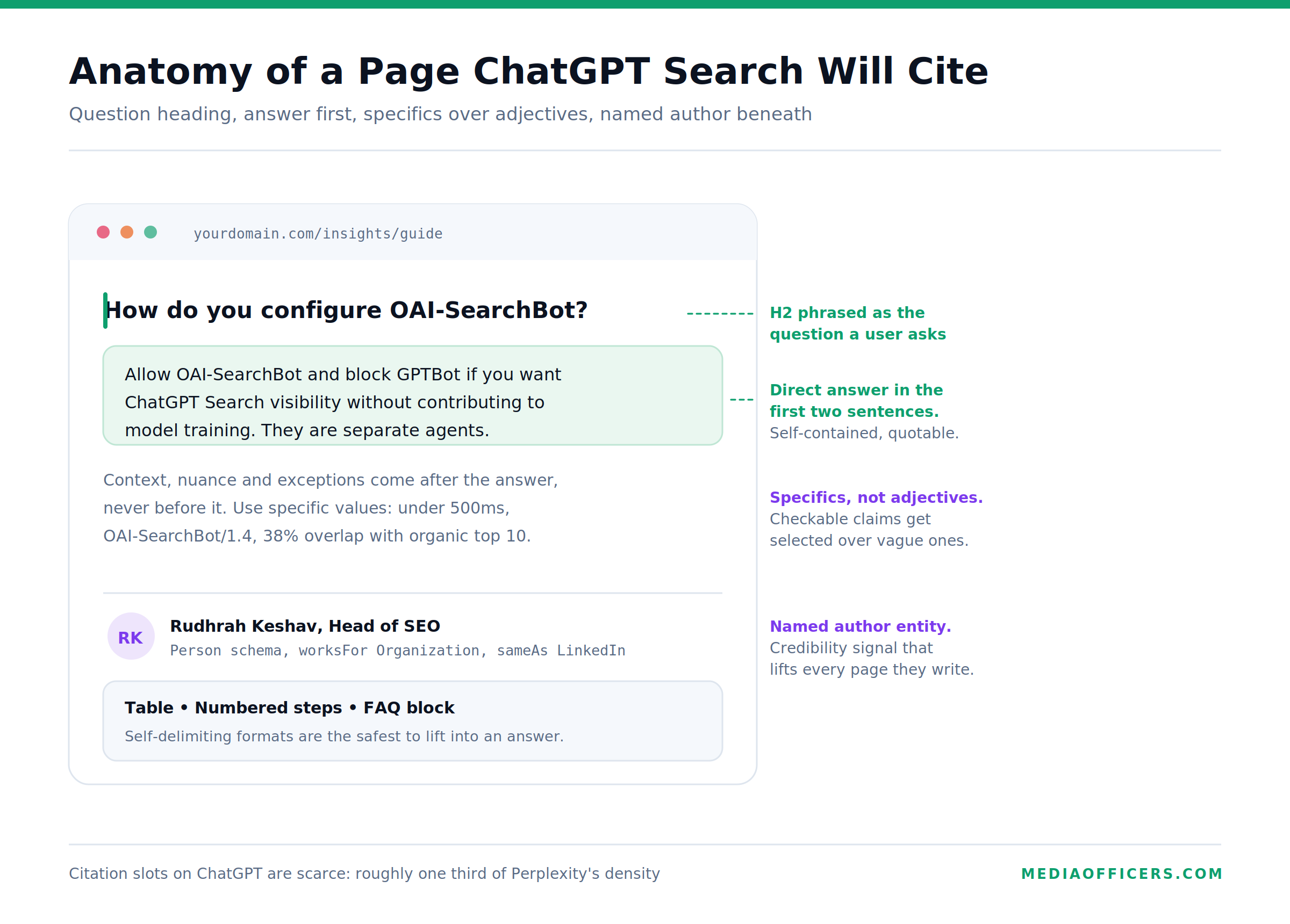 The anatomy of a page ChatGPT Search will cite: question-shaped heading, direct answer within the first two sentences, verifiable specifics over adjectives, and a named author entity.
Entity Optimization for ChatGPT Citations
Why entities matter more here
Language models reason about the world through entities and their knowledge graph relationships, not isolated keywords. If ChatGPT cannot resolve your brand to a specific entity with known attributes, it has no basis to treat your page as authoritative.
The Entity Checklist
On your own website:
Organizationschema on the homepage withname,url,logo,description,foundingDate,address, and fullsameAsarray.A substantive About page, not just a brief mission statement.
Author bio pages marked up with
Personschema and outbound authority links.Consistent NAP (Name, Address, Phone) matching footer and schema byte-for-byte.
Off-site entity validation:
Wikidata entity registration with correct properties and citations.
Verified LinkedIn Company page and Crunchbase profile.
Google Business Profile matching canonical NAP.
For complete technical implementation of entity schemas, refer to our deep dive on Advanced JSON-LD Schema for Google Knowledge Graph.
Writing Pages That ChatGPT Search Will Cite
Structure headings as questions
Your H2s and H3s should read like real questions people type or ask voice assistants. Retrieval matches semantic similarity between the user's prompt and passages in your document. A heading phrased as the exact question provides the strongest match signal and defines the extraction boundary.
Answer immediately, elaborate after
Under each question heading, the first 1 to 2 sentences must deliver the direct answer. Context, nuance, examples, and caveats follow after.
Weak (Unquotable):"When considering how to approach crawler configuration, there are several factors that organisations should evaluate before making a decision about which agents to permit..."Strong (Quotable):"Allow OAI-SearchBot and block GPTBot if you want ChatGPT Search visibility without contributing to model training. They are separate agents with separate directives."90-Day Implementation Roadmap
| Phase | Weeks | Actionable Deliverables |
|---|---|---|
| 1. Access | Weeks 1 to 2 | Configure robots.txt for all four agents, whitelist in WAF by agent and IP, confirm OAI-SearchBot hits in server logs. |
| 2. Entity | Weeks 3 to 6 | Deploy Organization schema with sameAs, claim Wikidata/Crunchbase, build author bios with Person markup. |
| 3. Content | Weeks 5 to 10 | Rewrite top 15 pages with question headings and answer-first blocks, add HTML comparison tables. |
| 4. Authority | Weeks 8 to 12 | Publish original data benchmarks, secure third-party brand co-occurrences, establish cluster internal links. |
Frequently Asked Questions
What is the difference between OAI-SearchBot and GPTBot?
OAI-SearchBot powers search results inside ChatGPT and determines whether your pages can be cited in answers. GPTBot collects content for training OpenAI's foundation models. They are separate agents with separate robots.txt directives, and blocking one does not affect the other.
Will blocking GPTBot hurt my ChatGPT Search rankings?
No. GPTBot handles training data only. As long as OAI-SearchBot is allowed and can reach your server without WAF blocks, your pages remain 100% eligible for ChatGPT Search citations.
Does ChatGPT Search use Bing's index?
ChatGPT Search runs its own retrieval built on OAI-SearchBot crawling, supplemented by third-party search partnerships. Strong general search visibility helps, but it is not a direct pass-through of any single engine's rankings.
How many sources does ChatGPT cite per answer?
Considerably fewer than Perplexity, roughly a third as many. That scarcity is why entity authority matters so much here: with fewer citation slots, the model defaults to sources with established Knowledge Graph corroboration.
How long does ChatGPT Search SEO take to work?
Crawler fixes can show up in search logs within two to four weeks. Full entity recognition takes longer, typically one to two quarters, as corroborating signals accumulate across independent web sources.
Audit Your AI Search Citation Readiness
Want to evaluate your site's crawler accessibility, robots.txt directives, and entity footprint across OpenAI, Perplexity, and Google AI Overviews? Run our free AI SEO audit or consult our modern search engine optimization services team.
Free AI SEO & GEO Audit →Explore Enterprise SEO ServicesLearn how to properly configure robots.txt and edge headers for OAI-SearchBot and GPTBot in our AI Crawler Optimization Guide.

Written by
Rudhrah KeshavCo-Founder & Chief Revenue Officer (CRO)
Rudhrah Keshav is the Co-Founder & CRO at MediaOfficers. 16+ years SEO architect, published author of "AI Marketing for Indian Businesses" and "Local SEO" (Google Books / Amazon), featured in Yahoo Finance.


