
Knowledge Graph SEO is the practice of making your brand a machine-readable entity that Google and AI search engines can identify, describe and trust. It runs on three inputs: a structured record in an authoritative database (usually Wikidata), consistent corroborating profiles across the web, and sameAs JSON-LD schema on your own site that connects them all. Discover how our holistic AI SEO services construct multi-node entity profiles that solidify brand authority across the web.
The payoff is not just the panel on the right-hand side of the SERP. Entity recognition is now the substrate underneath AI Overviews, ChatGPT Search and Perplexity citations. Models reason about entities and relationships, not strings. If Google cannot resolve your brand name to a specific organisation with known attributes, no amount of on-page work fixes that.
This guide is the complete step-by-step build, in the exact order we run it for clients.
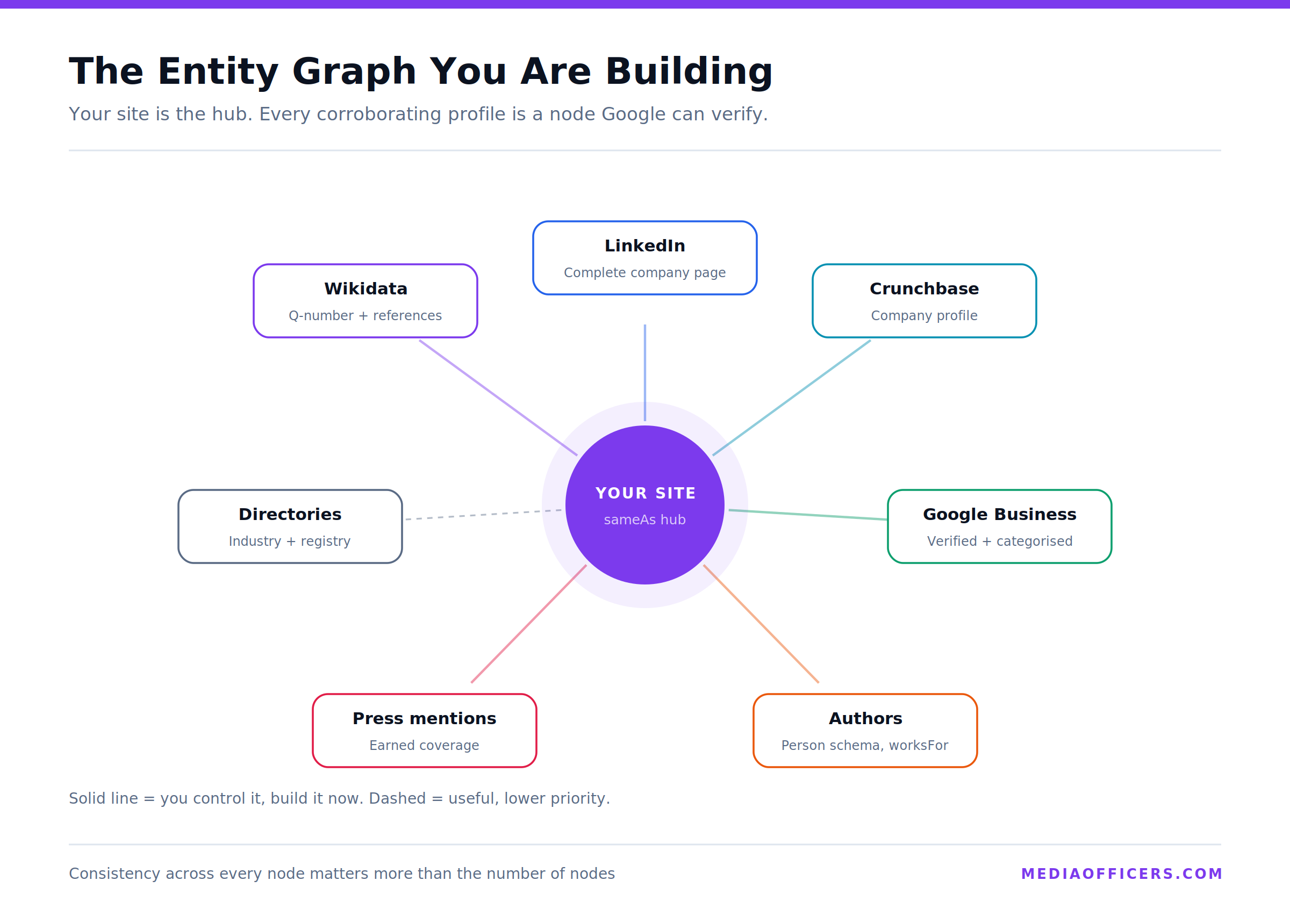 The entity graph: your website serves as the hub, sameAs edges establish connections, and verified external profiles provide corroboration.
What the Google Knowledge Graph Actually Is
Google's Knowledge Graph is a global database of entities (people, places, organisations, concepts, products) and the relationships between them. Each entity has a unique machine identifier (MID), a set of attributes, and connections to other entities.
The fundamental shift in modern search is from "strings to things". Google stopped treating "Media Officers" as a plain keyword query and started treating it as an organisation with a founding date, a headquarters, an active leadership team, and a defined set of services. Once entity resolution succeeds, every mention of your brand across the web is attributed to your master knowledge node.
Entity SEO vs Keyword SEO
| Dimension | Traditional Keyword SEO | Entity & Knowledge Graph SEO |
|---|---|---|
| Unit of optimisation | Query string | Machine-readable entity with attributes |
| Signal source | On-page density and backlink anchors | Structured JSON-LD and cross-web corroboration |
| Where it lives | On your isolated website | Your website plus Wikidata, Crunchbase & registries |
| Decay rate | Fast without continuous fresh links | Slow, permanent and compounds over time |
| AI search impact | Indirect | Direct & primary for citation selection |
Step 1: Audit Your Current Entity Status
Before creating new schema or properties, evaluate your entity baseline:
The Google Brand Search Test: Search your exact brand name. Does Google return a Knowledge Panel? If yes, check for attribute accuracy.
Knowledge Graph Search API Check: Query the Google Knowledge Graph API. If your brand returns an MID of the form
kg:/g/..., Google has officially cataloged your entity.Wikidata Search: Search Wikidata.org for your brand name, former business names, and founder names. Record the Q-number (e.g.
Q123456).Consistency Audit: Audit Name, Address, Phone (NAP), and website URL across all external business profiles to eliminate naming drift.
Step 2: Build Your Wikidata Item
Wikidata is an open, machine-readable database consumed directly by Google, Bing, and AI search systems. Its notability bar is far more accessible than Wikipedia: any legitimate registered company with an official website and referenced independent coverage qualifies.
| Wikidata Property | Property ID | Example Value |
|---|---|---|
| Instance of | P31 | business (Q4830453), company |
| Industry | P452 | digital marketing, search engine optimization |
| Inception | P571 | Official company founding date |
| Headquarters location | P159 | City entity |
| Official website | P856 | Canonical https URL |
| Founded by | P112 | Linked Person entity Q-number |
Step 3: Deploy sameAs JSON-LD Schema
The sameAs property tells search engines: "These external profiles are verified instances of the same entity."
{
"@context": "https://schema.org",
"@type": "Organization",
"@id": "https://mediaofficers.com/#organization",
"name": "Media Officers",
"url": "https://mediaofficers.com/",
"sameAs": [
"https://www.wikidata.org/wiki/Q000000",
"https://www.linkedin.com/company/mediaofficers",
"https://www.crunchbase.com/organization/mediaofficers",
"https://x.com/mediaofficers"
]
}
Step 4: Connect the Graph with @id References
Publishing isolated schema blocks creates fragmented signals. A unified @graph array linking your Organization, WebSite, WebPage, Article, and Person nodes allows Googlebot to traverse the entire entity structure.
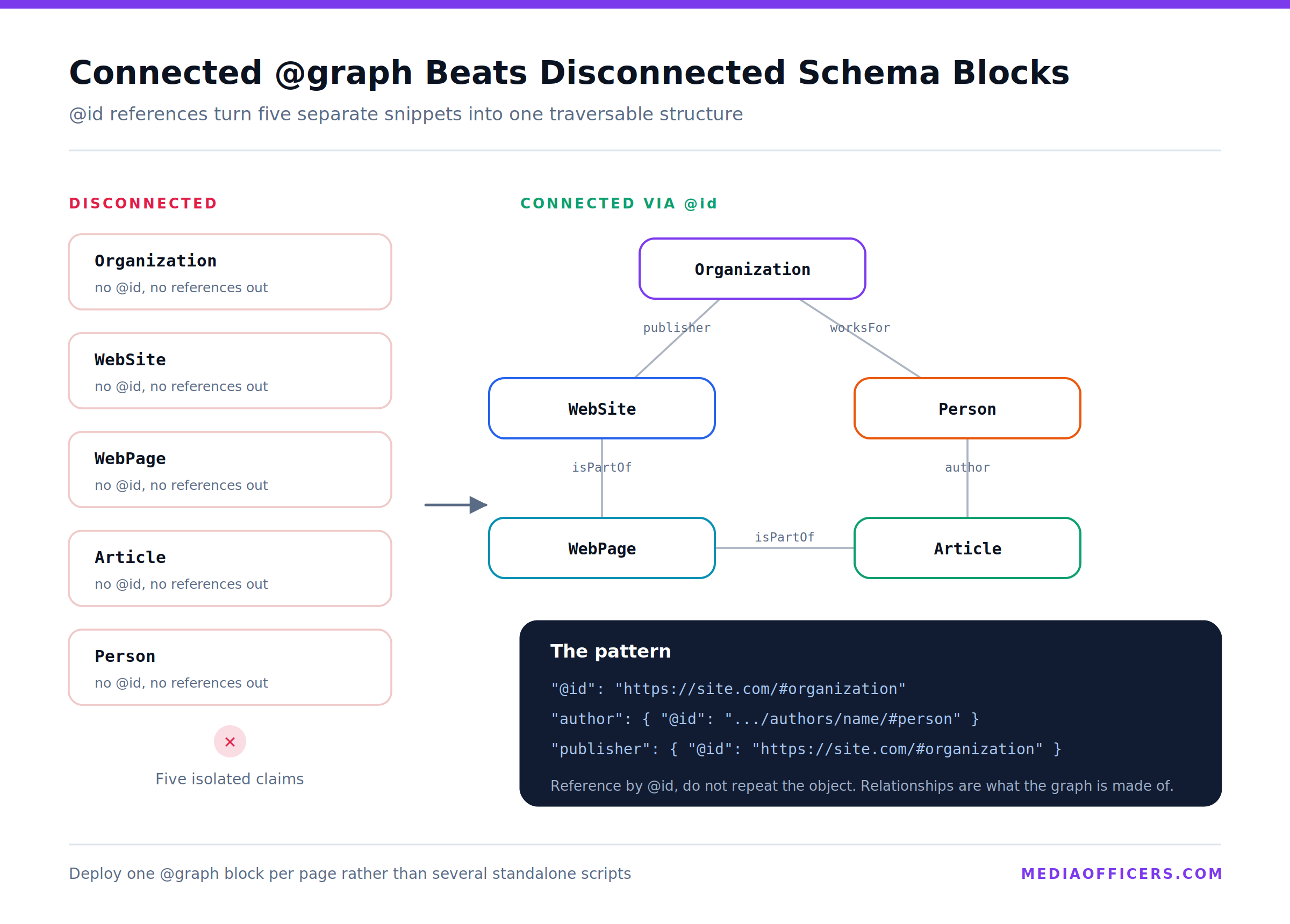 A connected @graph structure: linking nodes with @id allows search engines to traverse relationships seamlessly.
For complete code snippets and graph syntax, refer to our pillar guide on Advanced JSON-LD Schema for Google Knowledge Graph.
Step 5: Build Corroborating Third-Party Authority
Schema is an assertion; third-party corroboration is what makes it fact. Prioritise:
Tier 1: Verified Google Business Profile, LinkedIn Company page, Crunchbase profile, Wikidata item.
Tier 2: Verified industry associations, official state registries, verified author profiles on Medium and GitHub.
Tier 3: Earned press mentions in tier-1 publications, podcast guest appearances, and proprietary industry benchmark data.
Frequently Asked Questions
Do I need a Wikipedia page to get a Google Knowledge Panel?
No. Google generates Knowledge Panels from many authoritative sources, including Wikidata, Crunchbase, official business registries, and structured JSON-LD schema. Most business panels are generated without a Wikipedia article.
How long does Knowledge Graph SEO take to establish?
Expect 3 to 6 months for initial entity recognition and 6 to 12 months for measurable impact on AI search citations. Wikidata and schema go live immediately, but corroboration signals need time to be crawled and reprocessed.
What is the difference between sameAs and @id?
sameAs links your entity outward to external profiles for corroboration. @id is an internal identifier that allows schema nodes on your own domain to reference each other within a connected graph.
Does entity optimization help with ChatGPT and Perplexity citations?
Directly. Generative AI engines reason in entities rather than keywords. Recognised entities with verified Wikidata attributes are cited at a substantially higher rate across ChatGPT Search, Perplexity, and Google AI Overviews.
Audit Your Entity & Knowledge Graph Readiness
Evaluate your structured data health, Wikidata signals, and cross-engine citation authority with our specialized audit suite.
Check crawl access and indexation with our technical SEO checker.

Written by
Rudhrah KeshavCo-Founder & Chief Revenue Officer (CRO)
Rudhrah Keshav is the Co-Founder & CRO at MediaOfficers. 16+ years SEO architect, published author of "AI Marketing for Indian Businesses" and "Local SEO" (Google Books / Amazon), featured in Yahoo Finance.


