
Advanced JSON-LD schema means publishing one connected @graph per webpage rather than scattering multiple disconnected script blocks across your HTML. Each entity receives a permanent, stable @id, and every relationship between them is declared as an @id reference rather than a duplicated object.
The strategic result is a cohesive semantic architecture that Google and AI retrieval engines (ChatGPT Search, Perplexity, Claude, and Gemini) can traverse effortlessly: this Organization publishes this WebSite, which hosts this WebPage, which contains this Article, written by this Person, who works for that Organization.
Most websites do the exact opposite. A plugin injects an Organization block, a theme outputs an Article block, and an FAQ plugin adds a third - none of which reference each other. Google receives five isolated assertions with zero contextual relationships. Relationships are the fundamental building blocks of the Knowledge Graph; five isolated claims carry significantly less authority than one interconnected graph.
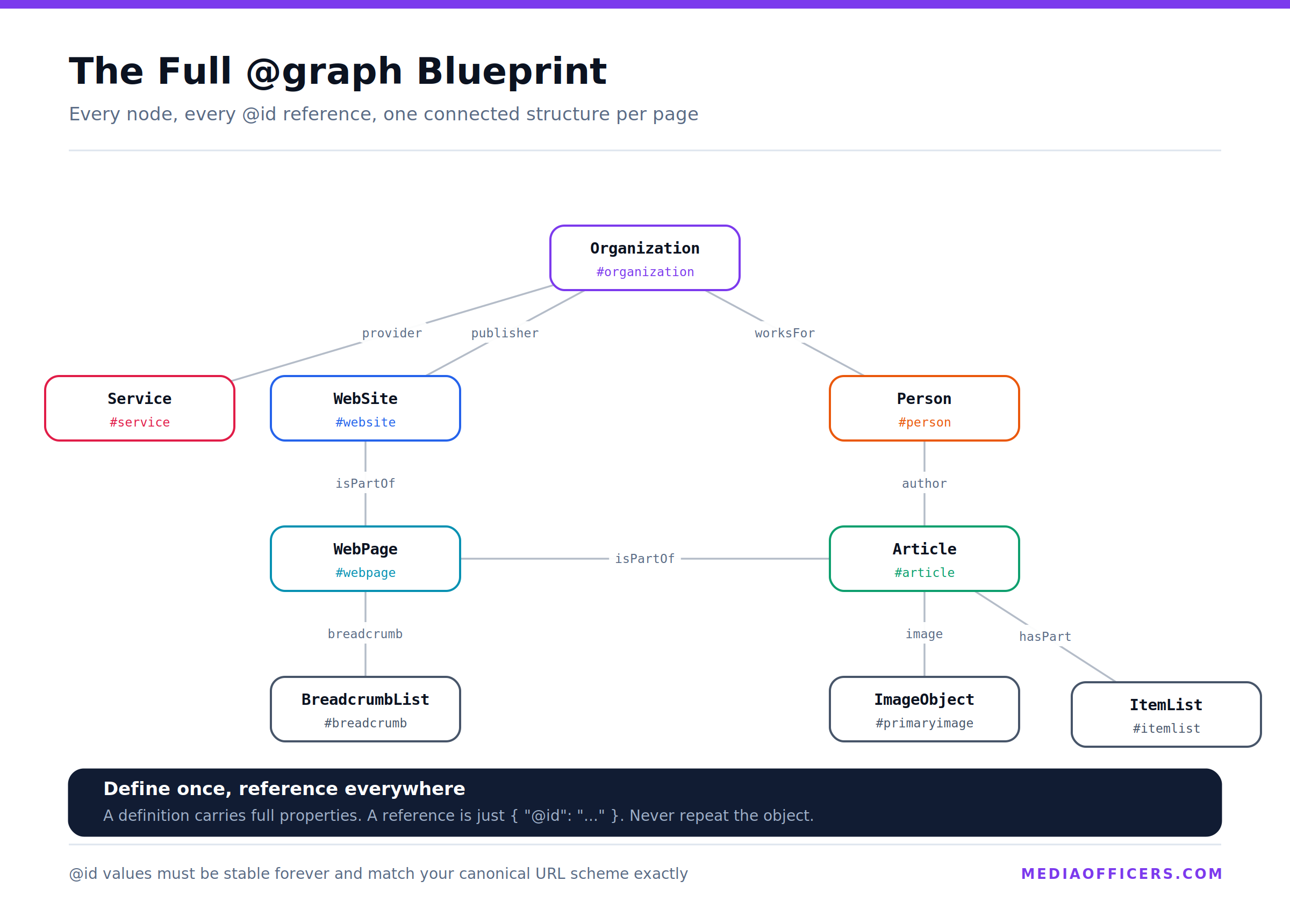
Figure 1: The multi-entity @graph architecture. Every connecting arrow is an @id reference that machine retrieval models and Google Knowledge Graph can follow deterministically.
Why @graph Beats Standalone Script Blocks
The Disconnection Liability
When you publish separate schema blocks, each block remains an isolated statement. Nothing indicates to Google that the Person listed in the article byline is the same recognized subject with published books, patents, or authoritative social profiles in your sameAs array.
Conversely, when you publish a unified @graph with explicit @id pointers, every entity reinforces the surrounding nodes:
The Author inherits institutional authority from the Organization.
The Organization gains topical depth from verified Article nodes.
The WebPage inherits canonical identity directly from the site-wide WebSite entity.
Understanding the @id Directive
An @id is a globally unique URI identifier for a specific entity. Industry standard practice uses the canonical URL of the entity appended with a fragment identifier naming its type:
https://mediaofficers.com/#organization
https://mediaofficers.com/#website
https://mediaofficers.com/authors/rudhrah-keshav/#person
https://mediaofficers.com/insights/advanced-json-ld-schema-google-knowledge-graph/#article
Two essential rules govern robust @id architecture:
Absolute Stability: An
@idmust never change once published. It is an immutable identifier, not a link. Changing an@idcreates an orphaned entity.Site-Wide Uniqueness: Define your primary
Organizationnode once with comprehensive properties, and reference it via@idacross all subsidiary pages.
Entity Definition vs. Entity Reference
Understanding the distinction between defining an entity and referencing it prevents markup bloat and synchronization drift:
Full Definition (Define Once):{
"@type": "Organization",
"@id": "https://mediaofficers.com/#organization",
"name": "MediaOfficers",
"url": "https://mediaofficers.com/",
"logo": {
"@type": "ImageObject",
"@id": "https://mediaofficers.com/#logo"
}
}{
"publisher": {
"@id": "https://mediaofficers.com/#organization"
}
}The Complete Copy-Paste @graph Blueprint
Below is the complete, fully-wired @graph structured data blueprint for an authoritative insight article. Adapt the properties to your brand while preserving the relational architecture:
{
"@context": "https://schema.org",
"@graph": [
{
"@type": "Organization",
"@id": "https://mediaofficers.com/#organization",
"name": "MediaOfficers",
"legalName": "MediaOfficers Marketing Solutions",
"url": "https://mediaofficers.com/",
"logo": {
"@type": "ImageObject",
"@id": "https://mediaofficers.com/#logo",
"url": "https://mediaofficers.com/assets/images/logo_blue.png",
"contentUrl": "https://mediaofficers.com/assets/images/logo_blue.png",
"width": 512,
"height": 512,
"caption": "MediaOfficers Logo"
},
"image": { "@id": "https://mediaofficers.com/#logo" },
"description": "Leading SEO, Generative Engine Optimization (GEO), and performance marketing agency in India.",
"foundingDate": "2010",
"address": {
"@type": "PostalAddress",
"streetAddress": "1571/29, near Baweza Nursing Home, Preet Colony",
"addressLocality": "Rupnagar",
"addressRegion": "Punjab",
"postalCode": "140001",
"addressCountry": "IN"
},
"contactPoint": {
"@type": "ContactPoint",
"telephone": "+919501504089",
"contactType": "customer service",
"areaServed": ["IN", "US", "UK", "AE", "AU"],
"availableLanguage": ["English", "Hindi", "Punjabi"]
},
"sameAs": [
"https://www.facebook.com/mediaofficersdigitalmarketing",
"https://www.instagram.com/mediaofficers",
"https://www.linkedin.com/company/mediaofficersmarketingsolutions",
"https://x.com/mediaofficers",
"https://www.youtube.com/@mediaofficers"
]
},
{
"@type": "WebSite",
"@id": "https://mediaofficers.com/#website",
"url": "https://mediaofficers.com/",
"name": "MediaOfficers",
"description": "SEO, GEO and Performance Marketing Insights",
"publisher": { "@id": "https://mediaofficers.com/#organization" },
"inLanguage": "en-US",
"potentialAction": {
"@type": "SearchAction",
"target": {
"@type": "EntryPoint",
"urlTemplate": "https://mediaofficers.com/search?q={search_term_string}"
},
"query-input": "required name=search_term_string"
}
},
{
"@type": "WebPage",
"@id": "https://mediaofficers.com/insights/advanced-json-ld-schema-google-knowledge-graph/#webpage",
"url": "https://mediaofficers.com/insights/advanced-json-ld-schema-google-knowledge-graph",
"name": "Advanced JSON-LD Schema: The Multi-Entity @graph Blueprint for 2026",
"isPartOf": { "@id": "https://mediaofficers.com/#website" },
"primaryImageOfPage": { "@id": "https://mediaofficers.com/insights/advanced-json-ld-schema-google-knowledge-graph/#primaryimage" },
"datePublished": "2026-09-11T09:00:00+05:30",
"dateModified": "2026-09-11T09:00:00+05:30",
"breadcrumb": { "@id": "https://mediaofficers.com/insights/advanced-json-ld-schema-google-knowledge-graph/#breadcrumb" },
"inLanguage": "en-US"
},
{
"@type": "ImageObject",
"@id": "https://mediaofficers.com/insights/advanced-json-ld-schema-google-knowledge-graph/#primaryimage",
"url": "https://mediaofficers.com/assets/images/blog/advanced-json-ld-schema-feature-image.png",
"contentUrl": "https://mediaofficers.com/assets/images/blog/advanced-json-ld-schema-feature-image.png",
"width": 1200,
"height": 630,
"caption": "Advanced JSON-LD schema @graph blueprint 2026 by MediaOfficers"
},
{
"@type": "BreadcrumbList",
"@id": "https://mediaofficers.com/insights/advanced-json-ld-schema-google-knowledge-graph/#breadcrumb",
"itemListElement": [
{ "@type": "ListItem", "position": 1, "name": "Home", "item": "https://mediaofficers.com" },
{ "@type": "ListItem", "position": 2, "name": "Insights", "item": "https://mediaofficers.com/insights" },
{ "@type": "ListItem", "position": 3, "name": "SEO & AI Search", "item": "https://mediaofficers.com/insights?category=seo-ai-search" },
{ "@type": "ListItem", "position": 4, "name": "Advanced JSON-LD Schema Blueprint", "item": "https://mediaofficers.com/insights/advanced-json-ld-schema-google-knowledge-graph" }
]
},
{
"@type": "Article",
"@id": "https://mediaofficers.com/insights/advanced-json-ld-schema-google-knowledge-graph/#article",
"headline": "Advanced JSON-LD Schema: The Multi-Entity @graph Blueprint for 2026",
"description": "A copy-paste advanced JSON-LD schema blueprint for 2026. Build one connected @graph linking Organization, WebSite, Person, Service and ItemList for Google and AI search.",
"isPartOf": { "@id": "https://mediaofficers.com/insights/advanced-json-ld-schema-google-knowledge-graph/#webpage" },
"mainEntityOfPage": { "@id": "https://mediaofficers.com/insights/advanced-json-ld-schema-google-knowledge-graph/#webpage" },
"author": { "@id": "https://mediaofficers.com/authors/rudhrah-keshav/#person" },
"publisher": { "@id": "https://mediaofficers.com/#organization" },
"image": { "@id": "https://mediaofficers.com/insights/advanced-json-ld-schema-google-knowledge-graph/#primaryimage" },
"datePublished": "2026-09-11T09:00:00+05:30",
"dateModified": "2026-09-11T09:00:00+05:30",
"articleSection": "Search Marketing",
"wordCount": 3400,
"keywords": ["Advanced JSON-LD Schema", "@graph schema", "Knowledge Graph SEO", "Entity SEO", "E-E-A-T Schema"],
"inLanguage": "en-US"
},
{
"@type": "Person",
"@id": "https://mediaofficers.com/authors/rudhrah-keshav/#person",
"name": "Rudhrah Keshav",
"url": "https://mediaofficers.com/authors/rudhrah-keshav",
"jobTitle": "Co-Founder & Chief Revenue Officer (CRO)",
"worksFor": { "@id": "https://mediaofficers.com/#organization" },
"description": "Technical search engineer and CRO at MediaOfficers specializing in Generative Engine Optimization (GEO) and Knowledge Graph schema architecture.",
"knowsAbout": [
"Search Engine Optimization",
"Generative Engine Optimization (GEO)",
"Knowledge Graph Architecture",
"Technical SEO"
],
"sameAs": [
"https://in.linkedin.com/in/rudhrahkeshav",
"https://x.com/krudhrah",
"https://yourstory.com/people/rudhrah-keshav",
"https://share.google/kPWi99JNnWz5FgxzH",
"https://profile.google.com/@rudhrah_keshav"
]
}
]
}
Integrating Service Nodes with OfferCatalog
Service landing pages require a commercial schema structure. The Service node defines what you offer and links directly to the Organization as its provider, allowing your service offerings to inherit entity trust:
{
"@context": "https://schema.org",
"@graph": [
{ "@type": "Organization", "@id": "https://mediaofficers.com/#organization" },
{
"@type": "Service",
"@id": "https://mediaofficers.com/seo-services/#service",
"name": "SEO Services",
"serviceType": "Search Engine Optimization",
"provider": { "@id": "https://mediaofficers.com/#organization" },
"areaServed": [
{ "@type": "Country", "name": "India" },
{ "@type": "Country", "name": "United States" },
{ "@type": "Country", "name": "United Kingdom" }
],
"description": "Comprehensive technical SEO, Generative Engine Optimization (GEO), and organic search growth programmes.",
"hasOfferCatalog": {
"@type": "OfferCatalog",
"name": "SEO Solutions",
"itemListElement": [
{
"@type": "Offer",
"itemOffered": { "@type": "Service", "name": "Technical SEO Audit" }
},
{
"@type": "Offer",
"itemOffered": { "@type": "Service", "name": "Generative Engine Optimization (GEO)" }
},
{
"@type": "Offer",
"itemOffered": { "@type": "Service", "name": "Entity & Schema Architecture" }
}
]
}
}
]
}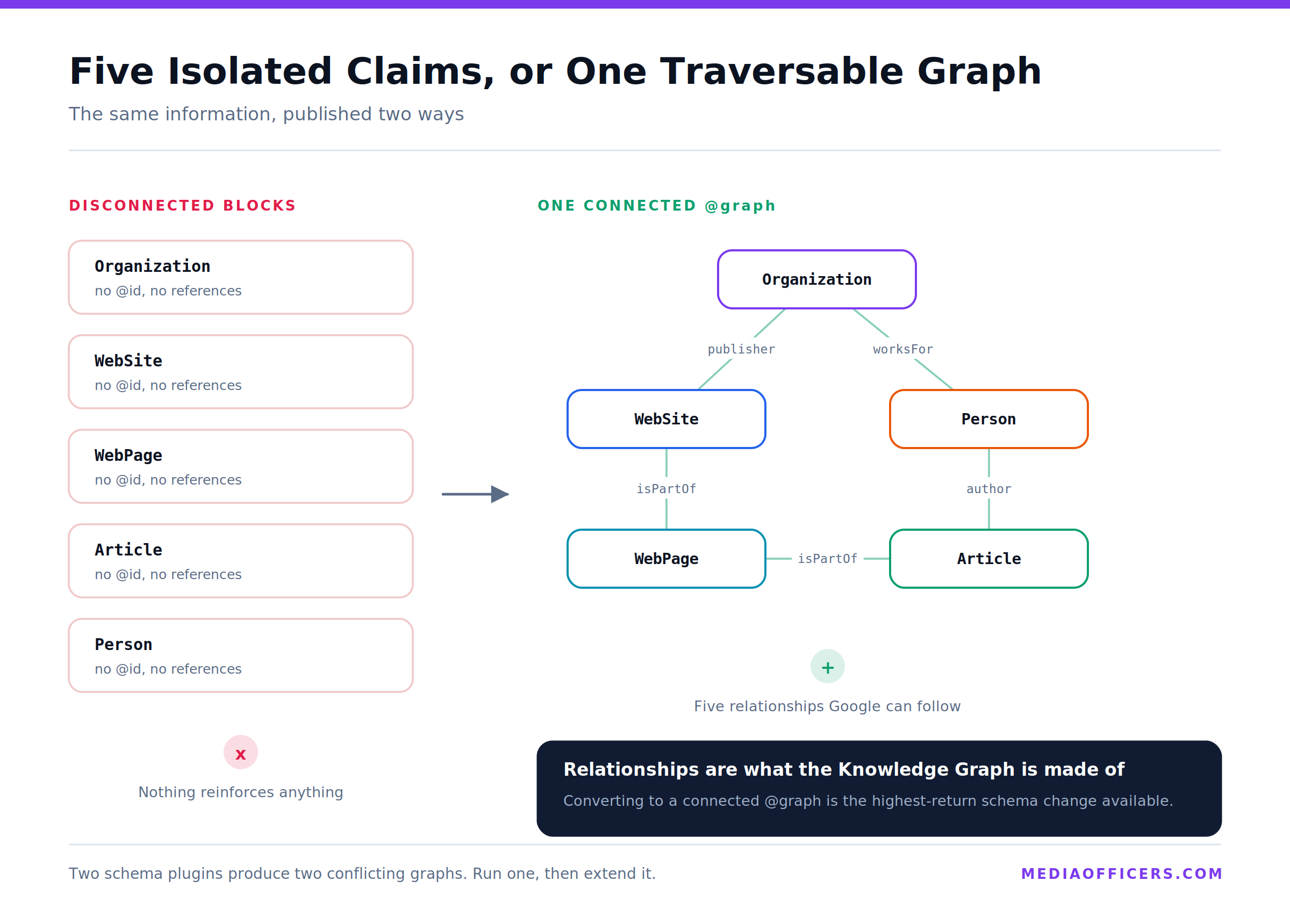
Figure 2: Isolated schema blocks vs. a connected @graph. With @id pointers, search crawlers can resolve entity authorship, institutional backing, and topical relevance in a single parse pass.
Adding ItemList for Guides & Listicles
Numbered guides, top-10 lists, and comparison roundups benefit from structured ItemList schema, creating a machine-readable sequence that unlocks rich carousel eligibility:
{
"@type": "ItemList",
"@id": "https://mediaofficers.com/insights/google-ai-overviews-optimization-checklist/#itemlist",
"name": "10 Proven Rules to Get Sourced in AI Search Summaries",
"itemListOrder": "https://schema.org/ItemListOrderAscending",
"numberOfItems": 10,
"itemListElement": [
{
"@type": "ListItem",
"position": 1,
"name": "Optimize the passage, not just the page",
"url": "https://mediaofficers.com/insights/google-ai-overviews-optimization-checklist#rule-1"
},
{
"@type": "ListItem",
"position": 2,
"name": "Answer query intent in the first 50 words",
"url": "https://mediaofficers.com/insights/google-ai-overviews-optimization-checklist#rule-2"
}
]
}
The Complete Node Reference Matrix
| Schema Node | Where Defined | Key Outbound @id References | Strategic Purpose |
|---|---|---|---|
| Organization | Homepage (referenced everywhere) | sameAs, logo, address | Establishes verifiable legal entity and brand trust |
| WebSite | Homepage / Sitewide header | publisher → Organization | Declares site identity and Sitelinks SearchBox |
| WebPage | Every published URL | isPartOf → WebSite, breadcrumb | Positions individual page within website hierarchy |
| Article | Blog / Insight posts | author → Person, publisher → Organization | Declares author byline, dates, and topical keywords |
| Person | Author bio pages | worksFor → Organization, sameAs | Supplies author E-E-A-T credentials & social profiles |
| Service | Service commercial pages | provider → Organization, hasOfferCatalog | Defines commercial offerings and target regions |
| BreadcrumbList | Every hierarchical page | itemListElement positions | Produces breadcrumb rich snippets in Google SERPs |
| FAQPage | Pages with visible FAQs | Question → Answer | Unlocks AI answer parsing and question accordion snippets |
What @graph Delivers for AI Retrieval & GEO
While structured data is not an explicit mandate for generative answer engines, it provides two massive ranking multipliers in 2026:
Deterministic Entity Disambiguation: Connected schema with comprehensive
sameAscorroboration allows retrieval models (such as ChatGPT Search and Perplexity) to immediately resolve your brand against Wikidata and Wikipedia knowledge bases.Unambiguous Machine Ingestion: LLM agents reading raw HTML prose must guess author identity, publication dates, and credentials. A structured
@graphprovides clean, machine-parsable facts, significantly elevating citation probability.
Frequently Asked Questions
What is @graph in JSON-LD?
@graph is a top-level JSON-LD container that groups multiple entity nodes into a single JSON script block. It allows individual nodes (such as Article, Person, and Organization) to establish deterministic relationships using @id pointers without duplicating data.
Do I need a single @graph or are separate schema blocks acceptable?
Separate script blocks are technically valid, but a connected @graph is substantially more effective. It expresses relational entity connections, which search engines and LLM vector systems rely on to verify authority and E-E-A-T credentials.
How should @id values be structured?
@id values should use the absolute canonical URL of the entity appended with a fragment identifying its type (e.g., https://mediaofficers.com/#organization, https://mediaofficers.com/authors/rudhrah-keshav/#person). They must remain stable permanently.
Can websites run multiple schema plugins simultaneously?
No. Running multiple schema plugins results in conflicting @id values, fragmented graphs, and duplicated node definitions. Consolidate your structured data into a single unified generator.
Does JSON-LD schema help with ChatGPT Search and Perplexity rankings?
Yes. Although AI search engines do not mandate schema, structured data disambiguates your entity in knowledge graphs and provides clean machine-readable facts that increase citation frequency during AI query fan-out.
Audit Your Website's Structured Data & AI Search Authority
Discover how your entity markup, schema graphs, and technical SEO perform across Google, Perplexity, ChatGPT Search, and Claude with our diagnostic audit.
Run Free Technical Readiness Audit →Explore Knowledge Graph SEO GuideEnsure AI retrieval engines can access your structured data markup by following our AI Crawler Optimization Guide.

Written by
Rudhrah KeshavCo-Founder & Chief Revenue Officer (CRO)
Rudhrah Keshav is the Co-Founder & CRO at MediaOfficers. 16+ years SEO architect, published author of "AI Marketing for Indian Businesses" and "Local SEO" (Google Books / Amazon), featured in Yahoo Finance.


