
SEO services fall into nine working categories: technical SEO, on-page SEO, content, off-page and digital PR, local SEO, ecommerce SEO, international SEO, generative engine optimisation, and analytics with conversion rate optimisation. Most agencies sell some combination of these, and most proposals describe them so vaguely that you cannot tell what you are actually buying.
This is the full list with the real deliverables under each category, who needs which, and the questions that separate genuine work from line items designed to fill a page.
If you already know what you need and want it run for you, our SEO services page covers how we package this. If you are still working out which parts apply to you, keep reading.
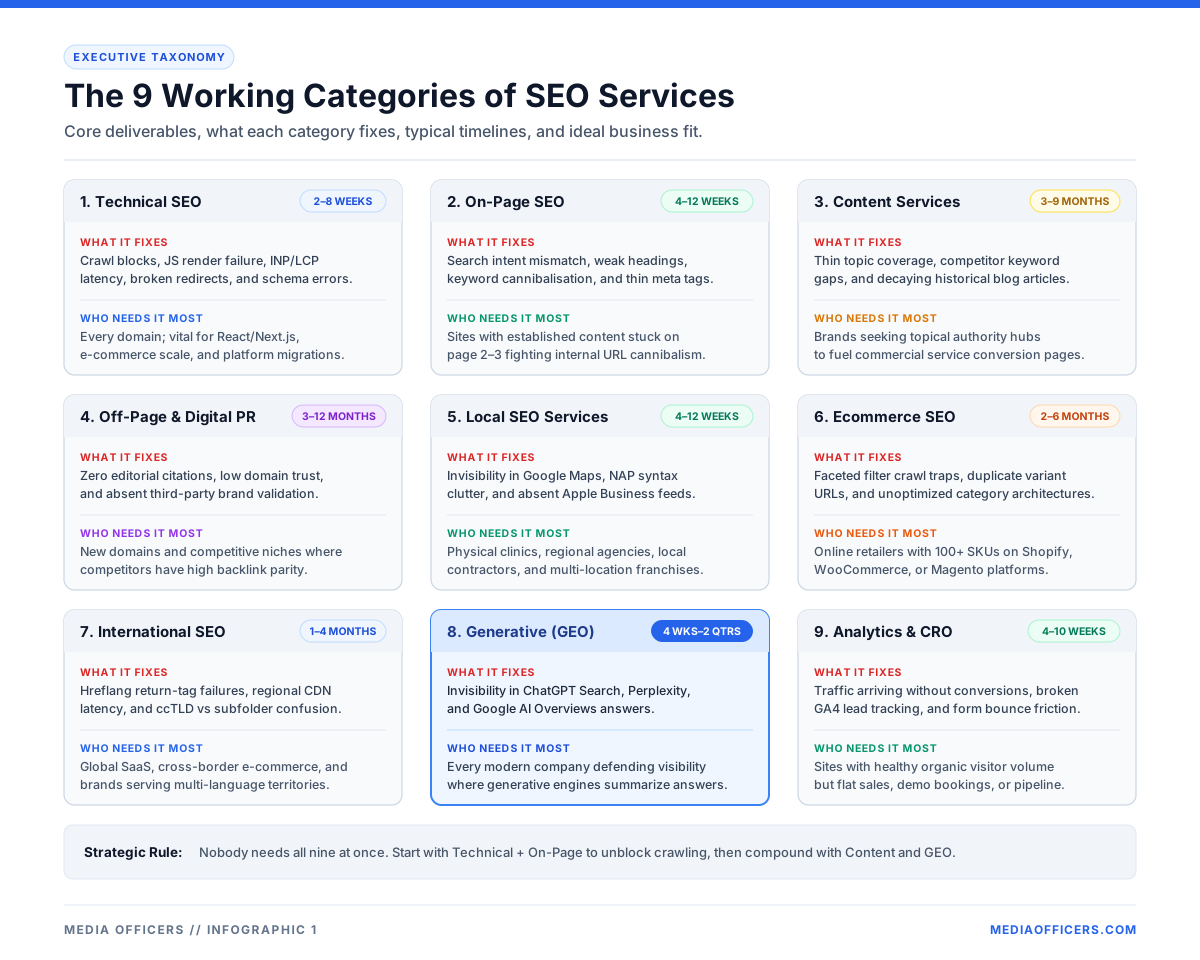
The Nine Categories at a Glance
| Category | What it fixes | Typical timeline to results | Who needs it most |
|---|---|---|---|
| 1. Technical SEO | Search engines cannot crawl, render or index you properly | 2 to 8 weeks | Every site, especially JavaScript-heavy frameworks |
| 2. On-page SEO | Your pages do not match what people search for | 4 to 12 weeks | Sites with traffic but weak rankings |
| 3. Content | You have no pages targeting the queries that matter | 3 to 9 months | Sites with thin or missing topic coverage |
| 4. Off-page and digital PR | Nobody credible mentions or links to you | 3 to 12 months | New or low-authority domains |
| 5. Local SEO | You do not appear for "near me" and city searches | 4 to 12 weeks | Physical locations and service areas |
| 6. Ecommerce SEO | Product and category pages underperform | 2 to 6 months | Online stores |
| 7. International SEO | Wrong country or language version ranks | 1 to 4 months | Multi-country businesses |
| 8. Generative engine optimisation | AI answers never cite you | 4 weeks to 2 quarters | Everyone, urgently |
| 9. Analytics and CRO | Traffic arrives but does not convert | 4 to 10 weeks | Sites with rankings but flat revenue |
Nobody needs all nine at once. A sensible engagement starts with two or three and expands.
1. Technical SEO Services
Technical SEO makes your site accessible and understandable to search engines. It is the foundation, because every other category depends on your pages being crawlable and indexable.
The deliverables:
- Technical audit covering crawl, index, render and performance
- Crawlability fixes: robots.txt configuration, XML sitemaps, crawl budget management, internal link architecture
- Indexation management: canonical tags, noindex rules, pagination handling, duplicate content resolution
- Site architecture: URL structure, category hierarchy, click depth reduction
- Core Web Vitals: LCP, INP and CLS optimisation
- JavaScript rendering: server-side rendering, hydration issues, ensuring content ships in the initial HTML
- Structured data: JSON-LD schema implementation and validation
- HTTPS, redirects and status codes: fixing chains, loops and soft 404s
- Log file analysis: what search engines actually crawl, and how often
- Migration support: redirect mapping and monitoring when you change domain, platform or URL structure
Two items here have become far more important recently. Interaction to Next Paint is now a Core Web Vital with a 200ms threshold, covered in our website speed optimization guide. And JavaScript rendering has a new failure mode: AI crawlers do not execute JavaScript at all, so a client-rendered site can rank on Google while being invisible to every AI answer engine. Our technical SEO audit guide covers that in detail.
How to tell if it is real work: ask for the crawl data. A genuine technical audit names specific URLs with specific problems. A weak one hands you a tool export with severity labels and no prioritisation.
2. On-Page SEO Services
On-page SEO aligns individual pages with the queries they should answer.
The deliverables:
- Keyword research and mapping: one primary intent per URL, with no two pages competing
- Title tags and meta descriptions written per page, not templated
- Heading structure: a single H1, question-shaped H2s, logical nesting
- Content optimisation: answer-first blocks, intent coverage, entity and term usage
- Internal linking: descriptive anchor text, hub-and-spoke architecture, orphan page fixes
- Image optimisation: compression, modern formats, descriptive alt text
- Cannibalisation audit and resolution: finding pages fighting each other and consolidating or differentiating them
- Featured snippet and answer block formatting: tables, lists and definition paragraphs built to be extracted
The cannibalisation piece is worth singling out. It is the most common problem we find on sites that have been publishing for a few years, and it is invisible unless someone looks for it. Two pages targeting the same intent split their signals and both underperform.
3. Content Services
Content SEO creates and maintains the pages that earn rankings.
The deliverables:
- Content strategy and topic clustering: pillar pages with supporting articles, mapped to a real link graph
- Content gap analysis against competitors and against the questions your buyers actually ask
- Editorial calendar with owners and publish dates
- Writing and editing, ideally by someone with subject knowledge
- Content refresh: updating existing pages rather than only adding new ones
- Content pruning: removing or consolidating pages that add nothing
- Author entity development: bio pages, credentials and schema so bylines carry weight, covered in our Google E-E-A-T core update recovery guide and author entity profiles
- Original research and data assets: the things other people cite
The refresh line matters more than the writing line. Most sites get better returns from improving twenty existing pages than from publishing twenty new ones, and almost no proposals lead with that.
4. Off-Page SEO and Digital PR Services
Off-page work builds the authority signals that sit outside your website.
The deliverables:
- Link acquisition through genuine editorial placements
- Digital PR campaigns built on original data or expert commentary
- Brand mention acquisition, linked and unlinked
- Journalist relationship building and response platform management
- Backlink audit and disavow where a real problem exists
- Competitor link gap analysis
- Community presence on legitimate industry platforms
- Podcast and speaking placement
The unlinked mention line is newer and underrated. Brand mentions correlate with AI search visibility roughly three times more strongly than backlinks do, which changes the brief: the same outreach now succeeds whether or not the journalist adds a link. Our off-page SEO services guide covers how to run it that way.
Warning sign: any agency selling a fixed number of links per month at a fixed price is buying them. That is a paid link scheme under Google's spam policies, and the risk lands on your domain, not theirs.
5. Local SEO Services
Local SEO wins searches tied to a place.
The deliverables:
- Google Business Profile optimisation: categories, services, description, attributes, photos, Posts and Q&A
- Apple Business Connect setup, which feeds Apple Maps, Siri, Spotlight and Safari
- Bing Places setup, which feeds Copilot
- NAP consistency audit across every directory and platform
- Citation building on legitimate directories
- Review generation and response management
- Local landing pages for each location or service area
- LocalBusiness schema with geo coordinates and opening hours
- Local rank grid tracking, which maps visibility across your service area rather than reporting one position
The Apple line is the gap. Most agencies optimise Google and stop. Apple Business Connect is free, takes an afternoon, and feeds four surfaces with a fraction of the competition.
6. Ecommerce SEO Services
Ecommerce SEO handles problems that only exist at product-catalogue scale.
The deliverables:
- Category page optimisation, which is where most ecommerce organic revenue actually sits
- Product page templates with unique, useful copy rather than manufacturer descriptions
- Faceted navigation handling: preventing millions of crawlable filter combinations
- Product schema: price, availability, reviews, GTIN
- Out-of-stock and discontinued product handling
- Duplicate and variant management across sizes, colours and configurations
- Merchant Center feed optimisation
- Internal linking between related products and categories
- Pagination and infinite scroll with real crawlable URLs
Faceted navigation is the one that quietly destroys crawl budget. An unmanaged filter system can generate hundreds of thousands of near-duplicate URLs, and search engines will spend their crawl allowance on them instead of your products.
7. International SEO Services
International SEO makes sure the right country and language version ranks for the right audience.
The deliverables:
- Hreflang implementation and validation, including the return-tag requirement
- URL structure decisions: subdirectory, subdomain or country-code domain
- Geo-targeting configuration in Search Console
- Localisation rather than translation, including currency, units, examples and payment methods
- Duplicate content management across near-identical language versions
- Country-specific keyword research, because direct translations often miss how people actually search
- Local hosting or CDN configuration for regional speed
Hreflang is the most commonly misimplemented tag in SEO. Every version must reference every other version, including itself, or the cluster silently breaks.
8. Generative Engine Optimisation (GEO) Services
GEO is the newest category on this list and the fastest-moving. It covers being retrieved, quoted and cited by AI answer engines rather than ranking in a list of links.
The deliverables:
- AI crawler access configuration: robots.txt and WAF rules for OAI-SearchBot, PerplexityBot, Claude-SearchBot, Applebot and Googlebot, covered in our AI crawler optimization guide
- Content restructuring for extraction: question headings, answer-first blocks, self-contained passages
- Entity building: Wikidata,
sameAsschema, consistent naming, detailed in our Knowledge Graph SEO guide - Connected JSON-LD
@graphimplementation, covered in our advanced JSON-LD schema blueprint - Engine-specific optimisation for Perplexity, ChatGPT Search, Google AI Overviews and Claude and Apple Intelligence
- AI citation tracking: running a prompt list monthly and logging which engines cite you, for which claim
Why this cannot wait. According to independent search industry research by Authoritas and BrightEdge, only ~38% of URLs cited in Google AI Overviews appear in the top 10 traditional organic results, which means ranking and being cited have separated. If your reporting is still position-only, you are measuring the wrong thing. Our GEO vs traditional SEO framework explains how the two fit together.
9. Analytics, Tracking and CRO Services
This category answers whether any of the above is producing revenue.
The deliverables:
- GA4 configuration: events, conversions, audiences, and segments for AI referrers
- Search Console setup and regular query analysis
- Rank tracking, ideally alongside citation tracking
- Custom dashboards tied to business outcomes rather than vanity metrics
- Conversion rate optimisation: landing page testing, form and checkout improvement
- Attribution modelling across channels
- Call tracking for businesses where the phone is the conversion
The reason this belongs on an SEO list: organic traffic that does not convert is a cost. We have seen sites double organic sessions with flat revenue, and the fix was never more SEO.
What a Real Engagement Looks Like
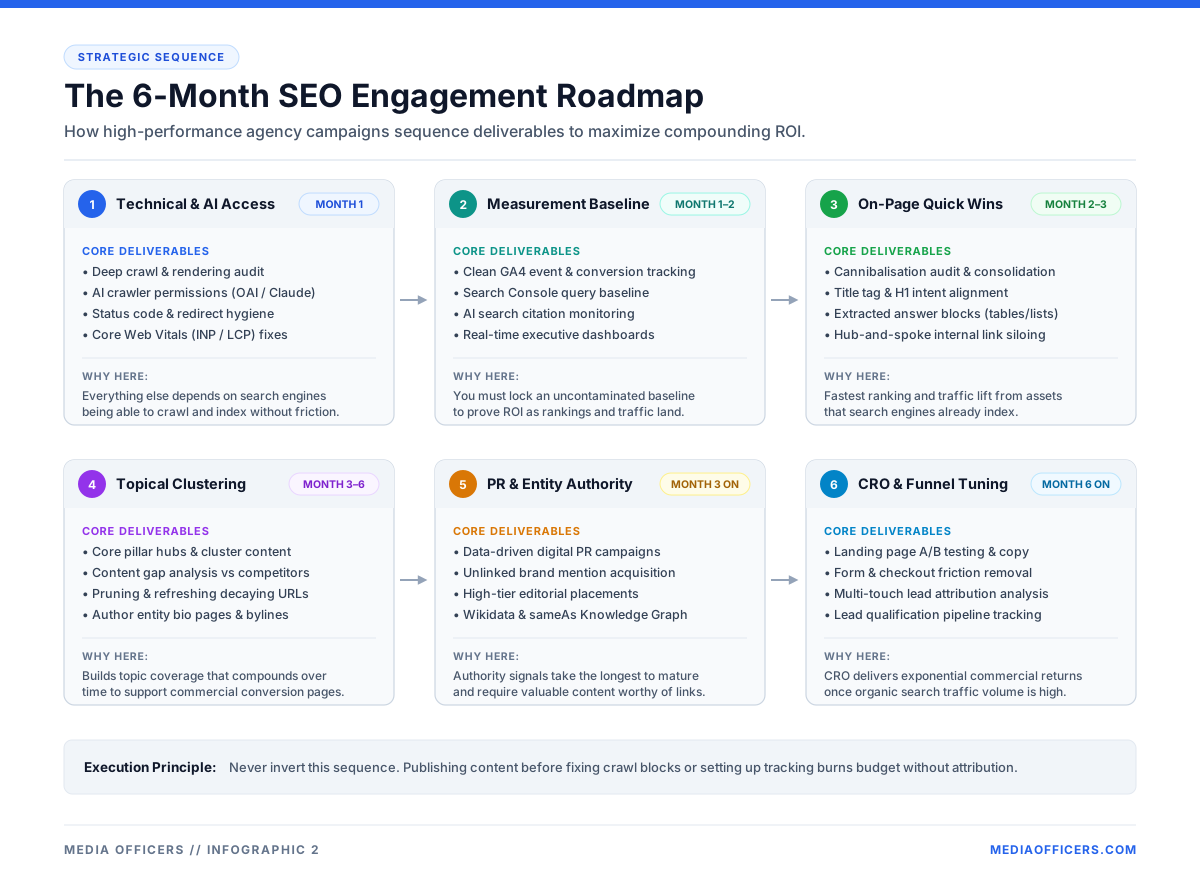
Most businesses need three of these nine to start. A workable sequence:
| Month | Focus | Why here |
|---|---|---|
| 1 | Technical audit and AI crawler access | Everything else depends on being crawlable and visible |
| 1 to 2 | Analytics and tracking setup | You need a baseline before changes land |
| 2 to 3 | On-page and cannibalisation fixes | Fastest wins from pages you already have |
| 3 to 6 | Content strategy and production | Builds the topic coverage that compounds |
| 3 onwards | Entity and digital PR | Slowest to start, longest to pay off |
| 6 onwards | CRO | Worth doing once traffic is meaningful |
Local, ecommerce and international slot in where they apply to your business rather than as universal steps.
How to Evaluate an SEO Services Proposal
Six questions that reveal whether you are buying work or a document.
"Which specific pages will you change in month one?" A real answer names URLs. A weak one describes a process.
"How are you handling AI crawler access?" If the answer is vague or the agency conflates GPTBot with OAI-SearchBot, they have not done this work. Those are different agents and blocking the wrong one removes you from AI answers.
"How do you measure success?" Rankings alone is the wrong answer in 2026. Look for organic conversions, assisted revenue and AI citation rate.
"Who writes the content, and what do they know about my industry?" Named writers with relevant background produce different results from an anonymous content pool, and Google's quality guidance is explicit about creator expertise.
"Where do links come from?" Genuine editorial placement takes time and varies month to month. A guaranteed quota means purchased links.
"What happens if we stop?" Honest answer: technical fixes and content persist, rankings decay slowly, and link momentum stops. Anyone promising permanence is overselling.
How SEO Services Are Priced
There are four common models, and each fits a different situation.
Monthly retainer. The standard for ongoing work. Suits businesses that need continuous content, link acquisition and technical maintenance. Ask exactly how many hours or deliverables the retainer covers.
Project-based. A fixed scope with a fixed fee: an audit, a migration, a schema implementation. Good for one-off needs and for testing an agency before committing to a retainer.
Hourly or consulting. Suits companies with an in-house team that needs direction rather than execution.
Performance-based. Payment tied to rankings or revenue. Sounds attractive and usually is not, because it incentivises short-term tactics and the definitions of success are easy to game. Revenue-share arrangements can work where attribution is genuinely clean.
What moves the price: your site's size and technical debt, how competitive your category is, how much content you need, whether you have a usable in-house team, and how many of the nine categories are in scope.
Frequently Asked Questions
What are the main types of SEO services?
Nine categories cover the field: technical SEO, on-page SEO, content, off-page and digital PR, local SEO, ecommerce SEO, international SEO, generative engine optimisation, and analytics with CRO. Most engagements combine two or three rather than all nine.
What is included in a standard SEO service package?
Typically a technical audit with fixes, keyword research and mapping, on-page optimisation, a content plan with ongoing production, link and mention acquisition, and monthly reporting. In 2026 a package should also include AI crawler access configuration and AI citation tracking, which many providers still omit.
Which SEO service should I start with?
Technical SEO and analytics setup. Technical work removes the blockers that limit every other effort, and analytics gives you a baseline to measure against. Content and off-page work are more effective once those are in place.
How long do SEO services take to show results?
Technical fixes can move things in two to eight weeks. On-page optimisation of existing pages typically shows in one to three months. Content and authority building take six to twelve months. Perplexity citations often move fastest of all, sometimes within four weeks of a structural rewrite.
Do I still need SEO if AI search is taking over?
Yes, and the work now covers both. AI engines retrieve from crawlable, well-structured pages, so the technical and content foundations still apply. What changes is that entity signals and brand mentions matter more, and rankings alone are no longer a sufficient measure of visibility.
What is generative engine optimisation and is it a separate service?
GEO is optimising to be cited by AI answer engines rather than ranked in a list of links. It sits on top of technical SEO rather than replacing it, so it is usually a workstream inside an SEO engagement rather than a separate purchase. Our GEO framework explains the overlap.
How much do SEO services cost?
It depends on scope, competition, site size and how much content production is involved. Rather than anchoring on a number, ask providers to price two or three specific categories from this list, with named deliverables, so you can compare like with like.
Can I do SEO myself instead of hiring an agency?
Parts of it. On-page optimisation, Google Business Profile management and content production are learnable. Technical SEO, migrations, schema architecture and digital PR usually need specialist time. A common split is in-house content with external technical and authority support.
Where to Go From Here
Work out which three of the nine categories apply to you right now, then ask any provider to price those three with named deliverables. Vague proposals become easy to compare the moment you insist on specifics.
If you want to see where your site currently stands across technical SEO and AI search readiness, run our free AI SEO and GEO audit. It checks crawler access, structure and entity signals in one pass.
To talk through which of these your business actually needs, see our dedicated SEO services and campaign architecture or get in touch.

Written by
Rudhrah KeshavCo-Founder & Chief Revenue Officer (CRO)
Rudhrah Keshav is the Co-Founder & CRO at MediaOfficers. 16+ years SEO architect, published author of "AI Marketing for Indian Businesses" and "Local SEO" (Google Books / Amazon), featured in Yahoo Finance.


