
Google AI Overviews SEO is the work of getting your pages cited inside Google's AI-generated answer summaries. AI Overviews now appear on more than one in five US Google searches, and the link between ranking and being cited has weakened sharply: only 38% of cited pages also ranked in Google's organic top 10, down from 76% in mid-2025. Partner with MediaOfficers for end-to-end AI search optimization to analyze passage extractability and capture prime real estate in Google's generative summaries.
Read that twice. Your top-three ranking no longer buys you a guaranteed seat in the AI Overview. Something else does.
This guide provides ten battle-tested rules, in the exact order we apply them in client work, backed by the underlying retrieval data.
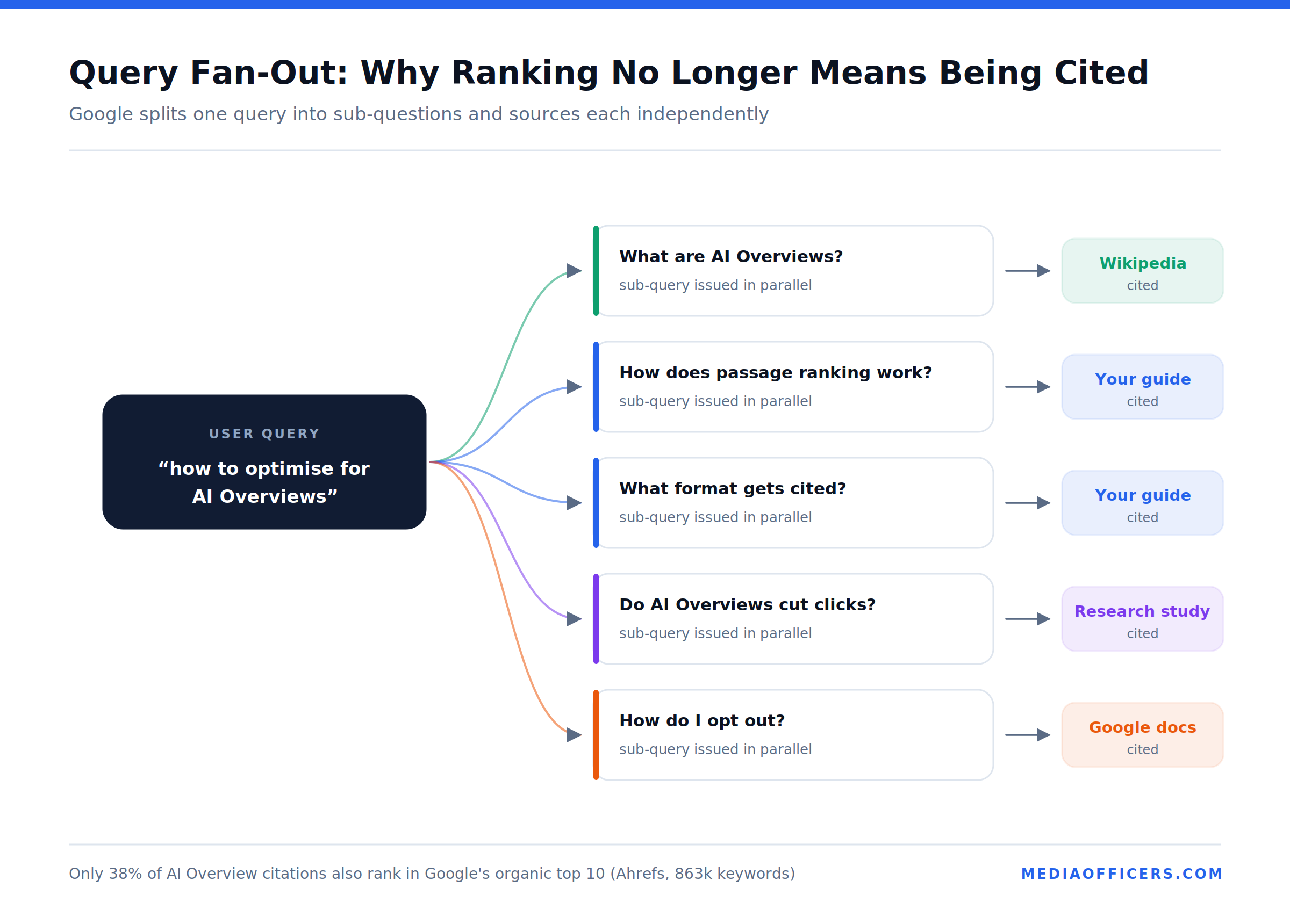 Query fan-out: Google breaks one user query into several sub-questions, retrieves sources for each, then synthesises. This is why passage-level optimisation beats page-level optimisation.
The Data Behind AI Overview Citations
Before diving into the rules, let us inspect the verified data shaping AI search behavior in 2026:
| Metric | Figure | Observed Impact |
|---|---|---|
| Share of US searches with an AI Overview | > 20% | More than 1 in 5 queries now display AI summaries |
| Comparison queries triggering AIO | ~95% | Near-total coverage on "X vs Y" queries |
| Question-format queries triggering AIO | ~86% | Massive trigger rate on natural language questions |
| CTR if cited in AI Overview | ~2.1% | 2.3x higher click-through than being uncited (0.9%) |
| Cited pages also in organic top 10 | 38% | Down from 76% in 2025 (decoupling of ranking & citation) |
Comparison and question queries are where the volume is. Informational content that answers a question or compares two things is the highest-yield format.
Rule 1: Optimize the Passage, Not Just the Page
Google's AI features use query fan-out. A single user query is expanded into multiple related sub-searches across subtopics, and sources are pulled for each independently. Your page does not need to be the best overall answer for the entire topic; it needs to contain the definitive answer to one sub-question in the fan-out.
Break each page into clearly bounded sections, one question per section.
Make each section survivable out of context, so it reads accurately when lifted alone.
Target adjacent sub-questions in the same document rather than spawning thin doorway pages.
Use descriptive headings that name the sub-question exactly.
Rule 2: Answer in the First 50 Words
Under every heading, deliver the answer in the opening two sentences. Google's systems need a contiguous span of text that answers the sub-question. If the answer is buried beneath preamble, there is no clean passage to quote.
Winning Pattern:State the definition, then the mechanism, then specific numbers, then the implication. Follow with nuances and supporting examples.Rule 3: Use Real Semantic Listicle Structure
Numbered and bulleted lists are disproportionately cited in AI Overviews because a list is self-delimiting. Google knows exactly where the answer begins and ends.
Use real
<ol>and<ul>HTML markup, never manually typed hyphens or styled divs.Give each item a bolded label followed by a complete explanation.
Aim for 5 to 10 items, which provides complete intent coverage without clutter.
Rule 4: Build Tables for Comparison Queries
Comparison queries trigger AI Overviews about 95% of the time. Tables are the single best format to win them because machine extractors can cleanly map row and column attributes.
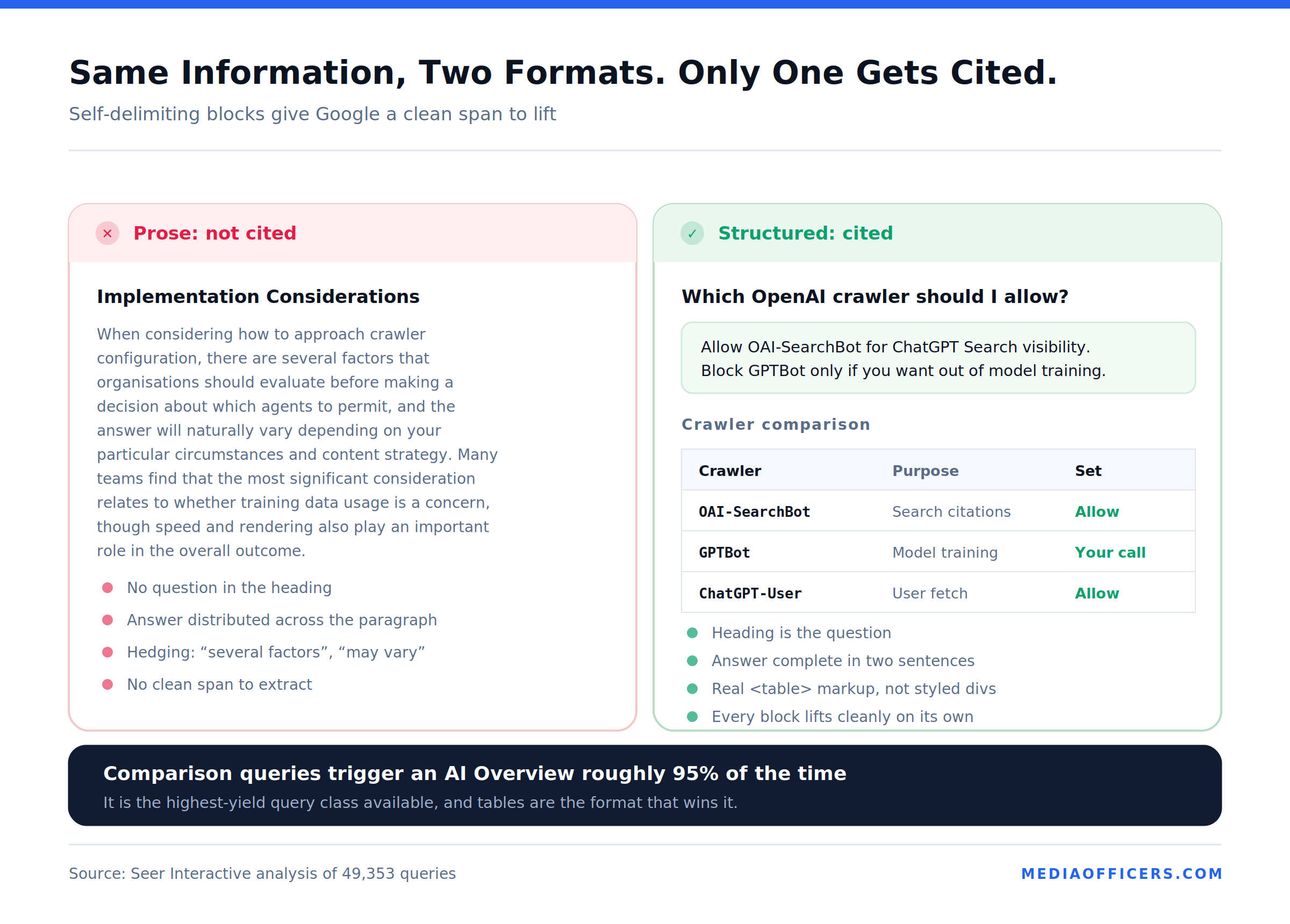 Unstructured prose versus extractable tables and lists. Structured markup wins AI citations because every block is independently quotable.
Rule 5: Match Structured Data to Visible Content
Mismatched markup is an algorithmic liability. Schema must reflect what is visibly present on the page word-for-word. Prioritise:
Article: with accurate
datePublishedanddateModifiedFAQPage: where questions and answers appear in visible accordion blocks
Organization: with verified
sameAslinks to Wikidata and CrunchbaseBreadcrumbList: to clearly express site hierarchy
Explore our comprehensive guide on Advanced JSON-LD Schema for Google Knowledge Graph, or partner with our team for enterprise technical SEO and schema architecture.
Rule 6: Configure Snippet Preview Directives Correctly
Google restricts AI feature appearance using the same robots meta directives that govern snippets. If a legacy nosnippet or max-snippet:0 is present, your content is blocked from AI Overviews.
<meta name="robots" content="index, follow, max-snippet:-1, max-image-preview:large, max-video-preview:-1">
Rule 7: Treat Freshness as a Continuous Signal
AI Overviews prioritise sources updated within the last 30 to 90 days. Keep a visible "Last updated" date in your template, sync dateModified in your Article schema, and update real data quarterly.
Rule 8: Cover the Full Intent in One Master Guide
Because of query fan-out, a page covering definitions, mechanisms, comparison tables, cost breakdowns, and common mistakes can be cited across multiple sub-queries. Build deep topical hubs rather than splintering content into thin doorway pages.
Rule 9: Build Entity & Brand Corroboration
Google's AI systems favor recognised entities. Maintain consistent business NAP, named author entities with Person schema, verified Wikidata entries, and active corporate profiles across LinkedIn and Crunchbase.
Rule 10: Leverage Video as a Citation Side Door
YouTube accounts for 5.6% of all AI Overview citations, and 18.2% of citations outside the top 100 were YouTube URLs. Create concise 4 to 8-minute videos with structured chapter timestamps and embed them with VideoObject schema.
Frequently Asked Questions
Do I need special markup to appear in Google AI Overviews?
No. Google states there are no additional technical requirements beyond standard Search eligibility and snippet permissions (max-snippet:-1). Structured data helps with entity understanding, but standard indexable HTML is the primary requirement.
Why am I ranking in the top 10 but not cited in the AI Overview?
Because ranking and citation have decoupled: only 38% of cited pages also rank in Google's organic top 10. Citation is decided at the passage level through query fan-out, so an overall high-ranking page may lack an extractable, self-contained answer for the specific sub-query.
Can I opt out of AI Overviews without losing regular search traffic?
Not cleanly. Using nosnippet removes your content from AI Overviews but also strips your organic search snippets. There is currently no AI-Overview-only opt-out directive.
Which content formats get cited most in AI Overviews?
Comparison tables lead by a wide margin (triggered on ~95% of comparison queries), followed by question-format lists (~86%), definition answer blocks, and timestamped video embeds.
Audit Your AI Search Citation Readiness
Compare your site's visibility across Google AI Overviews, ChatGPT Search, and Perplexity with our comprehensive audit suite.
Check crawl access and indexation with our technical SEO checker.

Written by
Rudhrah KeshavCo-Founder & Chief Revenue Officer (CRO)
Rudhrah Keshav is the Co-Founder & CRO at MediaOfficers. 16+ years SEO architect, published author of "AI Marketing for Indian Businesses" and "Local SEO" (Google Books / Amazon), featured in Yahoo Finance.


