
To rank in AI search, you need three things: AI crawlers must be able to access your site, your content must contain quotable, well-sourced answers to the sub-questions AI engines actually search for, and your brand must be mentioned on trusted third-party sites the models already rely on. Get those three right and citations follow - usually faster than a competitive Google ranking would. Through our dedicated AI SEO services, MediaOfficers engineers structured citation assets, manages crawler governance, and optimizes brand entities across all leading LLMs.
This is the tactical follow-up to our guide on what Generative Engine Optimization is. Here we cover exactly how to do it.
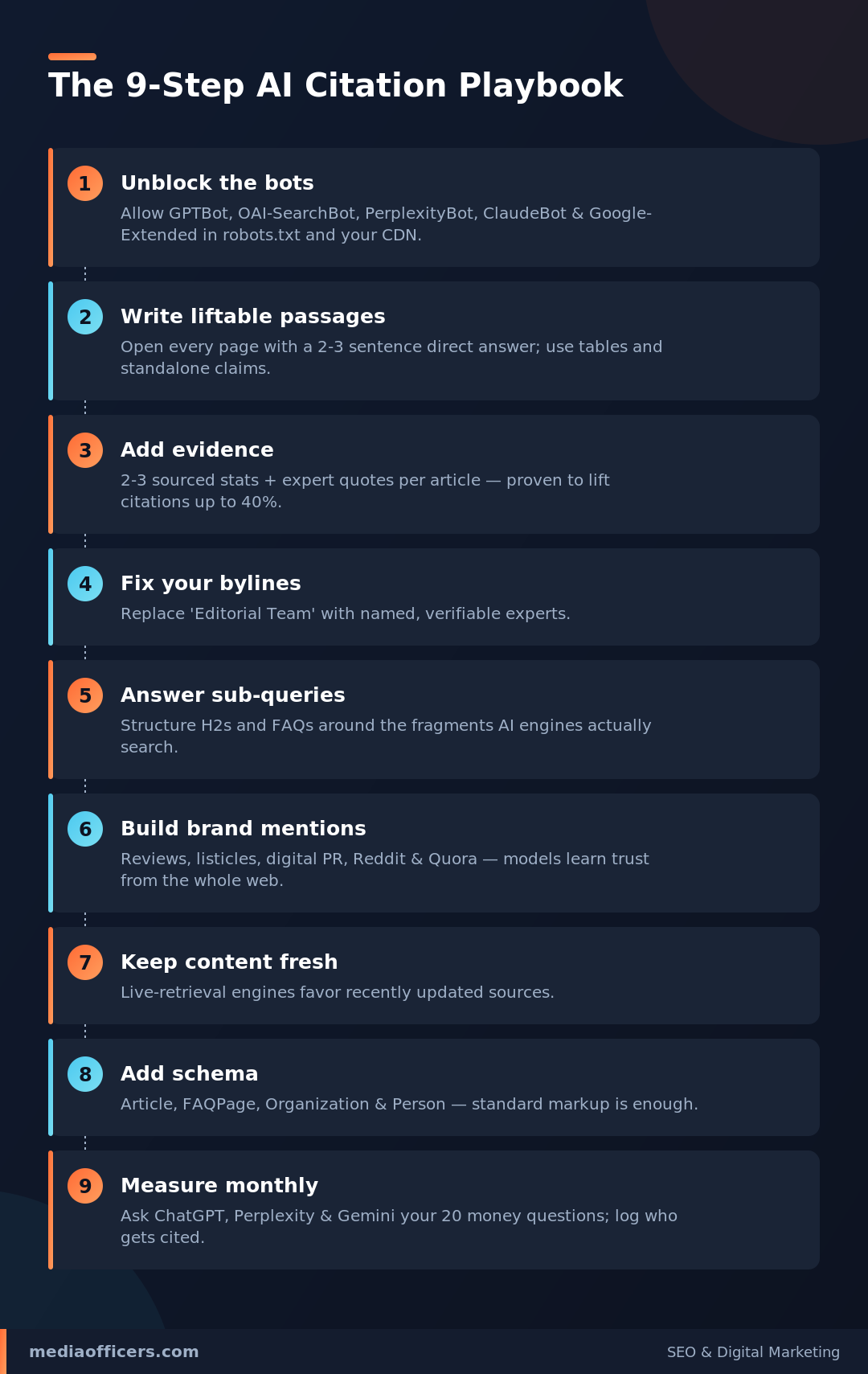
Step 1: Unblock the Bots (5 Minutes, Most-Missed Step)
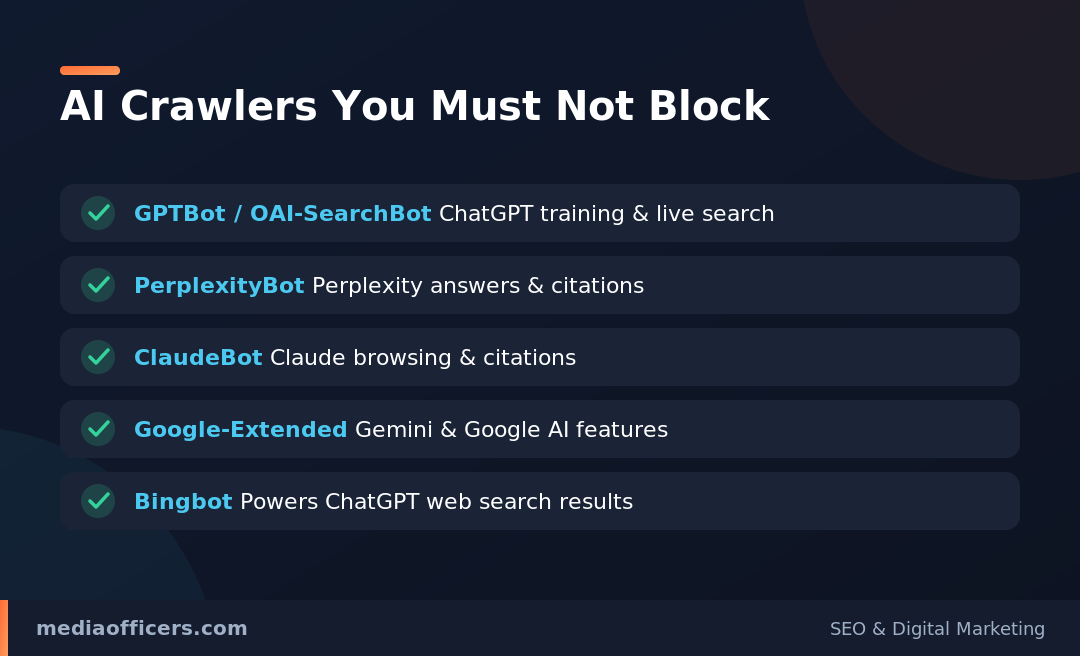
Check robots.txt for these user agents: GPTBot, OAI-SearchBot, PerplexityBot, ClaudeBot, Google-Extended, Bingbot (powers ChatGPT's browsing). Then check your CDN - Cloudflare switched to blocking AI crawlers by default, so many site owners are blocked without knowing it. If you can't be crawled, nothing else in this article matters.
Step 2: Write "Liftable" Passages
AI engines quote passages, not pages. For every important page:
- Open with a 2 - 3 sentence direct answer to the page's core question (before any storytelling).
- Turn key claims into standalone sentences: "Local SEO services in India typically cost ₹25,000 - ₹60,000 per month" is liftable; a vague paragraph about "varying prices" is not.
- Use tables for comparisons - engines parse and reproduce them reliably.
- Keep one idea per paragraph, 2 - 4 sentences each.
Step 3: Add Evidence That Earns Trust
Research from Princeton, Georgia Tech, and IIT Delhi measured what actually increases AI citations: adding statistics, expert quotations, and authoritative source references lifted citation rates by up to 40%. In practice per article: 2 - 3 sourced stats, at least one named expert opinion, links to primary sources (studies, official docs - not just other blogs).
Step 4: Fix Your Bylines
Anonymous content is a GEO liability. Replace "Editorial Team" with a named author who has a bio, credentials, a LinkedIn profile, and ideally authorship on other trusted sites. AI engines cross-reference authors as entities; a verifiable expert makes every article they sign more citable.
Step 5: Answer the Sub-Queries, Not Just the Keyword
When a user asks Perplexity "should my dental clinic hire an SEO agency or run Google Ads?", the engine fans out into searches like "dental SEO results timeline," "Google Ads cost dental clinic," "SEO vs PPC small business." Structure your content so H2s and FAQ entries answer these fragments individually. A good FAQ section is essentially pre-packaged sub-query bait.
Step 6: Build Third-Party Brand Mentions
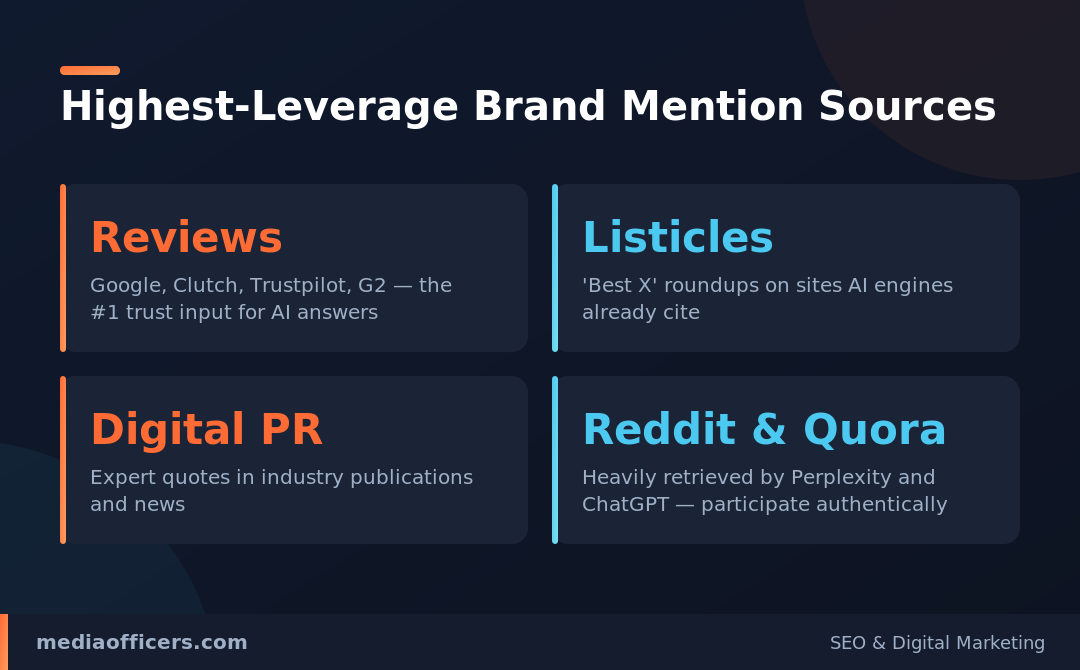
Models decide whom to trust from the entire web. The highest-leverage mention sources in our client work:
- Review platforms - Google reviews, Clutch, Trustpilot, G2 (industry-dependent)
- "Best X" listicles - being included in roundups on sites AI engines already cite
- Digital PR - quotes in industry publications and news
- Directories with editorial standards
- Reddit and Quora threads - heavily retrieved by Perplexity and ChatGPT; participate authentically, never spam
Step 7: Keep Content Fresh
AI engines with live retrieval (Perplexity, ChatGPT Search, AI Overviews) favor recently updated sources for time-sensitive queries. Add "Updated [month, year]" honestly, refresh stats, and re-publish meaningfully improved versions of your key pages every quarter.
Step 8: Add Schema and Keep Structure Clean
Article, FAQPage, Organization, and Person schema help engines resolve entities (who wrote this, which brand is this). Google has confirmed exotic "AI schema" isn't required - standard structured data plus clean heading hierarchy is enough.
Step 9: Measure Share of Voice Monthly
Build a simple tracking sheet: 20 questions your customers ask AI engines. Ask each in ChatGPT, Perplexity, and Gemini monthly. Log which brands get named and which URLs get cited. That's your AI share of voice - watch it move as you apply steps 1 - 8.
What Results Look Like
At MediaOfficers we run this playbook alongside classic SEO campaigns. Our own lead form now includes "AI Search (Perplexity/Gemini/ChatGPT)" as a source option because prospects increasingly arrive that way. AI citations compound like early-days SEO did: low competition now, defensible advantage later.
FAQs
How do I get my website mentioned in ChatGPT? Allow OpenAI's crawlers (GPTBot, OAI-SearchBot) in robots.txt, publish direct-answer content with sourced statistics and named authors, and build brand mentions on sites ChatGPT already cites, such as review platforms and industry publications.
Why does my competitor appear in AI Overviews but I don't? Common reasons: your site blocks AI crawlers, your content buries answers instead of stating them directly, your brand has fewer third-party mentions, or your pages lack the specific sub-answers the engine is assembling.
Do backlinks matter for AI search? Yes, indirectly and directly. Backlinks still drive the underlying web rankings many AI engines retrieve from, and mentions on authoritative sites teach models that your brand is credible.
Can I pay to appear in AI search results? Some engines are testing ad formats, but organic citations cannot be bought. They're earned through accessibility, answer quality, and brand authority - which is why early investment compounds.
How often do AI engines update their sources? Retrieval-based engines (Perplexity, ChatGPT Search, AI Overviews) pull near-live web results, so improvements can surface within days. Model training knowledge updates more slowly, which is why third-party mentions build long-term presence.
💡 Related Reading: Learn the structural differences in AI SEO vs Traditional SEO before optimizing for LLM citation.
For a complete breakdown of optimization tactics, read our full multi-engine GEO optimization guide guide.

Written by
Rudhrah KeshavCo-Founder & Chief Revenue Officer (CRO)
Rudhrah Keshav is the Co-Founder & CRO at MediaOfficers. 16+ years SEO architect, published author of "AI Marketing for Indian Businesses" and "Local SEO" (Google Books / Amazon), featured in Yahoo Finance.


