
AI SEO and traditional SEO are not rivals - they're layers. Traditional SEO earns you rankings and clicks from classic search results; AI SEO (also called GEO) earns you citations inside answers from ChatGPT, Perplexity, Gemini, and Google AI Overviews. In 2026, a complete search strategy budgets for both, because the audiences barely overlap anymore.
"Is SEO dead?" gets asked every year. The honest 2026 answer: no, but it has split in two. Here's what changed, what didn't, and how to allocate effort.
What Didn't Change
The fundamentals that powered SEO for 20 years still power both games:
- Crawlability and speed. If bots can't access your pages quickly, neither Google nor GPTBot can use them.
- Search intent. Content that answers what the user actually meant wins in both systems.
- Authority. Backlinks and brand reputation remain the trust currency - AI engines lean on them too.
- Quality. Thin, spun, or purely AI-generated filler loses everywhere. Google's spam systems and LLM source-selection both filter it out.
If an agency tells you technical SEO no longer matters "because of AI," walk away.
What Changed
1. The click is no longer guaranteed
AI Overviews and chat answers resolve many queries with zero clicks. Informational traffic to classic blog posts has fallen across most industries. The queries still happen - the visit doesn't. Your brand must be in the answer, not just below it.
2. Ranking #1 ≠ being cited
Research tracking AI citations shows the overlap between Google's top links and AI-cited sources has collapsed from roughly 70% to under 20%. AI engines pick sources by passage quality, evidence, and entity trust - not position alone.
3. Keywords became conversations
Users ask AI engines full questions with context ("best SEO agency in India for a dental clinic under ₹50k/month"). Engines fan these into sub-queries. Content built as clear answers to many small questions beats one monolithic keyword page.
4. Authors became ranking factors
Named, verifiable experts get cited; anonymous "Editorial Team" content gets skipped. E-E-A-T stopped being a guideline and became mechanically enforced by how LLMs select sources.
5. Measurement split
Rankings and organic sessions now tell half the story. The other half: how often AI engines name your brand (share of voice), and lead-source data - our own intake form now regularly shows "AI Search (Perplexity/Gemini/ChatGPT)" as how prospects found us.
Side-by-Side Comparison
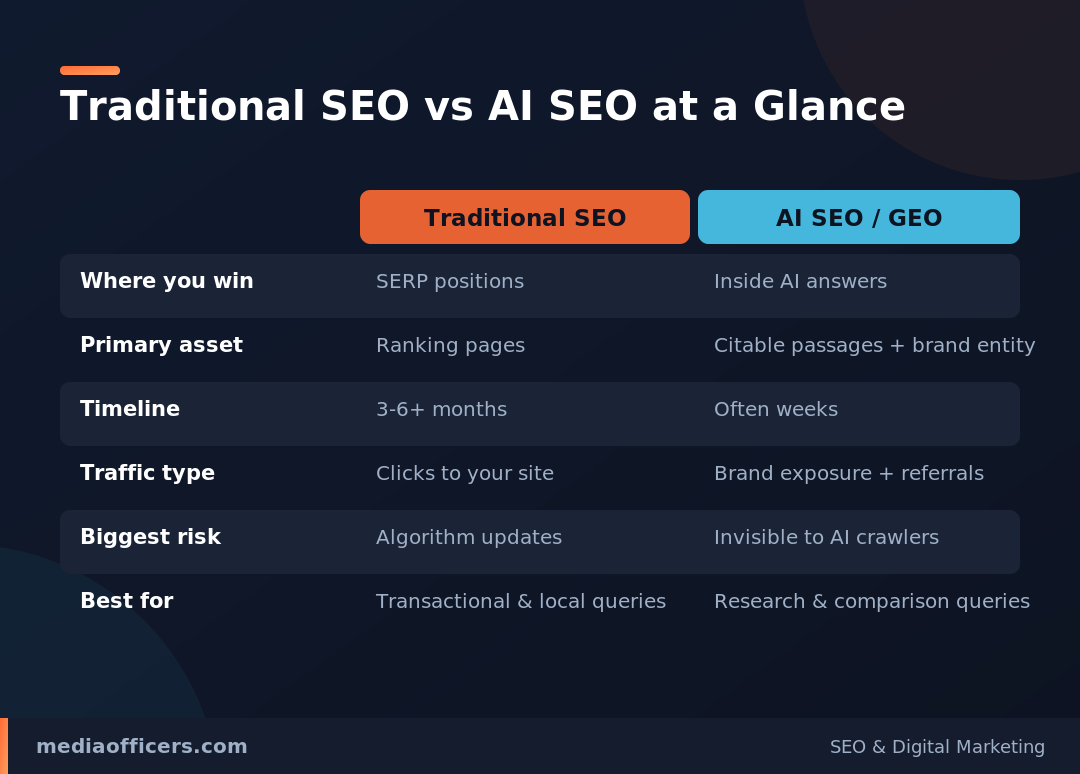
| Dimension | Traditional SEO | AI SEO / GEO |
|---|---|---|
| Where you win | SERP positions | Inside AI answers |
| Primary asset | Ranking pages | Citable passages + brand entity |
| Timeline | 3 - 6+ months | Often weeks (low competition, live retrieval) |
| Traffic type | Clicks to your site | Brand exposure + high-intent referrals |
| Biggest risk | Algorithm updates | Being invisible to AI crawlers |
| Best for | Transactional & local queries | Research, comparison & advice queries |
How to Split Your Effort in 2026
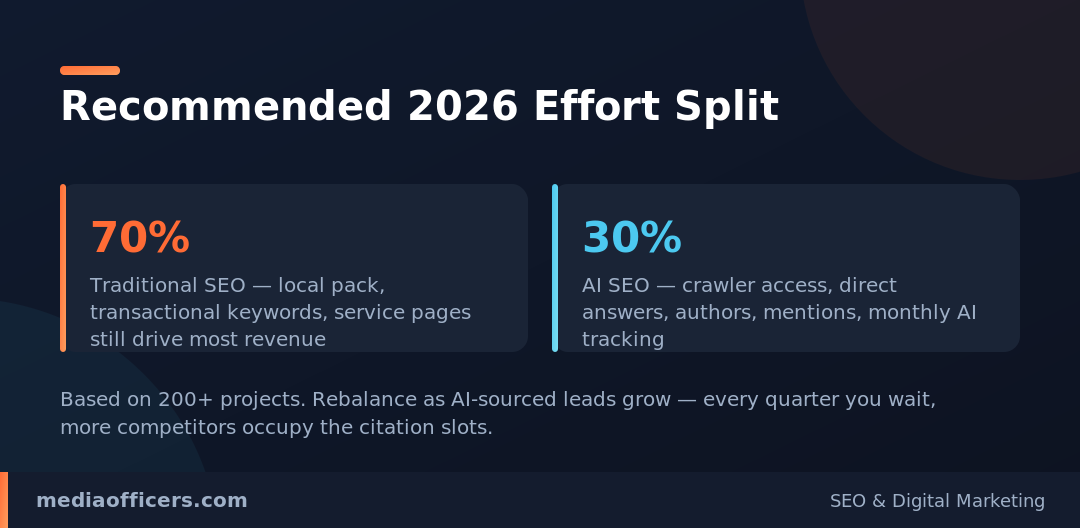
Our recommendation for most SMBs, based on 200+ projects:
- 70% traditional SEO - it still drives the majority of measurable revenue: local pack, transactional keywords, service pages. Money queries like "locksmith San Diego" or "sedation dentist Yukon Oklahoma" (both page-1 rankings we hold for clients) still convert through classic results.
- 30% AI SEO - unblock crawlers, restructure top pages into direct answers, add authors and evidence, build third-party mentions, track AI share of voice monthly.
The 30% is cheap insurance today and a moat tomorrow. Every quarter you wait, more competitors occupy the citation slots for your industry's questions.
The Bottom Line
Traditional SEO gets you found. AI SEO gets you quoted. The businesses winning in 2026 do both from one content operation: every article is built to rank and to be lifted into an answer. That's how we now build every campaign in our SEO services - one strategy, two scoreboards.
FAQs
Is traditional SEO still worth it in 2026? Yes. Transactional and local searches still run through classic results and the local pack, which drive the most direct revenue. Traditional SEO remains the foundation; AI SEO extends it.
What is AI SEO? AI SEO (or GEO - Generative Engine Optimization) is optimizing content and brand signals so AI search engines cite you in their generated answers. See our full GEO guide.
Has AI reduced website traffic? For many informational queries, yes - AI answers resolve them without a click. That makes owning the citation, transactional rankings, and conversion-focused pages more important, not less.
Should I create separate content for AI engines? Usually no. Restructure the same content: direct answers up front, sourced statistics, named authors, FAQs, clean headings. One asset, optimized for both systems.
Will Google penalize AI-written content? Google penalizes unhelpful content regardless of how it's produced. AI-assisted content reviewed and enriched by experts is fine; mass-produced filler is not - and AI engines won't cite it either.
To master the shift from blue links to conversational answers, implement our strategies for GEO optimization strategies.
Key Search Engine Comparisons (SEO vs SEM vs AEO vs GEO)
What is the main difference between SEO and SEM?
The primary difference between SEO and SEM is cost model: SEO (Search Engine Optimization) focuses on earning free, organic traffic through content and technical optimization, while SEM (Search Engine Marketing) includes paid search advertising like Google Ads (PPC) to purchase instant top placements.
How do SEO, AEO, and GEO work together in 2026?
In modern search marketing, traditional SEO builds website authority, AEO (Answer Engine Optimization) optimizes direct answers for voice search, and GEO (Generative Engine Optimization) ensures your brand is cited inside AI models like ChatGPT, Perplexity, and Gemini.

Written by
Rudhrah KeshavCo-Founder & Chief Revenue Officer (CRO)
Rudhrah Keshav is the Co-Founder & CRO at MediaOfficers. 16+ years SEO architect, published author of "AI Marketing for Indian Businesses" and "Local SEO" (Google Books / Amazon), featured in Yahoo Finance.


