
Ecommerce SEO is the practice of ranking your category and product pages for the searches shoppers make right before buying. Unlike blog-driven SEO, the money is in commercial pages: category pages capture "buy [product type]" searches, product pages capture exact-model searches, and supporting content captures research queries that feed both.
We've used this playbook to put HubcapZone on Google page 1 (#3) for "Ford Wheel Simulators" - a commercial keyword contested by national retailers. Here's the full system.
Step 1: Map Keywords to the Right Page Type
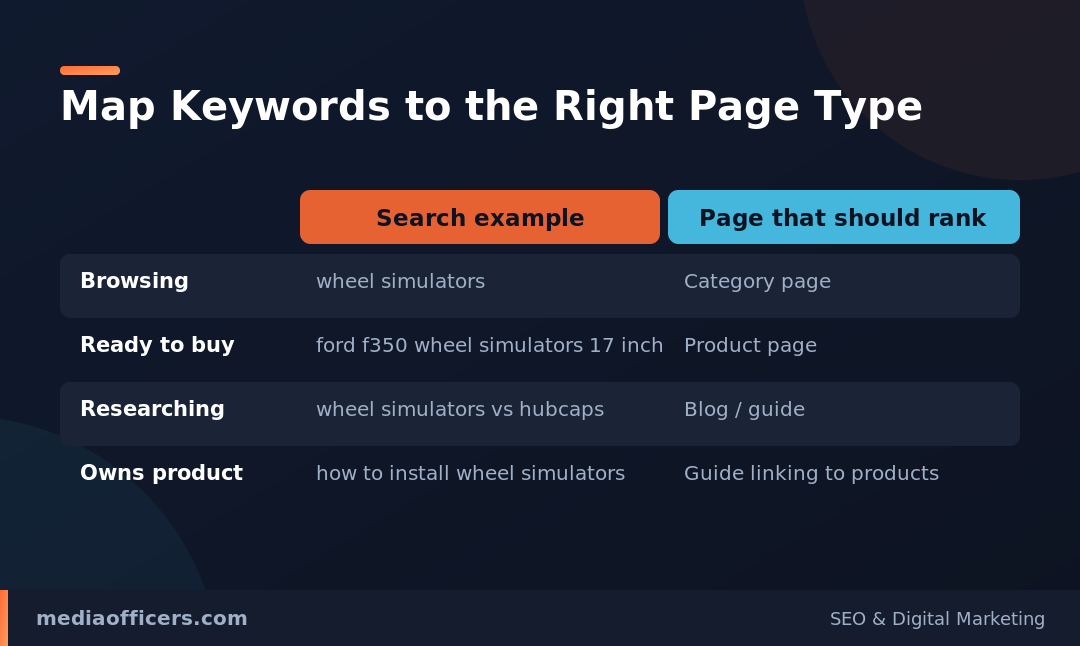
The most common ecommerce SEO mistake is targeting everything with blog posts. Match intent to page type:
| Search | Intent | Page that should rank |
|---|---|---|
| "wheel simulators" | Browsing a category | Category page |
| "ford f350 wheel simulators 17 inch" | Ready to buy a specific item | Product page |
| "wheel simulators vs hubcaps" | Researching | Blog/guide (linking to category) |
| "how to install wheel simulators" | Owns or about to buy | Guide (linking to products) |
Pull keywords from search console, competitor category structures, and Amazon autocomplete (shoppers' actual language), then assign each to exactly one page to avoid cannibalization.
Step 2: Category Pages - Your Highest-Value Real Estate
Category pages usually outrank product pages for volume terms, yet most stores leave them as bare product grids. Upgrade each key category with: a keyword-targeted H1 and title tag, 150 - 300 words of genuinely useful intro copy (buying considerations, not filler), FAQ block at the bottom, internal links to top products and subcategories, and breadcrumbs with schema.
Step 3: Product Pages That Rank and Convert
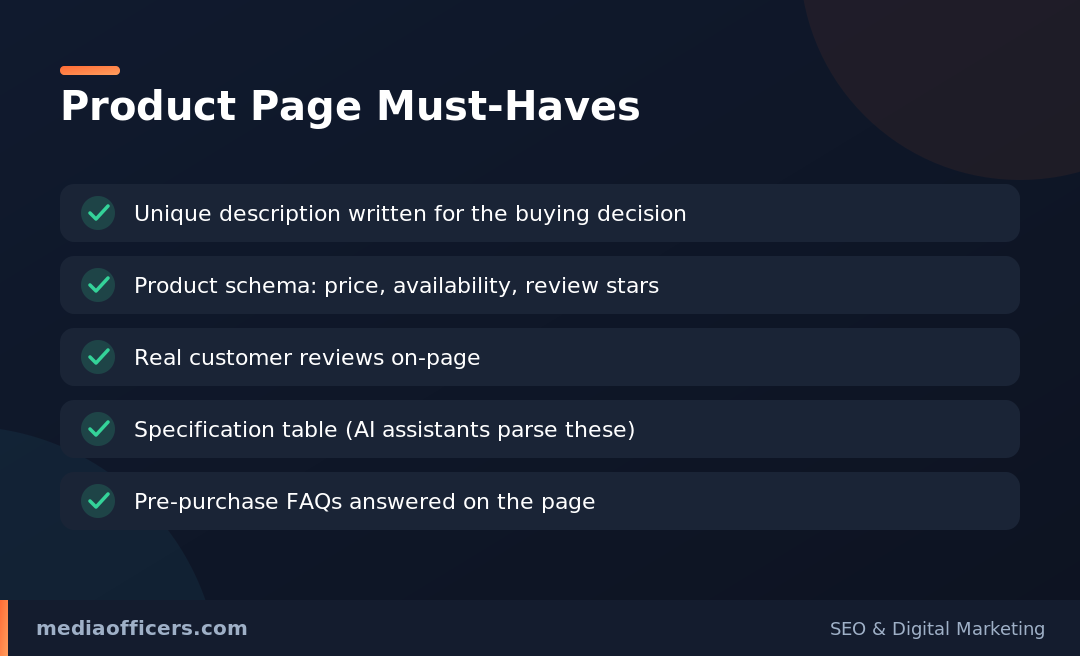 Product page SEO must-haves checklist infographic">
- Unique descriptions - never manufacturer copy pasted across 50 sites; write for the buyer's decision (fitment, materials, sizing, comparisons).
- Product schema with price, availability, and review stars - this powers rich results and, increasingly, AI shopping answers.
- Real customer reviews on-page (unique content + trust).
- Specification tables - engines and AI assistants parse them directly.
- Answer the pre-purchase questions on the page ("will these fit a 2019 F-350 dually?") - that's exactly what shoppers now ask ChatGPT.
Step 4: Technical SEO - Where Ecommerce Sites Bleed
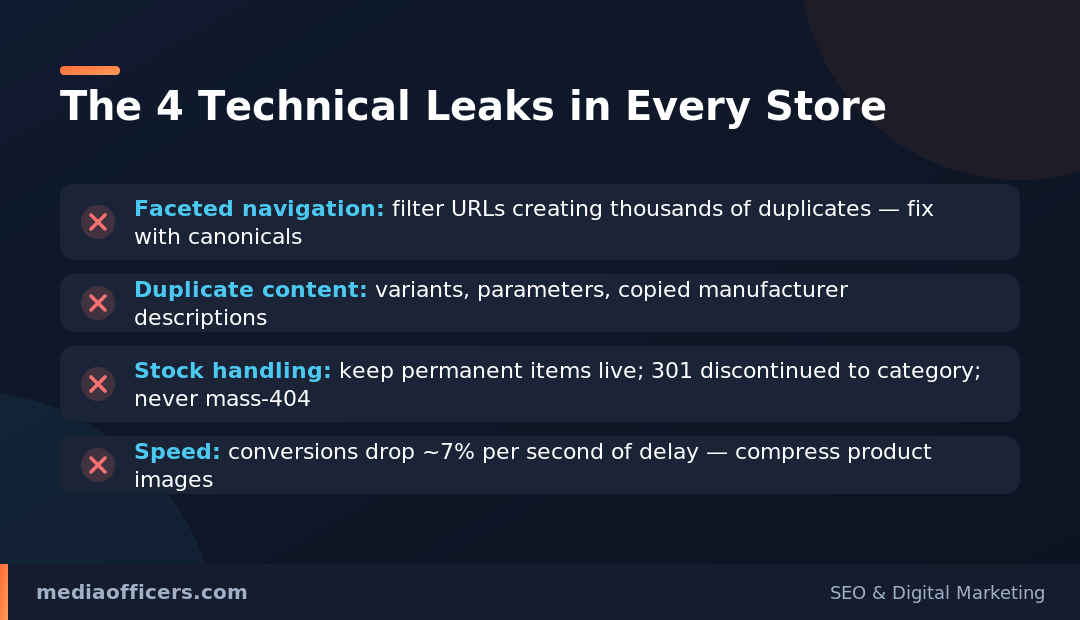
The big four issues we find in nearly every store audit:
- Faceted-navigation crawl waste - filter combinations creating thousands of near-duplicate URLs. Fix with canonicals and robots rules.
- Duplicate content from variants, session parameters, and syndicated descriptions.
- Out-of-stock handling - keep permanent products live with "notify me"; 301 discontinued items to the parent category. Never mass-404 seasonal items.
- Speed - conversion drops ~7% per second of delay; product images are the usual culprit. Run our speed optimization checklist.
For enterprise catalogs wrestling with crawl budget exhaustion across dynamic faceted navigation, our dedicated enterprise ecommerce SEO services resolve indexation bloat at the server and architectural level.
Step 5: Authority - Links and Mentions
Retailer sites earn links with assets: fitment/size guides, comparison tools, data-driven posts ("we analyzed 500 truck owners' wheel choices"), and supplier/manufacturer "where to buy" listings. For stores in niches like auto parts, being active and helpful in enthusiast forums and Reddit builds exactly the mentions AI shopping assistants weigh.
Step 6: The 2026 Layer - AI Shopping Search
Shoppers increasingly start with "best wheel simulators for a Ford dually?" in ChatGPT or Perplexity. To be the store those answers name: keep Product schema complete and accurate, maintain strong third-party review profiles, publish comparison and buying-guide content with clear verdicts, and make sure AI crawlers aren't blocked. Early movers here own recommendations the way early SEO adopters owned page 1.
FAQs
How is ecommerce SEO different from normal SEO? The revenue pages are category and product pages rather than articles, and the hardest problems are technical (faceted navigation, duplicates, stock churn) rather than editorial. Content still matters, but as support for commercial pages.
Should product pages or category pages be the SEO priority? Categories first - they target higher-volume terms, are more stable than individual products, and lift every product beneath them. Then optimize your highest-margin product pages individually.
How long does ecommerce SEO take? Technical fixes can lift traffic within weeks. Competitive category rankings typically take 4 - 8 months against established retailers - but rank once and, like HubcapZone's page-1 result, it keeps selling without per-click cost.
Can a small store outrank Amazon and big retailers? On specificity, yes. Deep expertise pages, exact-fitment content, and niche authority win long-tail commercial keywords that generalist giants cover thinly - that's precisely how a specialist beat national chains for "Ford Wheel Simulators."
What's the best platform for ecommerce SEO? Shopify, WooCommerce, and Magento can all rank; execution matters more than platform. WooCommerce/Magento offer more technical control; Shopify is simpler with a few URL-structure constraints.
Want this run on your store? Ecommerce SEO services · Automotive SEO services · HubcapZone case study

Written by
Rudhrah KeshavCo-Founder & Chief Revenue Officer (CRO)
Rudhrah Keshav is the Co-Founder & CRO at MediaOfficers. 16+ years SEO architect, published author of "AI Marketing for Indian Businesses" and "Local SEO" (Google Books / Amazon), featured in Yahoo Finance.


