
AI crawler optimization is the technical discipline of configuring server permissions, robots.txt directives, CDN edge security rules, and HTTP response headers so that generative AI search engines can seamlessly discover, extract, and attribute citations to your website while preventing unwanted scraping.
The single most critical operational distinction in modern AI search is that artificial intelligence companies operate two fundamentally distinct crawler families: training crawlers that harvest archival data to train future foundation models, and search crawlers that perform live web retrieval to ground answers and generate linked citations. Blocking the wrong user-agent removes your website from AI answers entirely while failing to protect your intellectual property.
For example, OpenAI's GPTBot collects model training data, while OAI-SearchBot powers live citations in ChatGPT Search. Anthropic's ClaudeBot gathers training data, while Claude-SearchBot powers citations. Google's Google-Extended trains Gemini, while standard Googlebot feeds Google Search and AI Overviews. Blocking a training bot costs nothing in search visibility; blocking a search retrieval bot removes your brand from AI answers completely.
Below is the complete 2026 AI crawler matrix, copy-paste robots.txt templates, Cloudflare WAF configuration recipes, and log verification steps to eliminate silent edge failures.
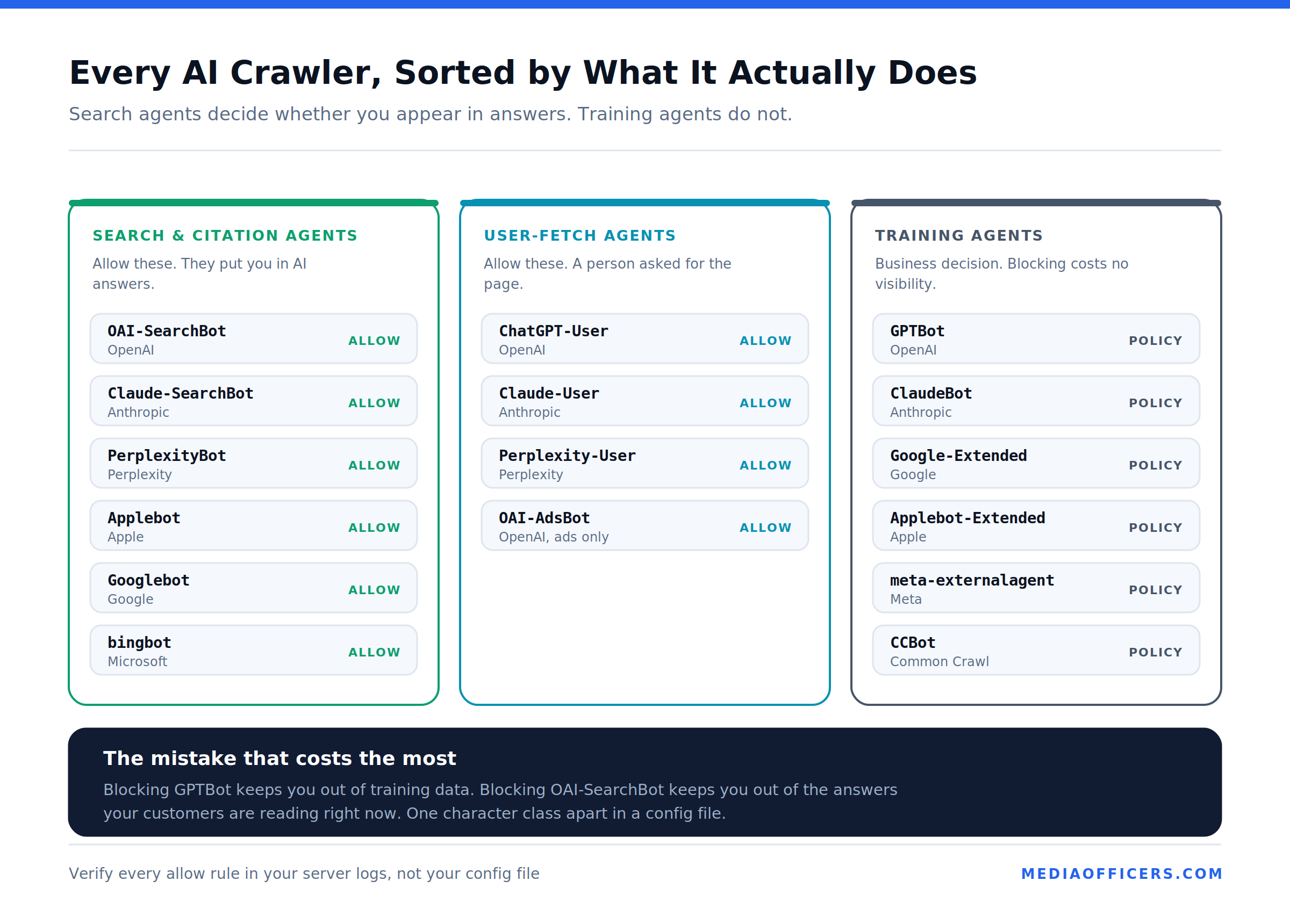
Figure 1: Every major AI crawler classified by functional role. Green search agents feed live citations and should be allowed. Grey agents feed foundation model training, where allowance is a commercial policy decision.
The Complete 2026 AI Crawler Matrix
| Company | User-Agent Token | Primary Purpose | Respects Robots.txt | Recommended Action |
|---|---|---|---|---|
| OpenAI | OAI-SearchBot | Powers ChatGPT Search citations & source cards | Yes | ALLOW (Critical) |
| OpenAI | GPTBot | Foundation model training data collection | Yes | Allow / Business Choice |
| OpenAI | ChatGPT-User | User-initiated conversational page fetches | Treats as user action | ALLOW |
| Anthropic | Claude-SearchBot | Live search retrieval and citation ranking | Yes | ALLOW (Critical) |
| Anthropic | ClaudeBot | Claude model training data collection | Yes | Allow / Business Choice |
| Perplexity AI | PerplexityBot | Real-time web indexing for answer citations | Yes | ALLOW (Critical) |
| Googlebot | Core Search index, Discover & AI Overviews | Yes | ALLOW (Mandatory) | |
| Google-Extended | Gemini & Vertex AI model training | Yes | Allow / Business Choice | |
| Apple | Applebot | Siri, Spotlight, Safari & Apple Intelligence | Yes | ALLOW (Critical) |
| Apple | Applebot-Extended | Apple foundation model training | Yes | Allow / Business Choice |
| Microsoft | bingbot | Bing Search index & Microsoft Copilot grounding | Yes | ALLOW (Mandatory) |
| Meta | meta-externalagent | Meta AI training and conversational retrieval | Yes | Allow / Business Choice |
Published Official IP Range Endpoints
Because HTTP User-Agent request headers are easily spoofed by malicious scrapers, leading AI companies publish machine-readable JSON feeds of their authentic IP blocks:
OpenAI SearchBot IPs:
https://openai.com/searchbot.jsonOpenAI GPTBot IPs:
https://openai.com/gptbot.jsonAnthropic Crawler IPs:
https://claude.com/crawling/bots.jsonPerplexity AI Crawler IPs:
https://perplexity.com/perplexitybot.jsonGooglebot Official IP Ranges:
https://developers.google.com/search/apis/ipranges/googlebot.json
The Strategic Decision: Training Crawlers vs Search Crawlers
Before modifying any configuration files, establish your organization's policy regarding foundation model training versus generative search visibility:
Why Most Commercial Brands Should Allow Training Crawlers
When foundation models train on your content, your brand name, core product terminology, executive biographies, and market positioning become embedded within the model's parametric memory. This is essential because millions of AI conversational prompts are answered without triggering live web retrieval. When a user asks an offline model "What are the top Generative Engine Optimization agencies in India?", the LLM recalls brands it assimilated during training.
When Publishers Should Block Training Crawlers
If your monetization model relies on subscription paywalls, licensed research archives, or proprietary data where AI summaries represent direct substitution risk, blocking training crawlers (such as GPTBot, ClaudeBot, and Google-Extended) is appropriate. Crucially, doing so does not impair your search citations, provided search retrieval bots remain explicitly permitted.
Production-Ready Copy-Paste robots.txt Configuration
Deploy the following standard configuration in your root robots.txt file. It provides explicit allowances for all generative search bots while retaining security controls over administrative directories:
# ==============================================================================
# MEDIAOFFICERS PRODUCTION ROBOTS.TXT: AI SEARCH & RETRIEVAL SUITE
# ==============================================================================

# -- Search & Citation Retrieval Agents (ALLOW) --------------------------------
# These crawlers feed live web retrieval, answer synthesis, and source citations.

User-agent: OAI-SearchBot
Allow: /

User-agent: ChatGPT-User
Allow: /

User-agent: Claude-SearchBot
Allow: /

User-agent: Claude-User
Allow: /

User-agent: PerplexityBot
Allow: /

User-agent: Perplexity-User
Allow: /

User-agent: Applebot
Allow: /

User-agent: Googlebot
Allow: /

User-agent: bingbot
Allow: /

# -- Foundation Model Training Agents (ALLOW / CUSTOMIZE) ---------------------
# Set Allow to Disallow if your organization opts out of model training data sets.

User-agent: GPTBot
Allow: /

User-agent: ClaudeBot
Allow: /

User-agent: Google-Extended
Allow: /

User-agent: Applebot-Extended
Allow: /

User-agent: meta-externalagent
Allow: /

User-agent: CCBot
Allow: /

# -- Global Crawler Rules & Sensitive Directories ----------------------------
User-agent: *
Disallow: /admin/
Disallow: /api/
Disallow: /storage/*.json
Disallow: /*?preview=
Allow: /

# -- Sitemap Declaration ------------------------------------------------------
Sitemap: https://mediaofficers.com/sitemap.xml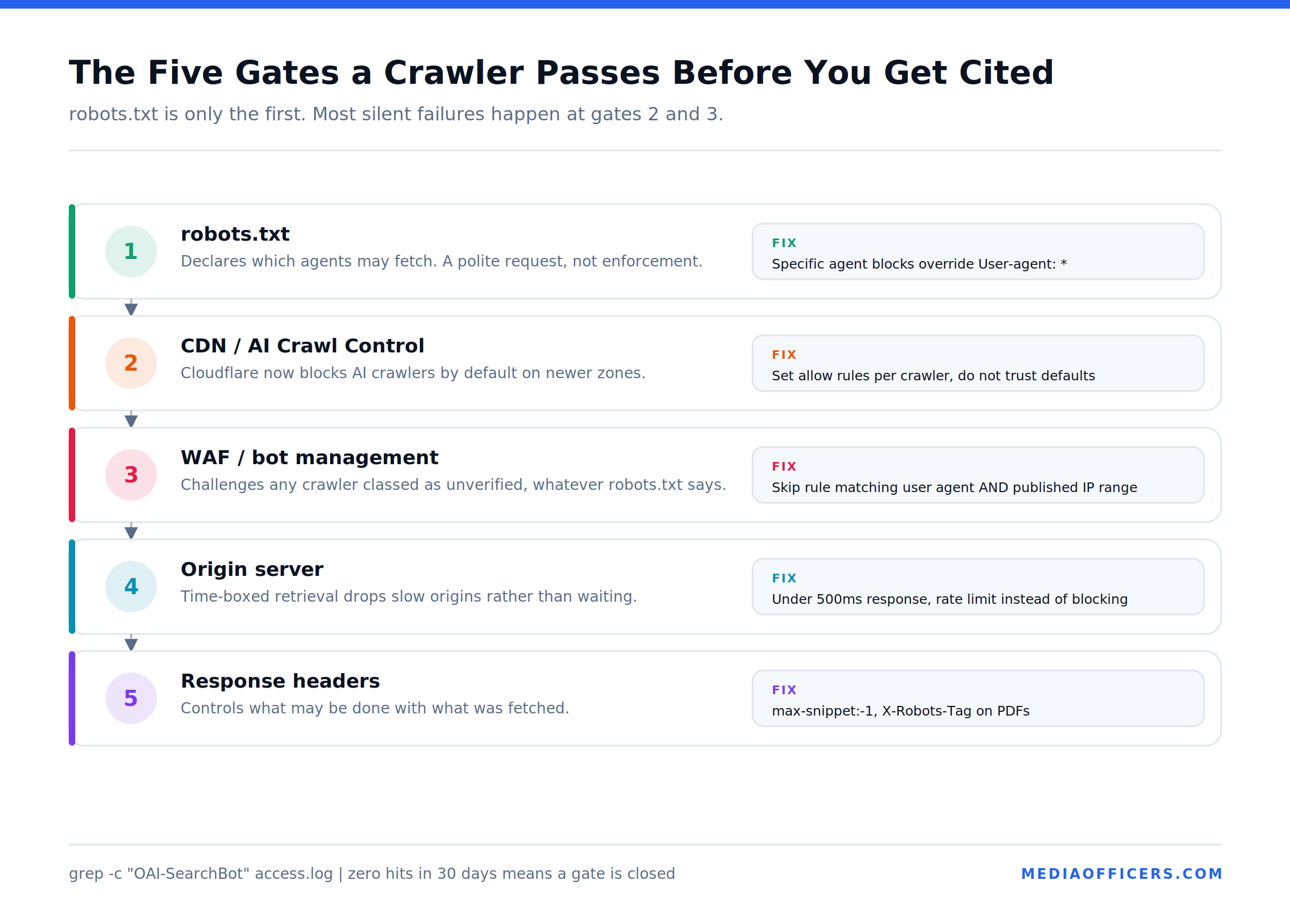
Figure 2: The Five-Gate AI Crawler Stack. Robots.txt is merely the first advisory check. Most silent crawler failures occur at the CDN and WAF layers.
Cloudflare CDN & WAF Configuration Guide
The most common cause of missing AI citations is not robots.txt, but rather Web Application Firewalls (WAF) and CDN bot management layers silently challenging AI bots with JavaScript challenges or HTTP 403 blocks.
1. Cloudflare AI Crawl Control
Cloudflare zones include an AI Crawl Control dashboard. Review your settings under Security → Bots and ensure search-driven agents (such as OAI-SearchBot, PerplexityBot, and Claude-SearchBot) are explicitly toggled to Allow rather than inheriting generic bot challenge rules.
2. Custom WAF Bypass Rule for Verified AI Crawlers
To ensure authentic AI search engines are never blocked during aggressive crawling bursts, configure a custom WAF Skip Rule in Cloudflare matching both the User-Agent and verified IP list:
(http.user_agent contains "PerplexityBot" and ip.src in $perplexity_ips) or
(http.user_agent contains "OAI-SearchBot" and ip.src in $openai_search_ips) or
(http.user_agent contains "Claude-SearchBot" and ip.src in $anthropic_ips)
Action: Skip → Select Bot Fight Mode, Managed Challenge, and Rate Limiting.
HTTP Response Headers & Meta Directives
While robots.txt governs crawler access, HTTP headers and meta tags dictate how your content may be quoted and synthesized:
1. Optimal Meta Robots Tag for AI Search
<meta name="robots" content="index, follow, max-snippet:-1, max-image-preview:large, max-video-preview:-1">max-snippet:-1: Informs search engines and AI Overviews that there is no character limit on text snippets, maximizing the likelihood of passage quotation.nosnippet: Completely suppresses text snippets from search results and removes the URL from AI Overviews. Avoid using this unless you intend to eliminate all search preview visibility.data-nosnippet: Use this HTML attribute on specific DOM elements (such as dynamic pricing or internal author notes) to exclude only those specific elements from AI extraction.
2. X-Robots-Tag for Non-HTML Documents (PDFs & Whitepapers)
AI answer engines frequently cite technical whitepapers and PDF reports. Because PDF files cannot execute HTML meta tags, send the following HTTP header from your web server:
X-Robots-Tag: index, follow, max-snippet:-1Server Log Verification: Proving AI Crawlers Reach You
Never rely solely on configuration files to confirm AI crawler health. Periodically inspect your raw Nginx/Apache access logs to measure active crawler hits:
# Count monthly requests by AI search bots
grep -c "OAI-SearchBot" /var/log/nginx/access.log
grep -c "PerplexityBot" /var/log/nginx/access.log
grep -c "Claude-SearchBot" /var/log/nginx/access.log
grep -c "Applebot" /var/log/nginx/access.log
If an agent you intended to allow shows 0 hits over a 30-day period, investigate your CDN edge security and Cloudflare WAF logs immediately.
Frequently Asked Questions
Should businesses block AI web crawlers?
No, businesses should almost never block search-oriented AI crawlers (like OAI-SearchBot, PerplexityBot, and Claude-SearchBot) because doing so removes the brand from generative AI answer citations. Blocking training crawlers (like GPTBot or ClaudeBot) is acceptable if your business model depends on paid content paywalls or proprietary data licensing.
What is the difference between GPTBot and OAI-SearchBot?
GPTBot collects web content for training OpenAI foundation models. OAI-SearchBot powers real-time search retrieval inside ChatGPT Search and determines whether your content can be cited in answers. They operate with separate user agents, distinct IP ranges, and independent robots.txt controls.
Does blocking Google-Extended affect Google AI Overviews?
No. Google-Extended only controls whether your site data is used to train Gemini and Vertex AI models. Google AI Overviews are powered by standard Googlebot crawling and are governed by standard snippet directives like max-snippet and nosnippet, not by Google-Extended.
Why is robots.txt allowing a bot but the crawler never visits?
This is almost always caused by a CDN or WAF security rule (such as Cloudflare Bot Fight Mode or Managed Challenges) intercepting crawler requests before they reach the origin server. Review your edge security logs and ensure verified AI crawlers are whitelisted by IP.
How can webmasters verify if an AI crawler IP is genuine?
Match the client IP address against the official JSON IP range endpoints published by OpenAI, Anthropic, Perplexity, and Google, or run reverse DNS lookups. Never allowlist crawlers based purely on the User-Agent header string.
Audit Your AI Crawler Access & Technical SEO
Discover if your robots.txt, Cloudflare WAF, and schema markup are properly configured for Perplexity, ChatGPT Search, and Google AI Overviews with our free automated audit tool.
Run Free Technical Readiness Audit →Read GEO Master FrameworkFor in-depth analysis on how Anthropic and Apple specifically evaluate crawled content, review our dedicated guide to Claude & Apple Intelligence SEO.

Written by
Rudhrah KeshavCo-Founder & Chief Revenue Officer (CRO)
Rudhrah Keshav is the Co-Founder & CRO at MediaOfficers. 16+ years SEO architect, published author of "AI Marketing for Indian Businesses" and "Local SEO" (Google Books / Amazon), featured in Yahoo Finance.


