
Generative Engine Optimization (GEO) is the practice of getting your content retrieved, quoted, and cited by AI answer engines. Traditional SEO is the practice of ranking a web page in a list of ten blue links. They share a common technical foundation - crawlable, indexable pages on a fast server - and then they diverge almost completely.
The clearest empirical evidence of that divergence: 83% of AI Overview citations come from pages outside the organic top 10, and brand mentions correlate with AI visibility roughly three times more strongly than backlinks do (0.664 correlation vs 0.218 across a 75,000-brand study). Ranking in organic search and being cited in AI generative answers are now two distinct competitions played on two different scoreboards.
This guide serves as our definitive pillar framework for Generative Engine Optimization in 2026. It establishes the architectural mechanics of LLM retrieval, breaks down the six-layer GEO implementation model, and links directly to our dedicated engine-specific execution blueprints.
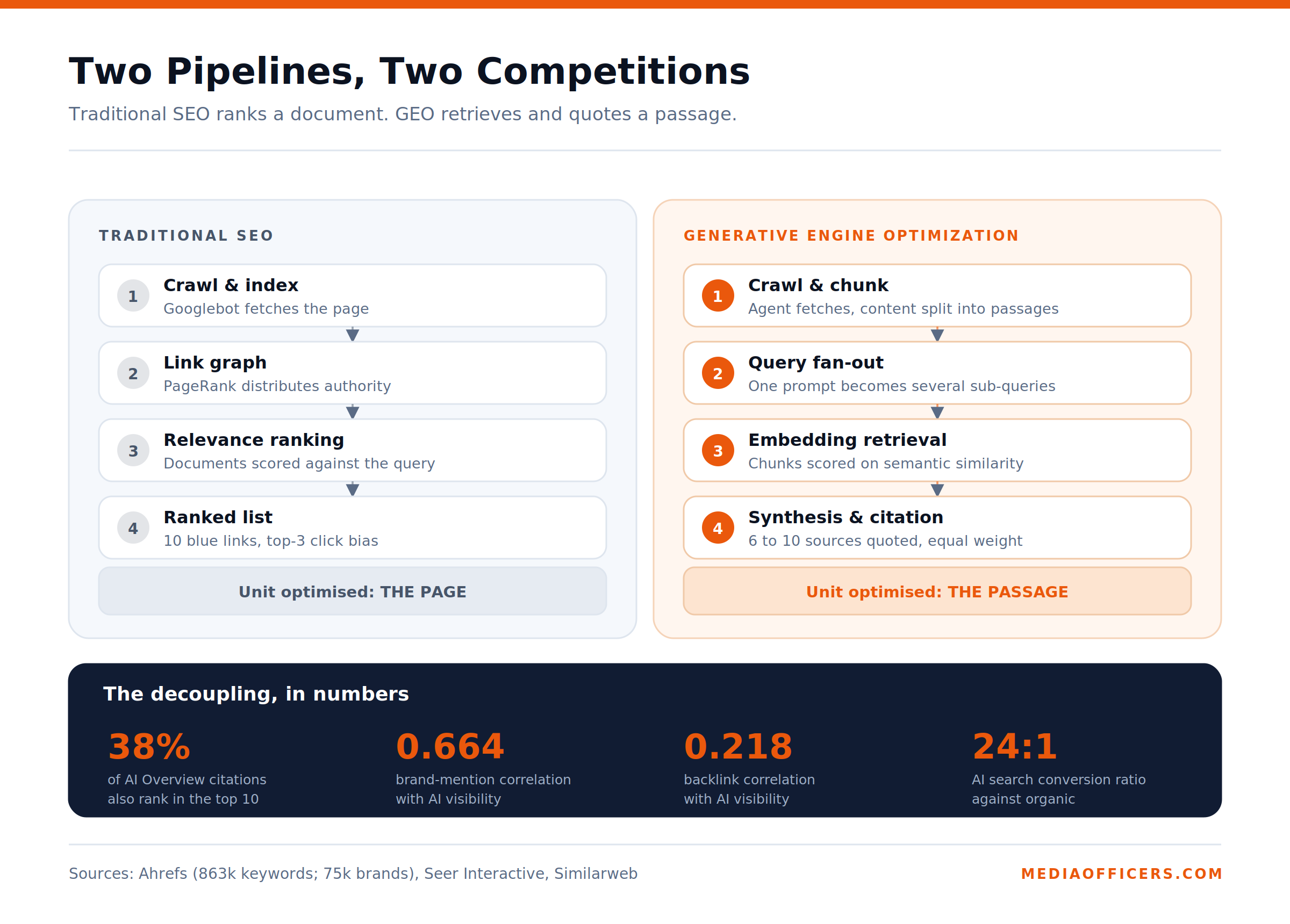
Figure 1: Two search pipelines, two competitions. Traditional SEO optimizes a page for a ranked list. GEO optimizes self-contained passages for semantic retrieval, synthesis, and LLM attribution.
What Is Generative Engine Optimization (GEO)?
Generative Engine Optimization (GEO) is the discipline of structuring content, technical crawler permissions, and entity corroboration signals so that generative AI answer engines retrieve your pages, synthesize your claims as core source material, and attribute the final answer to your brand.
Unlike classic search where the primary deliverable is an organic ranking position (e.g., Position #1), the output in GEO is a citation, a footnote, an interactive source card, or a trusted brand mention inside an AI response. All four drive significant commercial value, and the first three generate highly qualified referral traffic.
GEO vs AEO vs AI SEO: What Is the Difference?
While industry terminology frequently overlaps, understanding the operational boundaries prevents wasted resources:
GEO (Generative Engine Optimization): Optimizing content for conversational AI engines that synthesize multi-source answers with linked citations (e.g., Perplexity AI, ChatGPT Search, Google AI Overviews, Claude, Microsoft Copilot).
AEO (Answer Engine Optimization): The earlier optimization discipline focused on deterministic single-source answers like Google Featured Snippets, Knowledge Panels, and voice search results.
AI SEO: A broad, loose term that typically refers to utilizing AI tools for keyword research, copy generation, or site audits rather than optimizing for AI retrieval.
Why GEO Is Not Just "SEO with Extra Steps"
GEO represents a fundamental structural departure from traditional search engine optimization for two reasons:
The Unit of Competition: Google traditional organic search ranks complete HTML documents (pages). Generative AI engines retrieve, score, and quote individual passages or factual claims. A page can be an average document overall but contain an exceptionally clear, highly quotable 50-word answer block.
The Winner Set: A traditional SERP provides 10 organic slots with exponential click-through bias toward positions #1 through #3. An AI answer retrieves 6 to 10 citations with roughly equal visual weight and click propensity.
GEO vs Traditional SEO: Core Differences Matrix
| Dimension | Traditional SEO | Generative Engine Optimization (GEO) |
|---|---|---|
| Unit of Optimization | The entire web page / URL | The self-contained passage, data table, or factual claim |
| Core Algorithm | Link Graph (PageRank) + Keyword Inverted Index | Vector Embedding Retrieval (RAG) + LLM Cross-Attention |
| Discovery Mechanism | Sitemaps, crawl budget, internal link traversal | Live query-triggered crawling, background AI indexes |
| Primary Off-Site Signal | Hyperlinked Backlinks with anchor text | Contextual Brand Mentions & Corroborated Wikidata Entities |
| Query Input Type | Head Keywords (2 to 4 words) | Natural-language prompts with conversational constraints |
| Winner Set Distribution | 10 blue links with 60%+ CTR on Top 3 | 6 to 10 source citations with balanced click distribution |
| Freshness Weighting | Moderate (Query Dependent QDF) | Heavy (Engines strongly favour 30 - 90 day recency) |
| Primary Success Metric | Rank Position, Organic Clicks, Raw Impressions | AI Citation Share, Brand Mention Rate, High-Intent Conversions |
| Content That Wins | Comprehensive, authoritative long-form pages | Direct, extractable answer-first blocks with specific numbers |
1. PageRank vs Vector Embedding Retrieval
Traditional search engines evaluate the entire document against a keyword query using PageRank as a global authority score. In contrast, generative AI answer engines utilize Retrieval-Augmented Generation (RAG). When a user submits a prompt, the engine chunks candidate web pages into discrete text embeddings, calculates cosine similarity against the query's sub-intentions, and injects the highest-scoring chunks into the model's context window for synthesis.
As a result, authority remains a tiebreaker, but semantic precision, structure, and extractability do the heavy lifting.
2. Backlinks vs Brand Mentions
One of the most consequential findings in recent search research is the relationship between off-site signals and AI visibility. In Ahrefs' study of 75,000 brands, unlinked brand mentions correlated with AI citations at 0.664, compared to just 0.218 for traditional backlinks.
Why? Large language models develop their semantic understanding of entity authority through statistical co-occurrence in training corpora and live index text, not through HTML <a> hyperlinks. A brand named consistently in authoritative industry analysis carries immense weight for an LLM even without a direct backlink.
The 2026 Search Reality: Verified Performance Metrics
| Search Benchmark | Observed Value | Research Source |
|---|---|---|
| US consumers using AI search tools for product discovery | 35.0% vs 13.6% traditional search | Similarweb Research |
| US Google searches resulting in Zero-Clicks | ~60.0% | SparkToro / Datos |
| Top organic CTR drop when an AI Overview appears | -34.5% | Ahrefs SERP Study |
| Organic CTR increase when brand is cited inside the AI Overview | +35.0% | BrightEdge Data |
| ChatGPT-referred visitor conversion rate | 15.9% | Seer Interactive Analytics |
| Perplexity-referred visitor conversion rate | 10.5% | Seer Interactive Analytics |
| Traditional Google organic average conversion rate | 1.76% | Industry Average Benchmark |
| AI search visitor share vs share of total signups | 0.5% visitors → 12.1% signups (24:1 ratio) | Ahrefs Case Study |
The Core Takeaway: Raw informational session volume is declining across the web due to Zero-Click AI answers. However, conversion quality from AI citations is dramatically higher. A visitor clicking through an AI citation has already reviewed a synthesized comparison and has self-qualified to take action.
The Six-Layer Generative Engine Optimization Framework
To systematically optimize websites for generative AI retrieval, MediaOfficers applies a strict six-layer architecture. Each layer builds upon the previous layer - work on entity schema or digital PR is wasted if crawler access or technical structure is impaired.
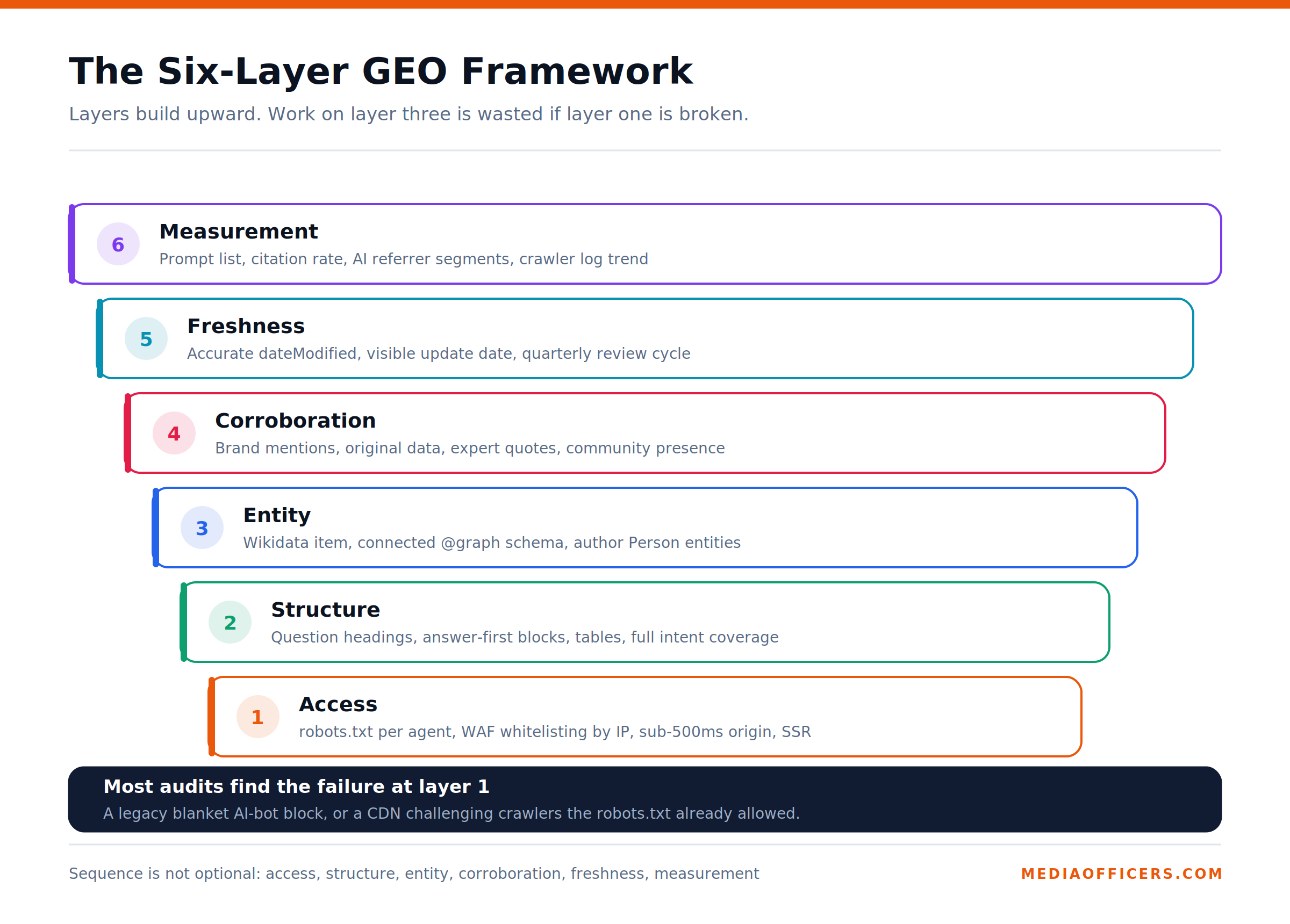
Figure 2: The Six-Layer GEO Framework. Optimization must progress sequentially from Layer 1 (Access) to Layer 6 (Measurement).
Layer 1: Technical Crawler Access & Performance
An AI engine cannot cite content it is blocked from fetching. Ensure your technical infrastructure is configured correctly:
Explicitly allow search-driven AI crawlers in
robots.txt:PerplexityBot,OAI-SearchBot,Claude-SearchBot,Applebot, andGooglebot.Whitelist AI bot user-agents and IP blocks in your Web Application Firewall (WAF) or Cloudflare security settings to prevent automated JavaScript challenge blocking.
Maintain Time to First Byte (TTFB) under 500ms and deliver complete server-side rendered (SSR) HTML, as AI retrieval engines enforce strict timeout thresholds.
Layer 2: Answer-First Content Structure
Make every heading and sub-section independently extractable for LLM context windows:
Phrase H2 and H3 headings as direct questions matching real user prompts.
Provide direct, definitive answers in the first 40 to 80 words immediately below each heading before expanding into background context.
Replace vague claims with verifiable statistics, explicit numbers, and source citations.
Structure complex comparisons in clean HTML
<table>elements and ordered lists, as comparison queries trigger AI summaries over 95% of the time.
Layer 3: Knowledge Graph Entity Authority
Transform your brand from an unindexed text string into an unambiguous entity in Google's Knowledge Graph and Wikidata:
Publish a verified Wikidata entity item connecting your founders, organization, and core service offerings.
Deploy unified JSON-LD schema using a connected
@graphthat linksOrganization,Person, andWebSitewith completesameAsauthority arrays.For comprehensive instructions, review our detailed guide to Knowledge Graph SEO & Wikidata Entity Optimization.
Layer 4: External Corroboration & Digital PR
AI models cross-verify factual claims across multiple third-party domains before synthesizing them as truth:
Execute Digital PR campaigns focused on generating contextual brand mentions in credible industry publications, trade journals, and podcasts.
Publish proprietary research studies, surveys, and benchmark data that third-party sites naturally quote.
Maintain active, authentic participation in high-weight community platforms (particularly Reddit and Quora), which AI search engines query heavily for unbiased sentiment.
Layer 5: Continuous Content Freshness
Generative search engines heavily penalize stale information. Perplexity AI and ChatGPT Search favor sources updated within the past 30 to 90 days:
Render explicit, machine-readable
datePublishedanddateModifiedtimestamps in both HTML and Article schema.Conduct quarterly substantive refreshes on core informational pillar guides, updating benchmark figures, tool screenshots, and methodology steps.
Layer 6: AI Citation & Share of Voice Measurement
Track GEO performance using purpose-built AI visibility metrics rather than outdated keyword rank trackers:
Configure Google Analytics 4 (GA4) referral segments to monitor traffic from
chatgpt.com,perplexity.ai,claude.ai, andgemini.google.com.Maintain a fixed monthly prompt battery (30 to 60 target buyer prompts) to track your brand's AI Citation Share against direct competitors.
Monitor server access logs to track crawl frequency spikes across
OAI-SearchBotandPerplexityBotas leading indicators of content indexing.
Engine-Specific Optimization Blueprints
Because each AI search engine uses distinct crawler technology, retrieval thresholds, and citation layouts, explore our dedicated implementation guides:
Perplexity AI: Master Reddit sentiment, multi-source chunking, and live web research in our Perplexity SEO Optimization Guide.
ChatGPT Search (SearchGPT): Optimize for OAI-SearchBot and high-authority entity recognition in our ChatGPT Search SEO Blueprint.
Google AI Overviews: Win query fan-out placement and comparison summaries in our Google AI Overviews Optimization Checklist.
Knowledge Graph SEO: Build Google entity authority with Wikidata and Schema in our Knowledge Graph & Wikidata SEO Guide.
Frequently Asked Questions
Is Generative Engine Optimization replacing traditional SEO?
No. GEO builds directly on top of technical SEO fundamentals including fast server response times, clean crawlability, valid canonicals, and genuine subject-matter expertise. What is shifting is the traffic distribution: informational click volume on traditional search is dropping due to zero-click answers, while traffic originating from AI answer citations converts at significantly higher rates.
What is the difference between GEO and traditional SEO in one sentence?
Traditional SEO competes to rank a complete web page in a list of organic blue links, whereas Generative Engine Optimization competes to have specific, factual passages retrieved, synthesized, and cited inside AI-generated answers.
Do backlinks still matter for AI search optimization?
Yes, but their relative importance has changed. Brand mentions correlate with AI search visibility roughly three times more strongly than backlinks (0.664 vs 0.218). Backlinks still support the foundational domain authority that enables discovery, but contextual brand mentions and corroborated entity data drive AI retrieval synthesis.
How long does Generative Engine Optimization take to show results?
Fixing technical crawler access issues in robots.txt and WAF settings can yield indexation results within 1 to 2 weeks. Content restructuring for answer-first extraction typically impacts Perplexity AI citations in 2 to 4 weeks, while building entity recognition for ChatGPT Search and Google AI Overviews takes 1 to 2 quarters.
Which AI answer engine should businesses optimize for first?
For most businesses, Perplexity AI provides the fastest measurable return. Perplexity cites an average of 8.2 sources per answer, heavily weights 30-day content freshness, and awards roughly 13% of its citations to brand domains. ChatGPT Search is more citation-selective (averaging 2.4 citations per answer) and requires deeper entity authority.
How can businesses measure GEO performance without dedicated software?
Combine three core data sources: (1) GA4 traffic referral segments filtered for chatgpt.com, perplexity.ai, and claude.ai; (2) A monthly manual testing battery of 30 to 50 commercial buyer prompts logging your citation presence against competitors; and (3) Server log analysis tracking crawler hit frequency from OAI-SearchBot and PerplexityBot.
Does Generative Engine Optimization work for local and small businesses?
Yes. Local and niche business queries often experience rapid GEO gains because generic community forums (like Reddit) have limited hyper-local data. Establishing a verified Google Business Profile, consistent NAP citations, local schema markup, and a Wikidata entity gives AI engines the definitive corroboration needed to recommend your business.
Audit Your Website for Generative AI & Google Search
Discover how your website performs across crawler access, passage extractability, entity schema, and AI search readiness with our free instant diagnostic tool.
Run Free Technical Readiness Audit →Generate Audit ChecklistFor copy-paste robots.txt rules and Cloudflare WAF configuration for every major AI crawler, see our complete AI Crawler Optimization Guide.

Written by
Rudhrah KeshavCo-Founder & Chief Revenue Officer (CRO)
Rudhrah Keshav is the Co-Founder & CRO at MediaOfficers. 16+ years SEO architect, published author of "AI Marketing for Indian Businesses" and "Local SEO" (Google Books / Amazon), featured in Yahoo Finance.


