
Perplexity SEO is the practice of structuring your content, technical setup and off-site footprint so that Perplexity's answer engine cites your pages as a source. It is not about ranking at position one. Perplexity averages roughly 8.2 cited sources per answer, and the pages it picks are the ones it can crawl quickly, parse cleanly and quote safely. Through our specialized generative engine optimization services, we structure technical documentation and commercial guides specifically to earn prominent citation footnotes in Perplexity threads.
That difference matters more than most teams realise. A page can sit at position three on Google and never get cited by Perplexity, while a lesser-known page with a tighter answer block gets pulled into the response instead. We see this pattern constantly in audits, and it almost always traces back to three things: crawl access, content structure and freshness signals.
This guide covers what actually moves the needle, based on how Perplexity's retrieval pipeline works in 2026.
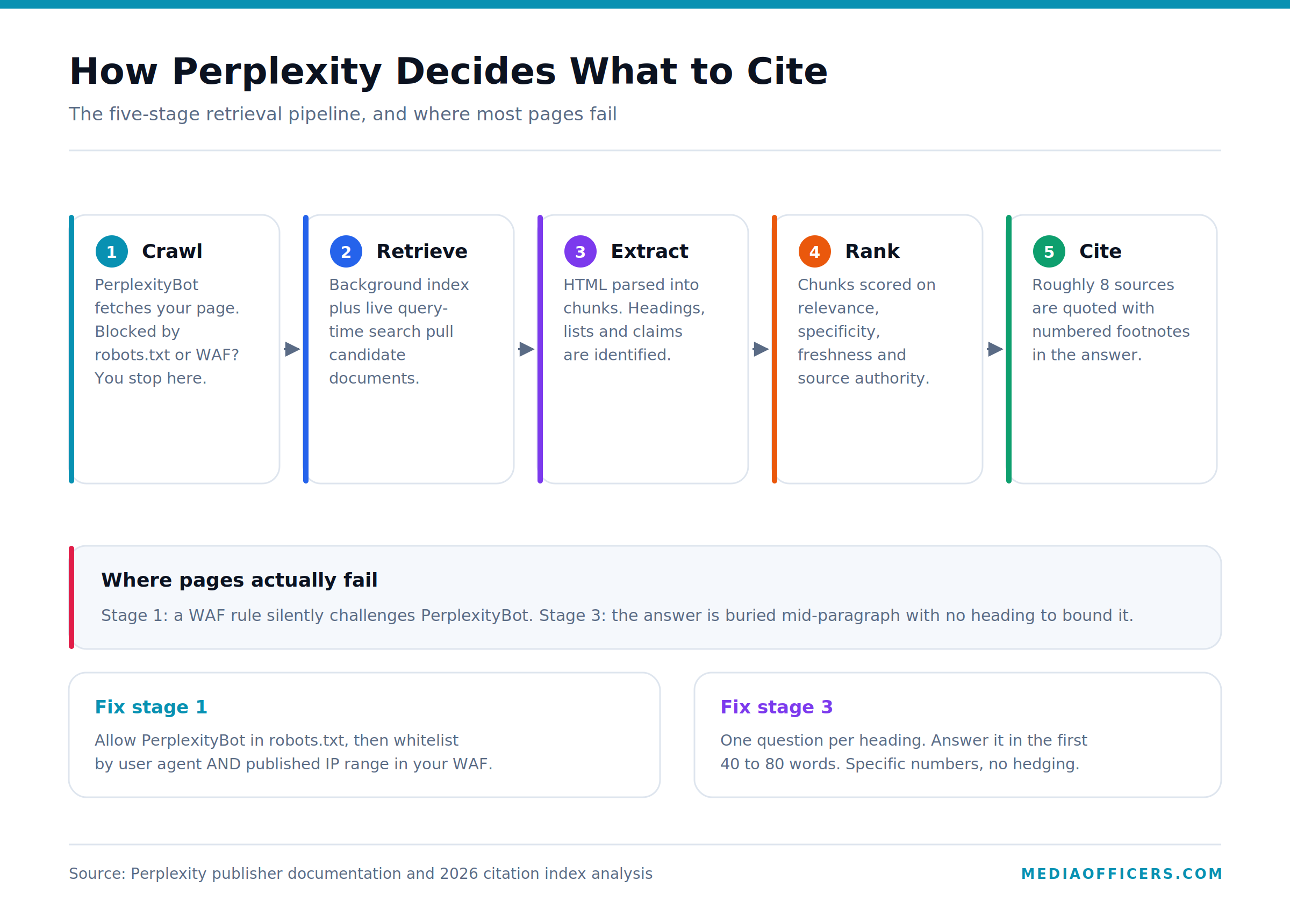 Perplexity's five-stage retrieval pipeline. Most pages fail at stage one (crawl access) or stage three (extraction), long before ranking is ever considered.
What Perplexity SEO Actually Means in 2026
Perplexity is a citation engine, not a ranking engine
Google returns a list. Perplexity returns a paragraph with numbered footnotes. Those footnotes are the real estate you are competing for, and they behave differently from blue links.
In a ten-result SERP, positions one through three take the bulk of clicks. In a Perplexity answer, all eight or so citations sit at roughly equal visual weight, and users click the ones that look most relevant to the specific sentence they just read. This has two practical consequences:
Being cited at all is the win: There is no meaningful "position two" penalty in conversational search.
Being cited for a specific claim matters more than being cited for a topic: If your page owns the definitive number, the definition or the step-by-step, you get pulled in repeatedly across multiple user prompts.
How Perplexity SEO differs from Google SEO
Understanding the structural differences between traditional Google organic search and Perplexity AI retrieval helps you tailor your content architecture effectively:
| Factor | Google Organic | Perplexity |
|---|---|---|
| Unit of competition | The whole page URL | The passage, table, or specific claim |
| Discovery | Sitemap plus link graph | Query-triggered crawl plus background index |
| Freshness weighting | Moderate, query dependent | Heavy, especially for temporal queries |
| Winner count | 10 blue links | 6 to 10 citations per answer |
| Biggest structural lever | Title tags and internal links | Extractable answer blocks and HTML tables |
| Social weight | Indirect | Very direct (Reddit is ~20% of citations) |
The overlap is real but partial. Solid technical SEO gets you into the running. Extractability decides whether you get quoted.
Where this sits in a wider GEO programme
Perplexity is one surface inside Generative Engine Optimization. If you are just starting, read our comprehensive Generative Engine Optimization (GEO) overview first, then come back here. For a cross-engine view of Perplexity, Grok and Gemini together, explore our GEO multi-engine optimization guide.
How Perplexity's Citation Engine Works
The hybrid index: own crawler plus live retrieval
Perplexity does not simply rent Google's index. It runs a hybrid model: a background index built by its own crawler for fast retrieval, combined with real-time web search for every query, supplemented by partner search APIs.
The practical read on this is that you have two paths into a Perplexity answer. The first is being in the background index already, which is the durable path. The second is being surfaced live at query time, which is the volatile path. Pages that are fast, indexable and topically clear tend to earn both.
Query-driven crawling and your publishing schedule
PerplexityBot crawls in response to demand. A significant share of its activity is triggered by what users are actually asking. High-authority domains that publish frequently get crawled daily or more often. Smaller sites may see PerplexityBot weekly or less.
If your site is in that second bucket, publishing cadence is a crawl lever, not just a content lever. Sites that ship two or three genuinely useful pages a month get sampled far more often than sites that publish in quarterly bursts.
How Perplexity reads a page
The extraction stage is where most optimisation actually happens. Perplexity parses the HTML, identifies factual claims, statistics and quotes, evaluates document structure through headings and lists, and assesses freshness from metadata.
Two things follow from that. First, semantic HTML is not a nice-to-have. If your headings are styled divs, your structure is invisible. Second, a claim buried mid-paragraph inside a 200-word block is far harder to quote than the same claim stated in a single sentence under a descriptive H3.
Which Sources Perplexity Cites Most
Perplexity's citation profile is unusually concentrated. Understanding the shape of it tells you where a brand site realistically fits.
| Rank | Domain | Notes & Category |
|---|---|---|
| 1 | Roughly 20% to 24% of all citations (community experience & reviews) | |
| 2 | Wikipedia | Definitional and entity knowledge anchor |
| 3 | YouTube | Video, teardowns, and tutorial queries |
| 4 | Company pages weighted over personal member posts | |
| 5 - 10 | Reuters, NYT, Bloomberg, WaPo, BBC, Guardian | Tier-1 News, financial analysis, and investigative reporting |
Social platforms together account for around 31% of Perplexity citations, with Reddit doing most of the heavy lifting. That is the highest single-domain concentration on any AI engine.
The Reddit reality
This scares a lot of marketing teams, and it should not. Reddit dominates opinion and experience queries: "is X worth it", "what do people actually think of Y", "best Z for a small team". It does not dominate technical definitions, process guides, pricing breakdowns, compliance detail or original data. Those are the query types where a well-built brand page wins.
So the strategy is not to beat Reddit. It is to pick the query clusters where Reddit is a weak answer and own those completely.
Where a brand site fits
Brand citation rate on Perplexity sits around 13% versus well under 1% on ChatGPT (read our in-depth ChatGPT Search SEO guide for OpenAI crawler rules), which means Perplexity is comparatively generous to non-media domains. It is the single best AI surface for a services or SaaS brand to earn visible citations. That is worth prioritising accordingly.
Technical Setup: Getting PerplexityBot to See You
robots.txt directives
Perplexity operates two agents you need to know about:
PerplexityBot: Surfaces and links websites in Perplexity search results. It is not used for model training. This is the one that builds your index presence.
Perplexity-User: Visits pages when a user's question requires a live fetch. Because the request is user-initiated, it generally ignores robots.txt.
User-agent: PerplexityBot
Allow: /
User-agent: Perplexity-User
Allow: /
Do not leave this to inference. Many sites inherited a blanket AI-bot block during the 2024 scraping panic and never revisited it. Check your live robots.txt before you do anything else in this guide.
The WAF problem nobody checks
This is the single most common blocker we find. Your robots.txt says allow, but Cloudflare, Akamai or your WAF is challenging or dropping the request before it reaches your server. Bot-management rulesets frequently classify PerplexityBot as an unverified crawler by default.
Fix it by whitelisting on both user agent and IP. Perplexity publishes its ranges at perplexity.com/perplexitybot.json and perplexity.com/perplexity-user.json. Combine the two checks so you are not exposed to spoofing. If you want this checked across all AI crawlers at once, run our free AI SEO and GEO audit.
Speed and rendering
Target a server response under 500ms. Perplexity's retrieval is time-boxed, and a slow origin gets dropped rather than waited on.
Client-side rendered content is a serious liability here. If your key answer text only appears after a JavaScript bundle executes, assume Perplexity may never see it. Server-side render or statically generate anything you want quoted.
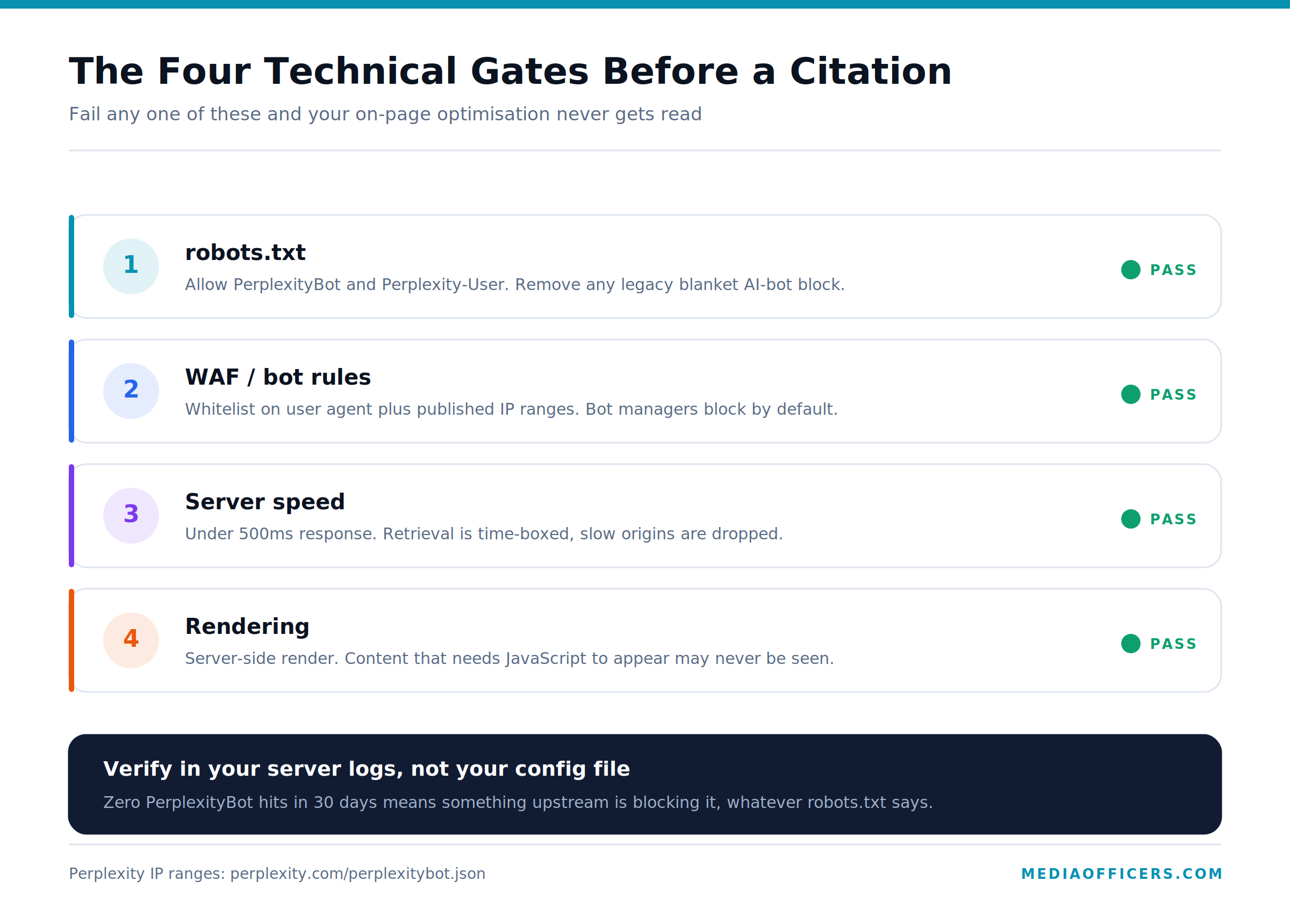 The four technical gates every page passes before Perplexity can cite it. A failure at any one gate makes the on-page work irrelevant.
On-Page Optimization for Perplexity Citations
Lead with the answer
Answer the query inside the first 5 to 10 lines. Not context, not a preamble about how the industry has changed, the actual answer.
The reason is mechanical. When Perplexity chunks your page, the opening block is the chunk most strongly associated with your title and H1. If that block is throat-clearing, you have wasted your best asset.
Write extractable blocks
An extractable block is 40 to 80 words that stands alone as a complete answer to one question, sitting directly under a heading that phrases that question. It needs no surrounding context to make sense.
One question per H2 or H3, phrased the way a user would ask it.
A direct answer immediately below the heading.
Supporting detail, examples and caveats after the answer, not before.
Specific numbers rather than vague quantifiers ("under 500ms", not "fast").
Freshness signals
Perplexity weights freshness heavily, especially on temporally sensitive queries, and prioritises content published or updated in the last 30 to 90 days. Make the signal unambiguous:
Publish
datePublishedanddateModifiedin your Article schema.Show a visible "Last updated" date in the page template.
Only bump the date when you have made a substantive change, not on cosmetic edits.
Schema Markup That Helps
Structured data improves discoverability meaningfully. Prioritise in this order:
Article: with
headline,author,datePublished,dateModifiedFAQPage: for your question sections, matched exactly to visible text
Organization: with
sameAspointing to verified profilesPerson: for author bio pages with credential attribution
For deeper implementation, see our guide to advanced JSON-LD schema for the Google Knowledge Graph.
A 30-Day Perplexity SEO Action Plan
| Week | Focus | Deliverable |
|---|---|---|
| Week 1 | Access | Audit robots.txt and WAF, whitelist PerplexityBot by agent and IP, verify in server logs. |
| Week 2 | Baseline | Build the 40-prompt tracking list, run it, record current baseline citation rate. |
| Week 3 | Structure | Rewrite top 10 pages: answer-first openings, question headings, extractable blocks, tables. |
| Week 4 | Signals | Add Article and FAQ schema, author bios with Person markup, visible update dates. |
Frequently Asked Questions
How long does it take to get cited by Perplexity?
Faster than Google rankings. Because a share of crawling is query-triggered and freshness is weighted heavily, structural changes on an already-indexed page can show up in citations within two to four weeks. New domains take longer, since they need to earn a place in the background index first.
Does Perplexity use Google's rankings?
Partly. It combines its own crawler-built index with live retrieval and partner search APIs. Google visibility helps but does not guarantee citation, and plenty of cited pages do not rank in Google's top 10 for the same query.
Should I block PerplexityBot to protect my content?
Only if you have decided you do not want Perplexity traffic at all. PerplexityBot is used for search and linking, not model training. Blocking it removes you from citations without protecting you from anything meaningful.
How many sources does Perplexity cite per answer?
Around 8.2 on average, which is roughly 3.4 times ChatGPT's citation density. That makes it the most citation-heavy mainstream AI engine and the most realistic one to target for business and service brands.
What is the difference between Perplexity SEO and GEO?
Perplexity SEO is engine-specific. GEO (Generative Engine Optimization) is the umbrella practice covering Perplexity, ChatGPT Search, Google AI Overviews, Gemini and Grok together. Most of the work overlaps, but each engine has its own crawler rules and citation behaviour.
Evaluate Your AI Search Citation Readiness
Want to know how your site performs across Perplexity, ChatGPT Search and Google AI Overviews (read our Google AI Overviews SEO checklist) right now? Read our companion guide on winning generative engine citations.
Free AI SEO & GEO Audit →How to Get Cited by ChatGPT & Perplexity
Written by
Rudhrah KeshavCo-Founder & Chief Revenue Officer (CRO)
Rudhrah Keshav is the Co-Founder & CRO at MediaOfficers. 16+ years SEO architect, published author of "AI Marketing for Indian Businesses" and "Local SEO" (Google Books / Amazon), featured in Yahoo Finance.


