
Ask most marketers about search engine optimization and they will talk about Google - and only Google. That made sense a decade ago. It is a costly blind spot in 2026. While your competitors pour every hour into fighting for Google rankings, an entire second ecosystem of search traffic sits comparatively uncontested: Microsoft Bing.
This is the first article in the mediaofficers Bing SEO series. Over ten in-depth guides, we will take you from understanding why Bing deserves a place in your strategy to mastering Bing Webmaster Tools, IndexNow, keyword research, local SEO with Bing Places, and ranking inside Bing's AI-powered Copilot answers. Today we start with the foundation: what Bing SEO is, why it matters right now, and exactly how it differs from Google SEO.
Key Takeaways
- Bing is the #2 search engine worldwide, with 100M+ daily active users and around 1.2 billion searches per day.
- Microsoft's overall market share is about 5%, but on desktop it exceeds 10% - critical for B2B, professional, and older, higher-income audiences.
- Bing SEO favors exact-match keywords, quality backlinks from established domains, social signals, and multimedia-rich pages.
- IndexNow lets Bing index your new or updated content within minutes instead of days.
- Microsoft powers Copilot and ChatGPT search - optimizing for Bing is now the fastest route into AI-generated answers (GEO).
What Is This Search Service?
Bing SEO is the process of improving your website's visibility in Microsoft Bing's organic search results. It covers the same broad disciplines as Google SEO - content quality, on-page optimization, technical health, and authority building - but the weighting of those signals is different, because Bing's algorithm is different.
Bing is owned by Microsoft and is deeply integrated into the Windows ecosystem. It is the default search engine for the Edge browser, the Windows taskbar and Start menu, Cortana, and Microsoft Office. Beyond its own results pages, Bing's index also feeds Yahoo, DuckDuckGo (in part), AOL, and - most importantly for the years ahead - Microsoft Copilot and ChatGPT's built-in web search. When you optimize for Bing, you are optimizing for an entire network of search surfaces at once.
Why This Search Engine Matters in 2026
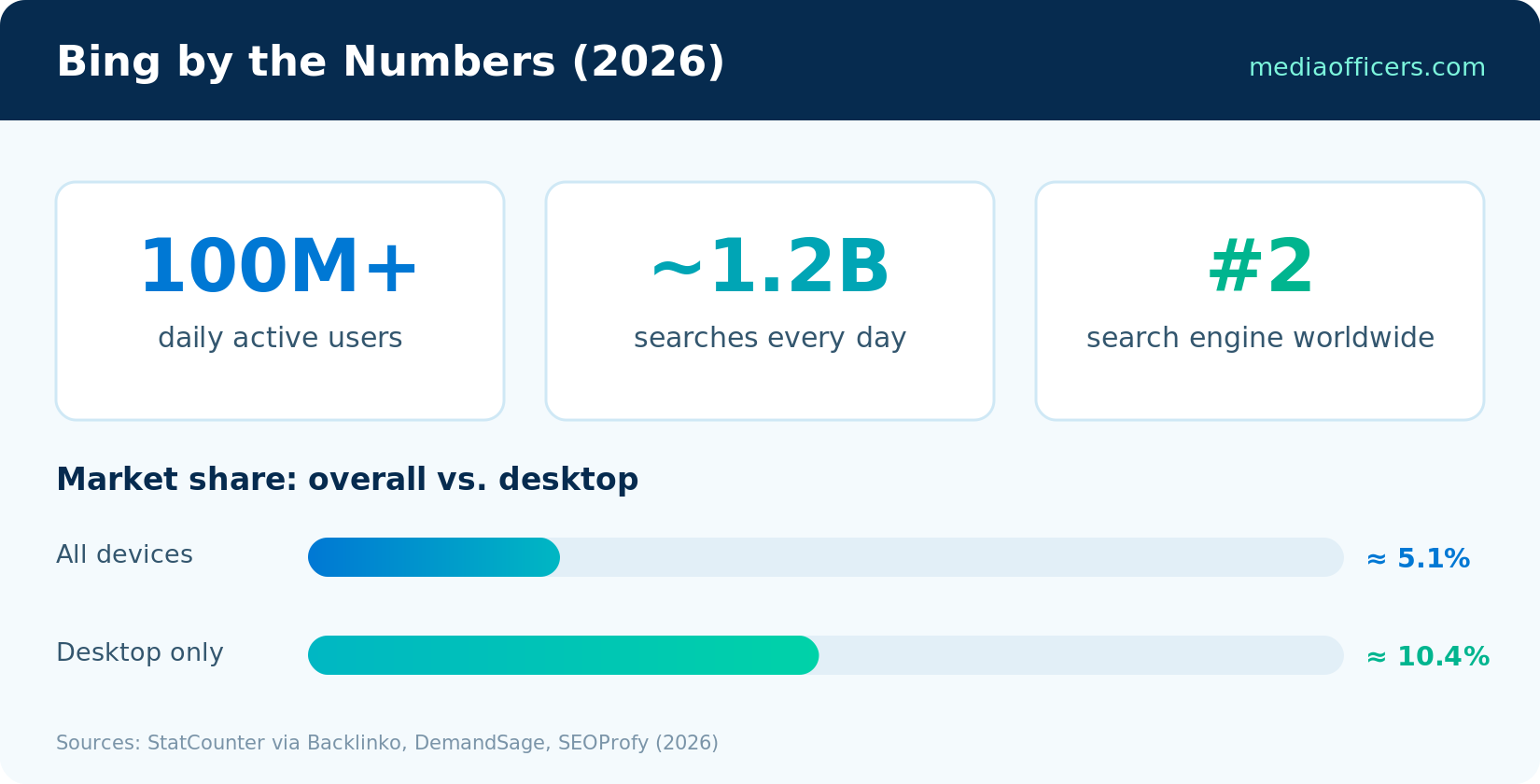
Bing by the numbers in 2026: users, search volume, and market share
The headline numbers understate Bing's real value. Yes, Bing's overall global market share sits around 5.1% against Google's roughly 90% (StatCounter, 2026). But averages hide where Bing is actually strong:
- Desktop dominance. The platform holds roughly 10.4% of the global desktop search market. If your audience searches from an office computer - B2B buyers, finance, legal, healthcare administration, government - Bing's share of your traffic can be two to four times the global average.
- A valuable demographic. Its users skew slightly older, are more likely to be desktop-based professionals, and repeatedly show higher average purchase intent in Microsoft Advertising's own retail data.
- Massive absolute volume. Around 1.2 billion searches happen on Bing every day. Even a small slice of a billion-search pie is meaningful traffic.
- Lower competition. Most sites never submit a sitemap to Bing, never verify with Bing Webmaster Tools, and never optimize a single page for Bing's preferences. Ranking on page one of Bing is simply easier than on Google for most keywords.
- The AI multiplier. Bing's index grounds Microsoft Copilot answers and ChatGPT's live web search. Content that ranks in Bing gets cited in AI answers - a traffic source Gartner projects will absorb a significant share of discovery as classic organic clicks decline.
Bing SEO vs. Google SEO: The 5 Differences That Matter
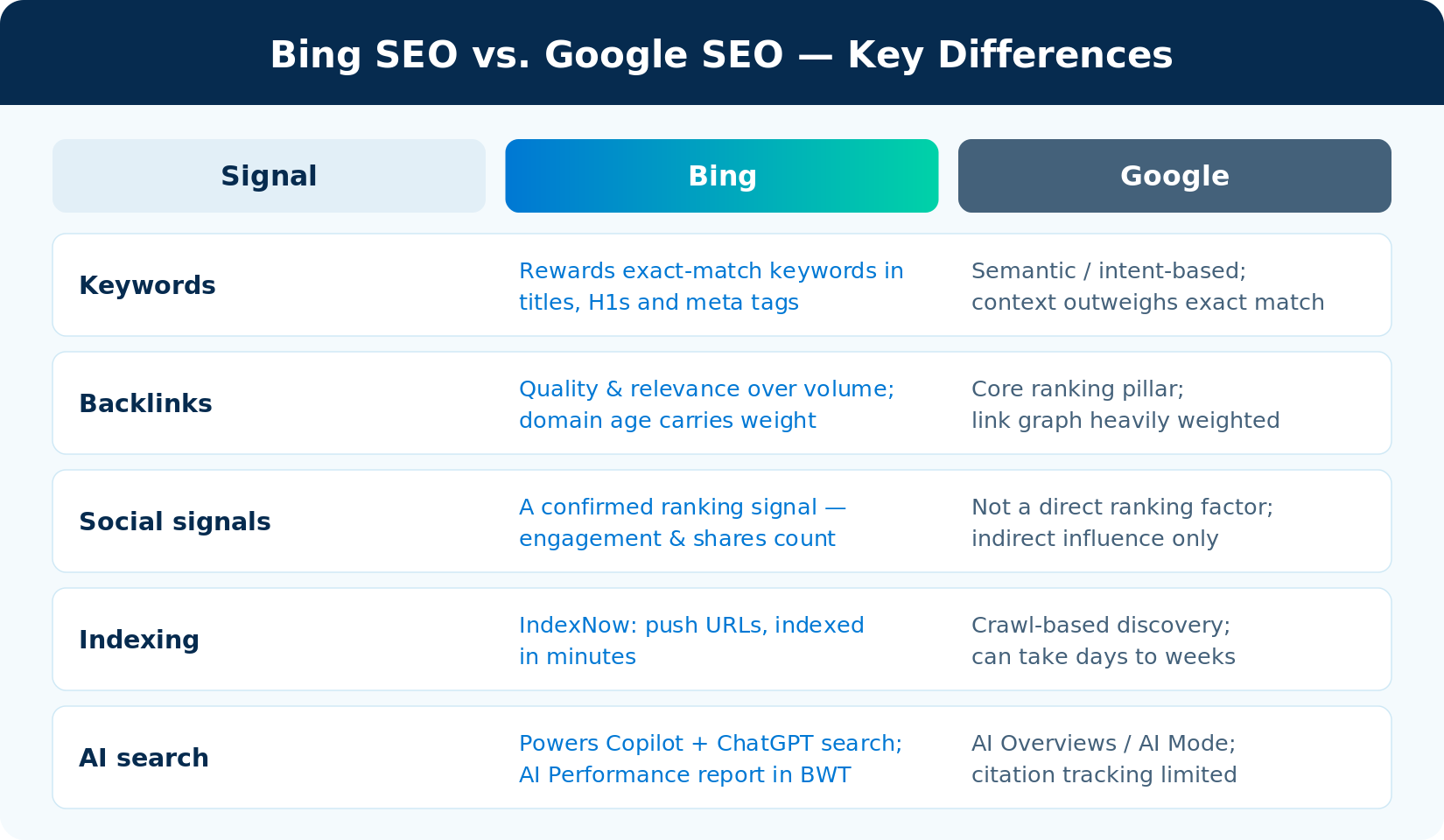
Bing SEO vs. Google SEO - the five differences that change how you optimize
1. Keywords: exact match still wins on Bing
Google has spent a decade teaching SEOs that semantic relevance beats keyword placement - its algorithm understands synonyms, context, and intent. Bing is more literal. Pages with the exact target keyword in the title tag, H1, meta description, and URL consistently outperform semantically similar pages on Bing. This does not mean keyword stuffing; it means being precise. If you want to rank for “Bing SEO checklist,” your title should say “Bing SEO checklist,” not “optimizing for Microsoft's search platform.”
2. Backlinks: quality and age over quantity
Both engines value links, but differently. Google's link graph rewards large volumes of diverse, editorially earned links. Bing puts more weight on the authority, relevance, and age of the linking domain. A handful of links from established, topically relevant sites - especially .edu, .gov, and long-standing industry domains - moves the needle more on Bing than dozens of links from young websites.
3. Social signals: Bing actually counts them
This is the sharpest philosophical split. Google has repeatedly stated that social media engagement is not a direct ranking factor. Bing says the opposite: its webmaster guidelines have long acknowledged that social signals - shares, engagement, and the visibility of your brand across social platforms - factor into rankings. If your content earns real engagement on LinkedIn, X, or Facebook, Bing notices.
4. Indexing: IndexNow changes the speed game
Google discovers content by crawling, which can take days or weeks for smaller sites. Bing pioneered IndexNow, an open protocol that lets your site push URLs to Bing the moment content is published, updated, or deleted - with indexing often completed in minutes. For news, e-commerce inventory, and frequently updated content, this is a structural advantage no Google workflow can match. We cover IndexNow setup step by step in Bing Sitemaps & IndexNow guide of this series.
5. AI search: Bing gives you measurable GEO
In February 2026, Microsoft launched the AI Performance report in Bing Webmaster Tools - the first tool from a major search engine that shows how often your pages are cited in AI-generated answers across Copilot and Bing's AI summaries. Google offers nothing comparable for AI Overviews. For anyone practicing Generative Engine Optimization (GEO), Bing is currently the only ecosystem where you can actually measure your AI citation footprint.
The 6 Ranking Factors Bing Cares About Most
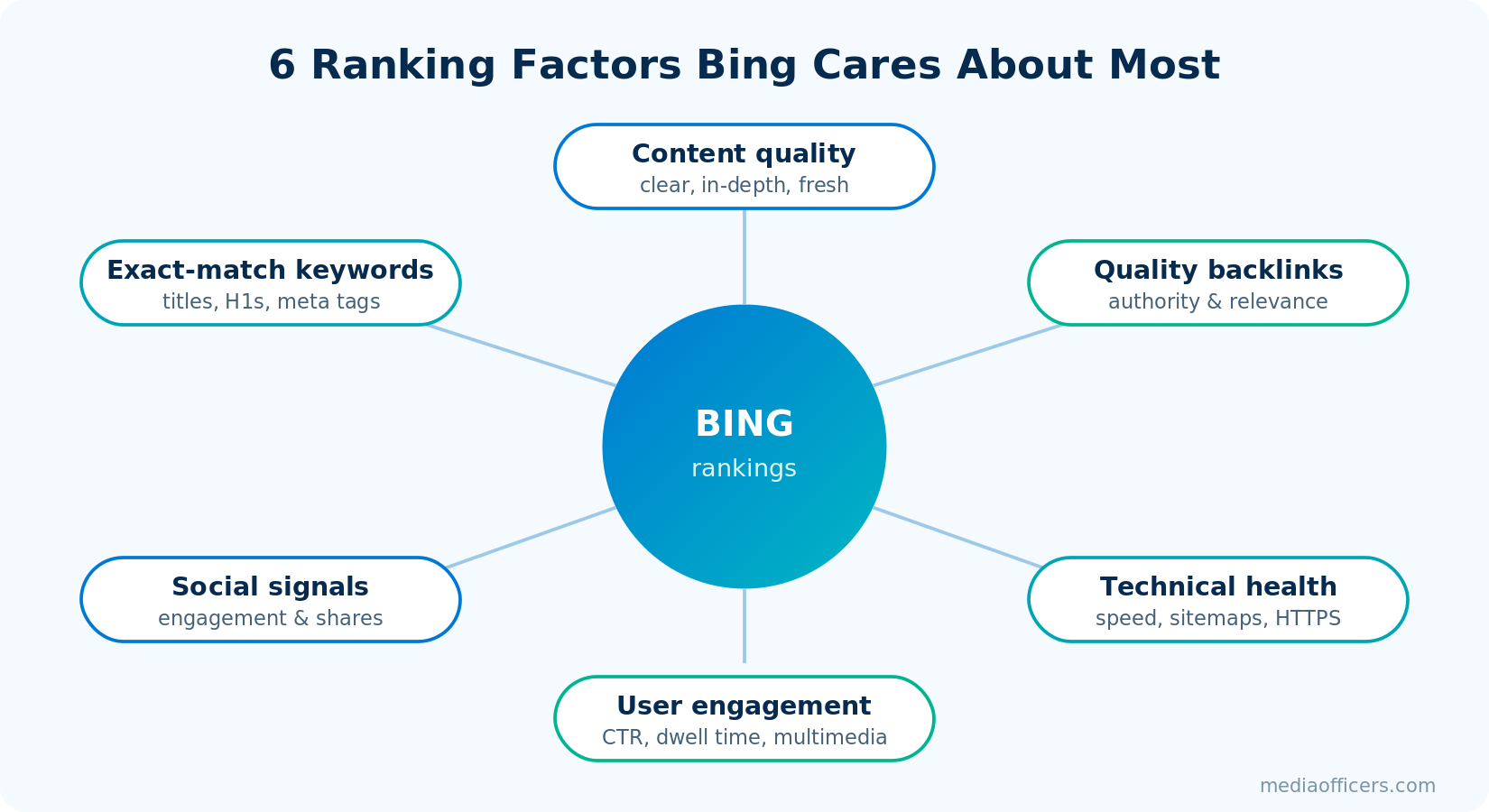
The six ranking factors that drive Bing search results in 2026
Synthesizing Bing's official webmaster guidelines and current industry testing, six factors consistently drive Bing rankings in 2026:
- Content quality and freshness. Bing evaluates clarity, depth, and how recently a page was updated. Thin or stale pages fade fast.
- Exact-match on-page optimization. Target keyword in the title tag, H1, meta description, first 100 words, and URL.
- Authoritative backlinks. Relevance and domain trust beat raw volume; older domains carry extra weight.
- Social signals. Genuine engagement across social platforms supports rankings.
- Technical health. Fast load times, clean sitemaps, HTTPS, mobile-friendliness, and crawlable architecture. Bing relies on your sitemap more than Google does.
- User engagement and multimedia. Click-through rate, dwell time, and rich media matter - Bing openly rewards pages with relevant images and video.
How to Get Started With Bing SEO Today
You do not need a separate website or a separate content strategy - you need a short list of deliberate adjustments:
- Verify your site in Bing Webmaster Tools and import your Google Search Console data in one click (full walkthrough in Bing Webmaster Tools Setup Guide).
- Submit your XML sitemap directly to the portal and enable IndexNow (Bing Sitemaps & IndexNow guide).
- Audit your top 20 pages for exact-match titles, H1s, and meta descriptions.
- Strengthen your social presence - it counts here.
- Run Bing's built-in SEO Reports and Site Scan to catch technical issues (Bing Webmaster Tools Reports guide).
Each of these steps gets a dedicated deep-dive later in this series, so you can implement as you read.
Frequently Asked Questions
Is Bing SEO worth it in 2026?
Yes - especially for desktop-heavy, B2B, and older demographics. Bing serves over 100 million daily active users and 1.2 billion daily searches, with far less ranking competition than Google. Because Bing also powers Copilot and ChatGPT search, Bing SEO now doubles as AI search optimization.
Does ranking on Google help me rank on Bing?
Partially. Good content, clean technical SEO, and quality backlinks help everywhere. But Bing weights exact-match keywords, social signals, and domain age differently, so pages that dominate Google can underperform on Bing until they are tuned for it.
What is the Bing equivalent of Google Search Console?
Bing Webmaster Tools. It is free, imports your sites straight from Google Search Console, and includes keyword research, SEO audits, URL inspection, IndexNow, and the new AI Performance report.
How long does it take to rank on Bing?
Typically faster than Google. With IndexNow, new pages can be indexed within minutes, and lower keyword competition means well-optimized pages often reach page one in weeks rather than months.
Does Bing SEO help with ChatGPT and Copilot visibility?
Yes. ChatGPT's web search and Microsoft Copilot both ground their answers in Bing's index. Pages that rank well on Bing are significantly more likely to be cited in those AI answers - and Bing Webmaster Tools now lets you track exactly how often that happens.
What's Next in the Series
In Bing Webmaster Tools Setup Guide, we set up Bing Webmaster Tools from scratch: verification methods, one-click import from Google Search Console, and a tour of every report you will use for the rest of this series. Subscribe or bookmark mediaofficers so you don't miss it.
💡 Related Reading: Keep pace with modern search algorithms by applying these 7 AI Search SEO Shifts for 2026.
💡 Related Reading: For community engagement strategies, read our Reddit SEO Guide 2026.
For keyword volume research specifically tailored to Bing search traffic, explore our complete guide on Bing Keyword Research: Free Tool With Exact Volumes.
💡 Related Reading: Bing weighs these six factors. Google weighs a different set. Here is the full comparison across Google, Bing, and AI engines in our guide to the most important ranking factors in 2026.

Written by
Rudhrah KeshavCo-Founder & Chief Revenue Officer (CRO)
Rudhrah Keshav is the Co-Founder & CRO at MediaOfficers. 16+ years SEO architect, published author of "AI Marketing for Indian Businesses" and "Local SEO" (Google Books / Amazon), featured in Yahoo Finance.


