
Quick answer: In 2026, AI assistants — Google AI Overviews, Microsoft Copilot, ChatGPT and Perplexity — answer a growing share of questions directly, and Gartner projects classic organic traffic will fall by roughly 25% as a result. But AI answers cite only 2–5 sources each, so the sites that adapt capture more visibility, not less. The winning playbook combines classic SEO with Generative Engine Optimization (GEO): quotable answers, cited statistics, structured data, freshness, and coverage of both Google's and Bing's indexes.
For twenty years, SEO had one deal: rank in the top ten blue links and collect clicks. That deal is being renegotiated in real time. Search engines now answer questions themselves, assistants summarize the web before users ever see it, and the "results page" is increasingly a conversation. At MediaOfficers we've spent this year optimizing sites for both sides of that shift — here are the seven changes that actually matter, and what to do about each one.
1. The click is no longer the default outcome
The biggest mental shift first. When an AI answer resolves a query, no click happens — and that's now normal for informational searches. Gartner's projection of a 25% decline in organic search traffic isn't a doomsday call; it's a redistribution. Visibility is moving from "position on a results page" to "presence inside an answer." Sites that measure only sessions will feel like they're losing; sites that track citations and brand mentions inside AI answers will see where the attention actually went.
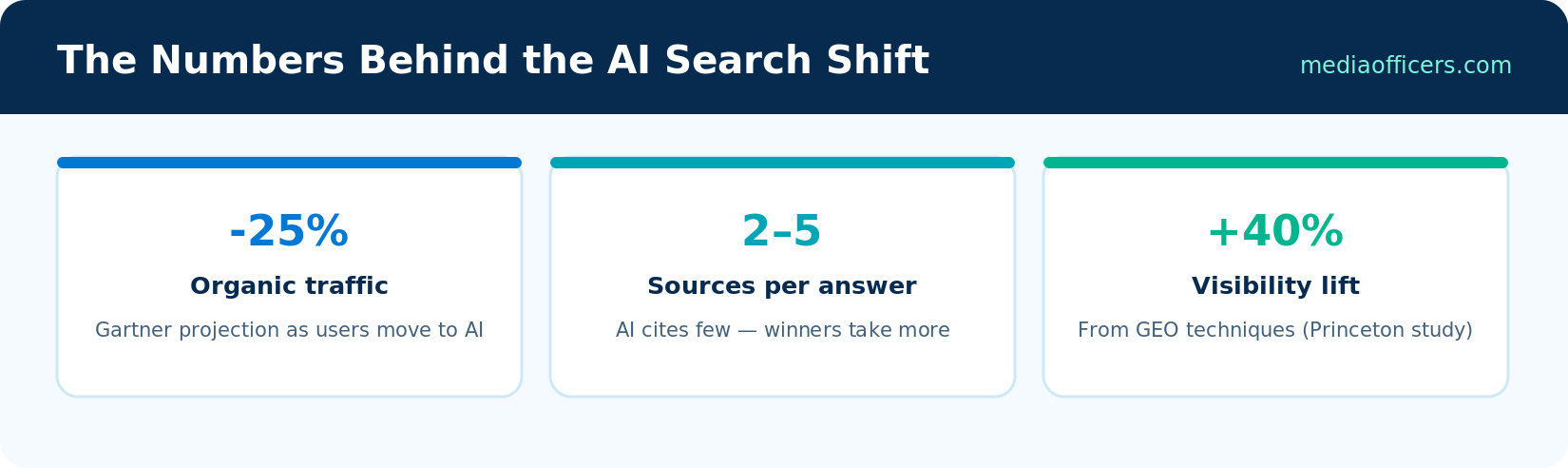
The three numbers that define the AI search shift
2. AI answers cite few sources and that's an opportunity
A classic results page splits attention ten ways. An AI answer typically cites two to five sources. The math is brutal for the average site and generous for the cited one: being referenced means capturing a much larger share of a smaller click pool, plus something blue links never gave you — your brand name spoken inside the answer itself. Early movers in every niche are locking in these citation positions now, while most competitors are still optimizing for a results page that fewer people scroll.
3. GEO is now a discipline with evidence behind it
Generative Engine Optimization stopped being a buzzword when researchers from Princeton, Georgia Tech and IIT Delhi tested nine optimization techniques across thousands of AI queries. The winners were unglamorous: adding statistics, citing sources, and including expert quotations — each lifting a page's visibility in AI answers by 30–40%. AI models cite content that gives them concrete, attributable fragments. A page of vague prose gives a model nothing to quote; a page with numbers, named sources and clear claims practically cites itself.
4. Structure is a ranking factor for machines that read
AI engines extract passages, and extraction rewards structure: a direct 40–60 word answer at the top of the page, H2s phrased as real questions, tables for comparisons, lists for processes, and FAQ / Article schema in the page head. Structured markup consistently ranks among the strongest predictors of whether a page gets cited. If your CMS still publishes walls of unstructured text, that's the single highest-leverage fix available this quarter.
5. There are now two indexes that matter
Google still dominates classic search — but Microsoft Copilot and ChatGPT's web search both ground their answers in Bing's index. That means a site invisible to Bing is invisible to two of the fastest-growing AI surfaces in the world, regardless of its Google rankings. Verifying in Bing Webmaster Tools takes minutes (it imports straight from Google Search Console), and Bing's IndexNow protocol indexes new content in minutes instead of weeks. We've published a complete 10-part playbook on this, starting with why Bing SEO suddenly matters and ending with how to rank inside Copilot's answers.
6. Freshness compounds harder than ever
AI engines weight recency aggressively — a 2024 guide loses citations to a 2026 article making the same points with newer data. The practical response is a refresh cycle: update cornerstone pages quarterly with current statistics, honest updated dates, and an instant reindex ping (IndexNow on Bing; normal recrawl on Google). One well-maintained page now beats five aging ones, which also means content pruning — merging and deleting stale pages — is quietly one of 2026's most effective "new content" strategies.
7. E-E-A-T went from guideline to gatekeeper
Both Google's Discover feed and AI answer engines have tightened quality screening: real authors with bios, first-hand experience signals, accurate headlines that match the content, and topical authority — a body of related work on your domain rather than one-off posts. This is why topic clusters win: a site with ten interlinked articles on one subject reads as an authority to both classifiers, while ten disconnected posts on ten subjects read as noise. Pick your lane and cover it completely.
What to actually do this quarter
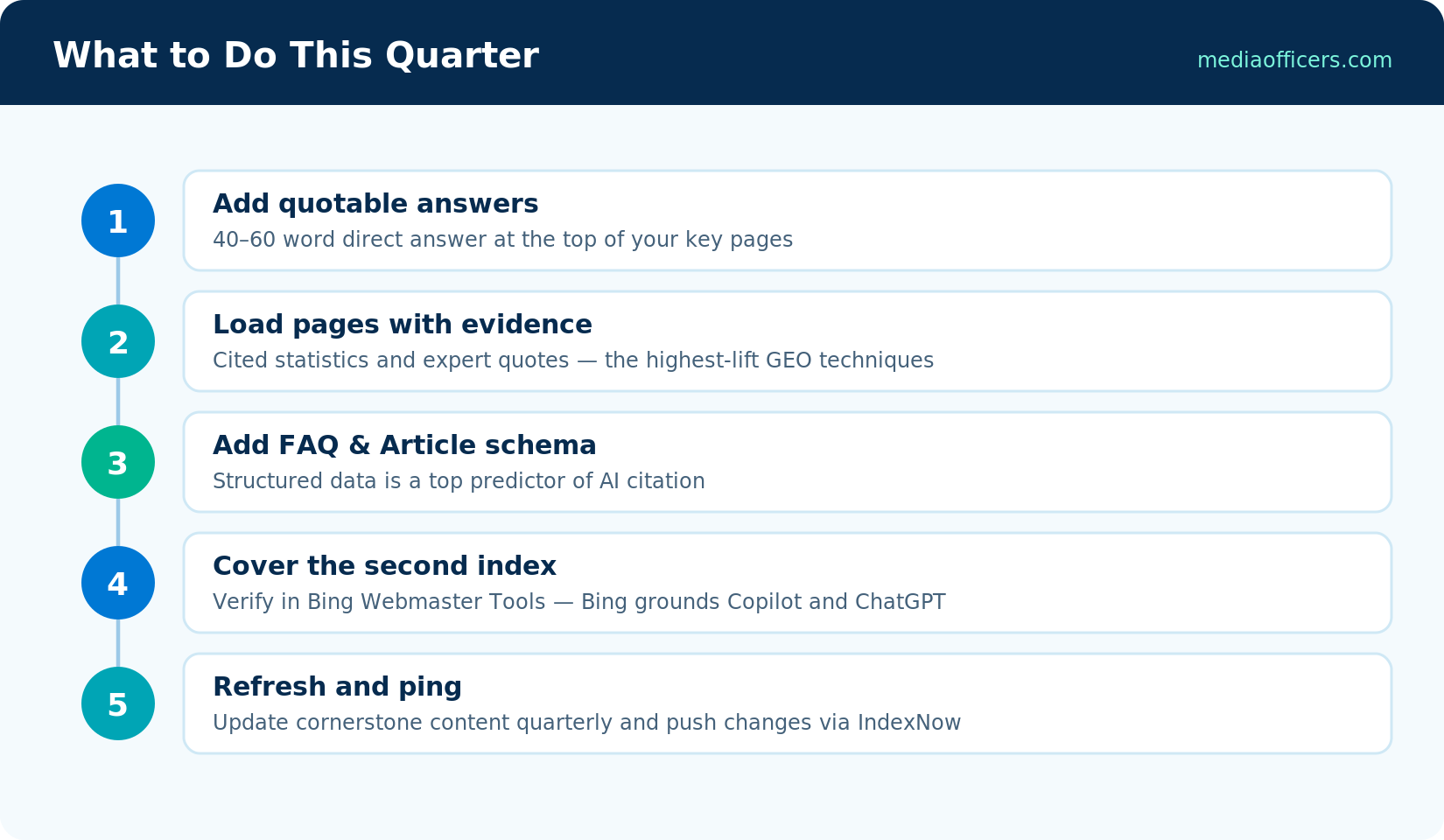
A one-quarter action plan any site can execute
Start with your five most-trafficked informational pages. Add a quotable answer block to the top of each. Work in at least three cited statistics and one expert quote per page. Add FAQ and Article schema. Verify the site in Bing Webmaster Tools so Copilot and ChatGPT can find you, and put the five pages on a quarterly refresh calendar. That's one month of part-time work — and it covers every shift on this list. Our GEO playbook walks through each step in detail, and the Bing Webmaster Tools setup guide gets the measurement side running in five minutes.
Frequently asked questions
Is SEO dead in 2026?
No — it's redistributing. AI engines still retrieve from search indexes, so ranking still matters; the difference is that fewer sources win each query. Sites combining classic SEO with GEO capture outsized visibility, while sites doing neither lose twice.
What is Generative Engine Optimization (GEO)?
GEO is structuring content so AI engines retrieve, quote and cite it: direct answer blocks, cited statistics, expert quotes, structured data, and freshness. Research shows these techniques lift AI visibility by 30–40%.
How do I know if AI engines cite my website?
Bing Webmaster Tools' AI Performance report shows how often Copilot and Bing's AI experiences cite your URLs — currently the only official citation report from a major engine. For others, test your target prompts manually and watch referral patterns.
Does Bing really matter for AI search?
Yes. Microsoft Copilot and ChatGPT's web search ground answers in Bing's index, so Bing visibility directly determines whether those assistants can cite you — independent of your Google rankings.
For more details on semantic retrieval, check our roadmap for guide to generative engine optimization.

Written by
Rudhrah KeshavCo-Founder & Chief Revenue Officer (CRO)
Rudhrah Keshav is the Co-Founder & CRO at MediaOfficers. 16+ years SEO architect, published author of "AI Marketing for Indian Businesses" and "Local SEO" (Google Books / Amazon), featured in Yahoo Finance.


