
By this point in the series your site is verified, indexed within minutes of publishing, keyword-mapped, optimized on-page, and building authority. This article is about the instrument panel: reading what Bing tells you, catching problems before they cost traffic, and running a monthly routine that takes about an hour. Everything covered is free, using the Bing Webmaster Tools account from Bing Webmaster Tools Setup Guide.
Key Takeaways
- Search Performance gives per-query and per-page clicks, impressions, CTR, and position - filterable and exportable, with 16 months of history.
- SEO Reports is an automatic site-wide on-page audit with issues ranked low, moderate, and high severity.
- Site Scan is an on-demand crawler that audits up to 10,000 pages and emails you when finished.
- High-impression, low-CTR queries are your fastest wins - usually fixed by rewriting titles and descriptions.
- A four-week rotation through the reports keeps a site healthy in about an hour per month.
The Three Reports
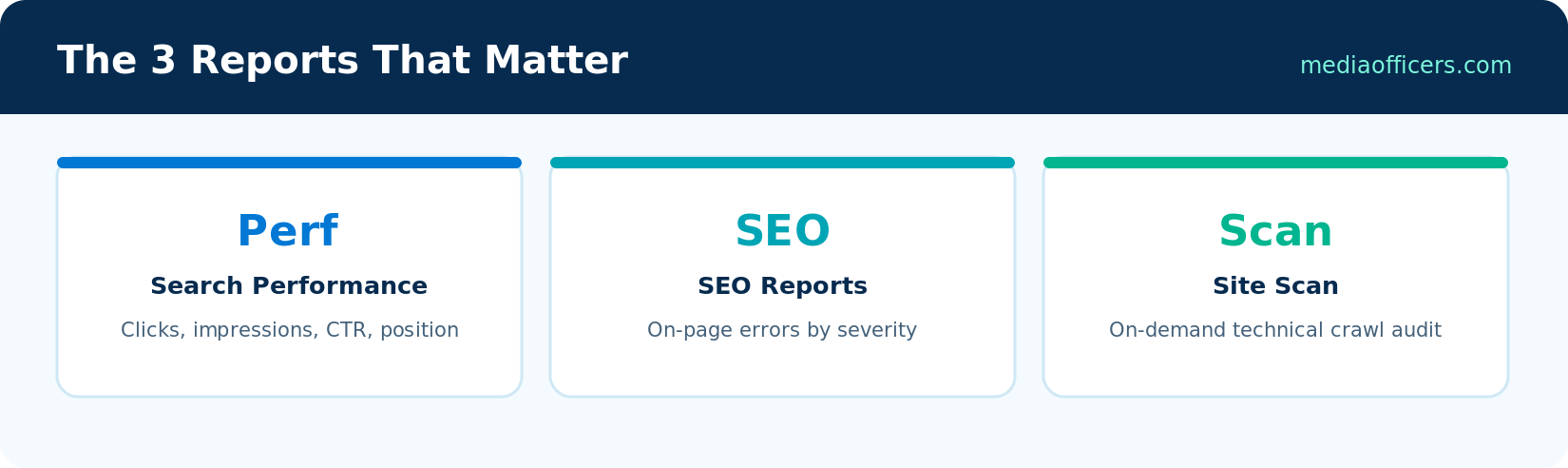
Your Bing SEO instrument panel
Search Performance: your traffic truth
The Search Performance tab charts clicks and impressions over time (three months by default, extendable to 16), broken down by page and by query, with CTR and average position for each. Three views earn your attention:
- High impressions, low CTR. Bing shows you often but users click elsewhere. The fix is packaging: rewrite the title and meta description with the exact query phrasing and a sharper value proposition.
- Positions 11 - 20. Page-two rankings are half-won battles. One optimization pass - refreshed content, better internal links, an authority link or two - typically tips them onto page one.
- Rising queries. Sort by impression growth to spot demand forming before competitors notice. Feed these back into your keyword map from Bing Keyword Research.
SEO Reports: the always-on audit
SEO Reports continuously evaluates your indexed pages against Bing's on-page standards and groups findings by severity. Expect flags like missing or duplicate titles and descriptions, multiple H1 tags, missing image alt attributes, thin content, and broken markup. Severity ordering is your prioritization for free: clear high-severity issues first - these directly suppress rankings - then work down. Because the report is generated from Bing's own crawls, fixing what it flags means fixing exactly what Bing's algorithm penalizes, not a third-party tool's opinion.
Site Scan: the deep crawl on demand
Site Scan is a configurable crawler you point at your own site: choose full-site, a URL subset, or a page cap, click Start new scan, and get an emailed report. It goes deeper than SEO Reports into technical territory - broken internal links, redirect chains, slow responses, robots conflicts, and now GEO-relevant checks. Run it after any site change (redesign, migration, plugin overhaul) and quarterly otherwise. Serious crawl errors it surfaces are the subject of Fixing Bing Indexing Issues guide.
The Monthly Bing Audit Routine
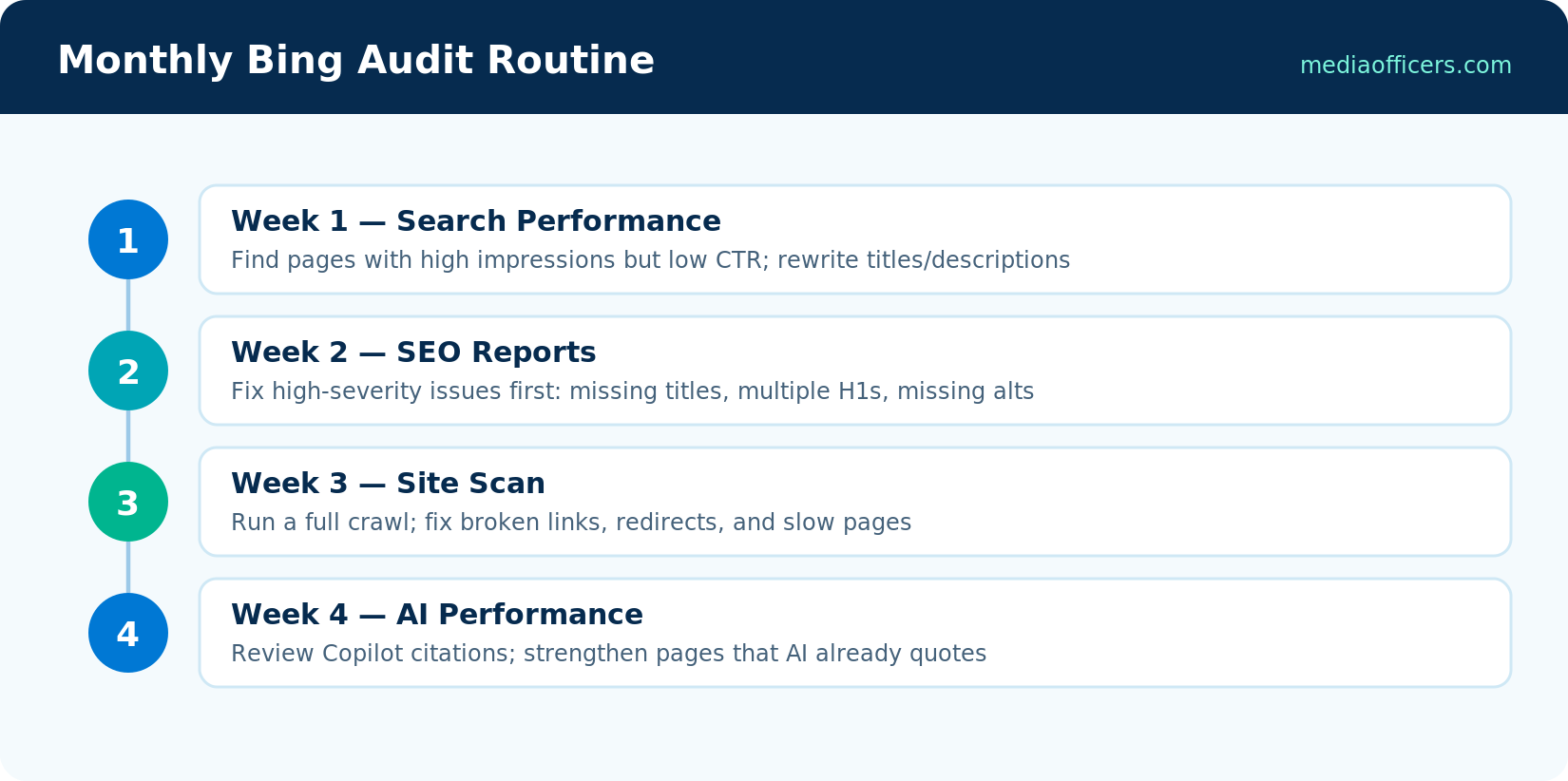
One focused session per week keeps the whole system healthy
Spread the work across the month, fifteen minutes at a time:
- Week 1 - Search Performance. Pull the high-impression/low-CTR list and rewrite the three worst title - description pairs. Note position 11 - 20 pages for content refreshes.
- Week 2 - SEO Reports. Clear every high-severity flag; log moderate ones for the backlog.
- Week 3 - Site Scan. Run a scan (monthly for large or frequently changed sites, quarterly for stable small ones). Fix broken links and redirect chains on the spot.
- Week 4 - AI Performance. Review which pages Copilot cited this month and reinforce them with fresh data and stronger quick answers - the full playbook lands in Rank in Copilot & AI Search playbook.
Two Underrated Companions
While you are in the dashboard: URL Inspection diagnoses any single page's index status, last crawl, and detected issues - the first stop whenever a specific page misbehaves (Fixing Bing Indexing Issues guide uses it heavily). And Backlinks shows not just your own link profile but lets you compare against any competitor domain - a free peek at competitor link sources that costs three figures a month elsewhere. Both compound the value of the monthly routine without adding meaningful time.
Reading the Data Like an Analyst
A few interpretation habits separate useful analysis from dashboard tourism. Compare like periods: Bing's B2B-heavy audience means weekday and weekend traffic differ sharply, so compare full weeks or months, never partial windows. Segment before concluding: a flat overall clicks line can hide one section growing while another decays - always break performance down by page group before deciding nothing changed. Watch position and CTR together: a page whose position improves while CTR falls usually has a title mismatched to the queries it now ranks for; the queries table tells you what searchers actually typed, and the title should echo it.
And treat anomalies as tickets, not mysteries. Impressions collapse on one page? URL Inspection. Site-wide dip? Site Scan plus a robots.txt check. CTR collapse with stable position? Someone - possibly a plugin update - rewrote your meta descriptions. Every symptom in the reports maps to a diagnostic elsewhere in the toolset, which is what makes BWT feel less like analytics and more like an operating system once the routine is ingrained.
Frequently Asked Questions
How often is Search Performance data updated?
Roughly daily, with a short processing lag. Sudden drops usually mean a technical issue - check Site Scan and URL Inspection before assuming an algorithm change.
How is Site Scan different from SEO Reports?
SEO Reports runs automatically on Bing's schedule and focuses on on-page issues; Site Scan is a crawl you trigger on demand with configurable scope and deeper technical checks.
Is there a limit on Site Scan?
Scans are capped at 10,000 pages per run. Larger sites can scope scans to sections and rotate coverage.
Can I export Bing Webmaster Tools data?
Yes - performance tables export to CSV, and an API is available for automated reporting pipelines.
Do these reports cover Yahoo and DuckDuckGo traffic?
They cover Bing's own results. Since Bing's index feeds Yahoo and parts of DuckDuckGo, improvements measured here lift those engines too, though their clicks are not itemized.
What's Next in the Series
The reports will inevitably surface crawl and indexing problems. Fixing Bing Indexing Issues guide is the repair manual: diagnosing why Bing isn't indexing your pages and fixing every common blocker, from robots.txt accidents to quality thresholds.

Written by
Rudhrah KeshavCo-Founder & Chief Revenue Officer (CRO)
Rudhrah Keshav is the Co-Founder & CRO at MediaOfficers. 16+ years SEO architect, published author of "AI Marketing for Indian Businesses" and "Local SEO" (Google Books / Amazon), featured in Yahoo Finance.


