
Articles 4 and 5 covered what you control on the page. This article covers everything else - the authority and trust signals that decide rankings when two pages are equally well optimized. Bing is unusually transparent about these factors: its webmaster guidelines openly describe what the algorithm evaluates, and where the guidelines are quiet, a decade of industry testing fills the gaps. Here is the evidence-based picture in 2026.
Key Takeaways
- Backlink quality, relevance, and the age of the linking domain matter more to Bing than link volume.
- Social signals are a real Bing ranking input - Bing's guidelines have acknowledged them for years.
- Domain age is a trust signal on Bing; established sites enjoy a structural advantage.
- Engagement metrics (CTR, dwell time) function as a continuous quality vote on your rankings.
- Multimedia-rich pages outperform text-only pages across Bing's results.
The Six Factors, Ranked
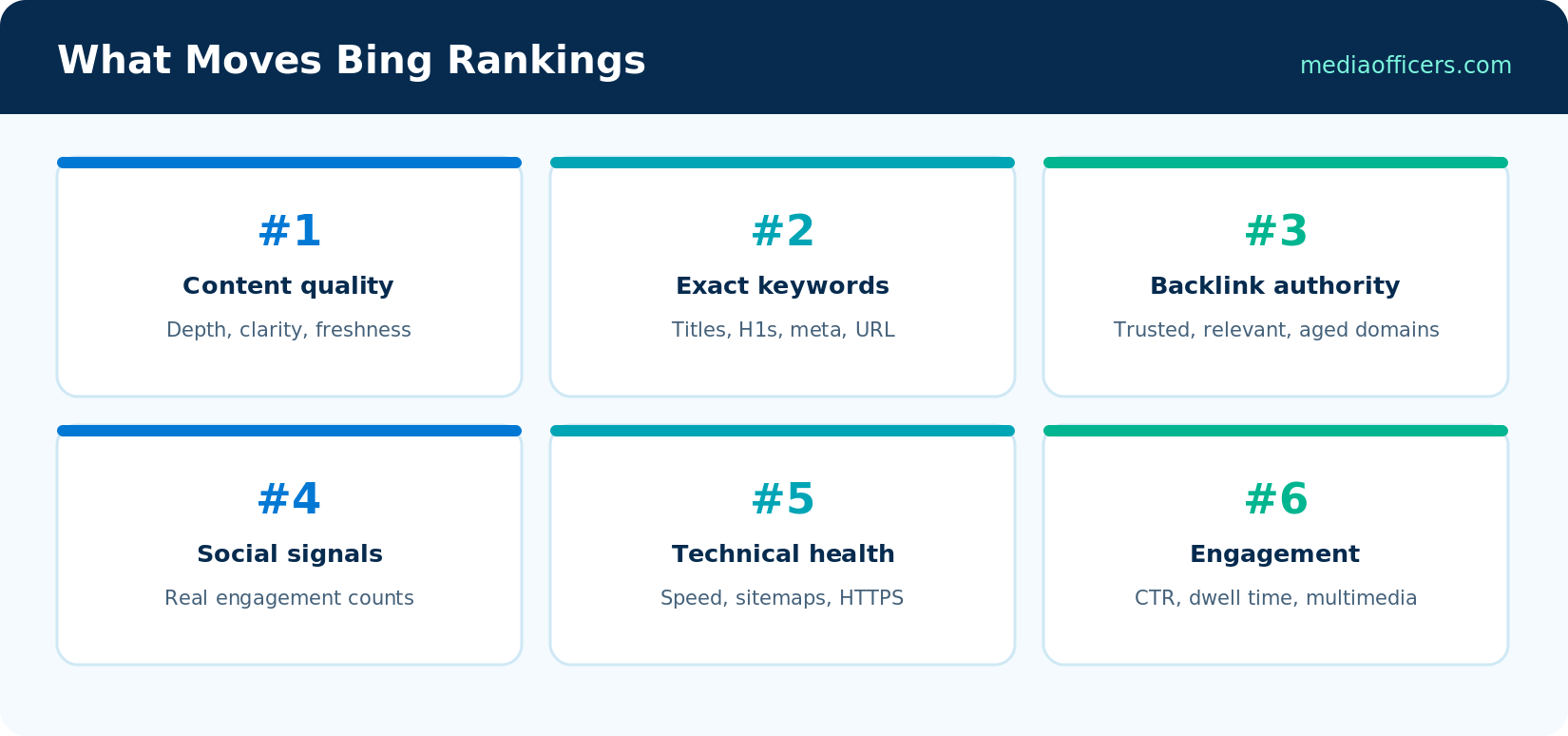
Bing's ranking inputs in order of typical impact
1. Content quality and freshness
Bing's guidelines define quality along three axes: authority (can the author be trusted?), utility (does the content actually serve the searcher?), and presentation (is it clear and well-structured?). Freshness multiplies all three - Bing recrawls and re-scores updated pages, and its AI surfaces prefer recently updated sources. A quarterly refresh cycle on your key pages, pinged via IndexNow, is the cheapest ranking maintenance available.
2. On-page keyword optimization
Covered fully in On-Page SEO for Bing guide: exact-match placement in title, H1, meta description, URL, and opening copy. Listed here for completeness because it interacts with everything below - authoritative links pointing at a page that never states its target keyword are horsepower without steering.
3. Backlinks: authority over arithmetic
Bing evaluates who links to you more than how many. Three properties consistently matter: the linking domain's authority and trust, its topical relevance to your content, and its age. A single link from an established industry publication or university site outweighs dozens from young, thin blogs. Anchor text is read fairly literally - descriptive, keyword-relevant anchors help - but anchor manipulation at scale trips spam filters just as it does on Google.
4. Social signals: the Bing exclusive
This is Bing's most distinctive factor, covered conceptually in Bing SEO in 2026 Guide. Practically: content that earns genuine shares and engagement on LinkedIn, X, Facebook, and other platforms sends Bing a popularity signal it openly factors into rankings. Note the word genuine - Bing's guidance frames this as measuring real influence, and bought engagement patterns are detectable. The operational takeaway: distribution is part of SEO on Bing. Every article you publish should ship with a social push, which is doubly effective for a media brand.
5. Technical health
Fast responses, working HTTPS, clean sitemaps, crawlable architecture, mobile-friendliness. Bingbot is less patient than Googlebot with slow servers - hosting that responds in under a second protects both crawl coverage and the engagement metrics below. Articles 7 and 8 give you the tooling to audit and fix all of this.
6. User engagement
Bing measures how searchers interact with your result: click-through rate from the results page, dwell time on your page, and pogo-sticking (bouncing back to search results - a negative vote). You influence these with compelling titles and descriptions (CTR), immediate answers and good structure (dwell time), and content that fully satisfies the query (no pogo-sticking).
Building Authority Bing Respects
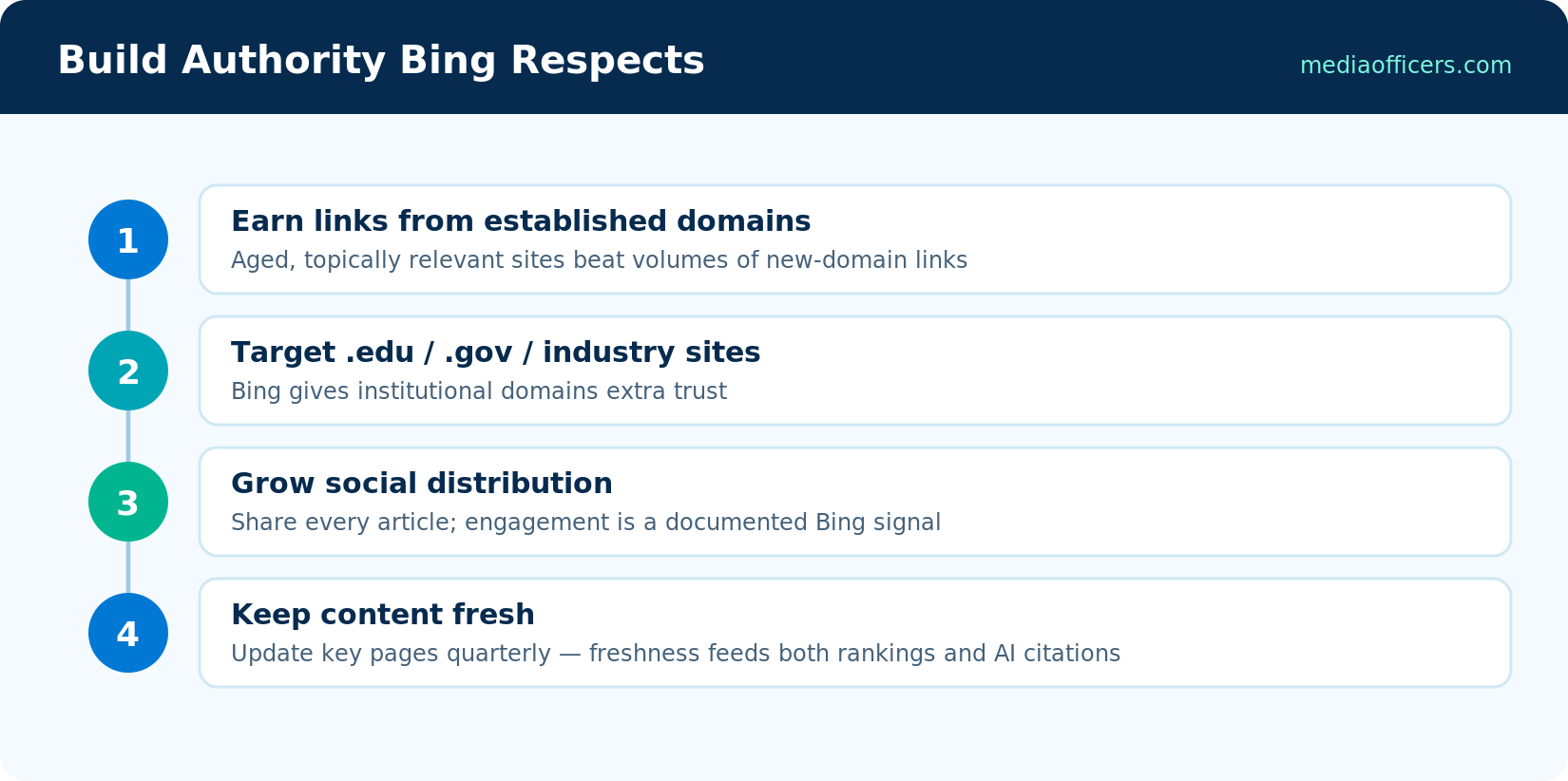
A repeatable authority-building routine for Bing
A practical monthly routine: pursue one or two links from established, topically relevant domains (guest expertise, original data, industry directories that editorial humans curate); prioritize institutional domains where legitimate opportunities exist - resource pages at universities, government small-business portals, trade associations; distribute every new article socially with actual engagement effort, not drive-by posting; and refresh one cornerstone page with updated statistics. Twelve months of this compounds into the trust profile Bing's algorithm is built to detect.
What Bing Penalizes
The mirror image of the ranking factors is worth knowing, because Bing's spam systems are mature and its penalties are quiet - traffic simply evaporates. The behaviors that trigger them:
- Link schemes. Bought links, link farms, and excessive reciprocal linking. Bing's guidelines are explicit that manipulative link acquisition risks delisting, and because Bing values quality so heavily, a spammy link profile stands out more against its model, not less.
- Keyword stuffing and cloaking. Serving crawlers different content than users, hidden text, and unnatural keyword density are classic delisting offenses.
- Manufactured social proof. Because social signals count on Bing, fake engagement is an actual ranking manipulation vector - and Bing's guidance frames its measurement around genuine influence precisely to filter it.
- Doorway and duplicate pages. Near-identical pages targeting keyword permutations dilute your site's quality profile and often drop out of the index entirely, as covered in Fixing Bing Indexing Issues guide.
Recovery follows the same path as on Google: remove the offending pattern, then request re-evaluation through Bing Webmaster Tools support. But the honest summary of this entire article is that the defensive game and the offensive game are the same game - the six factors above, pursued patiently, are both how you rank and how you never get penalized.
Frequently Asked Questions
What is the most important Bing ranking factor?
Content quality remains the foundation, but among differentiators, an exact-match optimized page on an established domain with a few authoritative backlinks is Bing's winning combination.
Do social media shares directly improve Bing rankings?
Bing's webmaster guidelines have long acknowledged social signals as a ranking input measuring influence and popularity. Genuine engagement helps; manufactured engagement is filtered.
How many backlinks do I need to rank on Bing?
Fewer than on Google for equivalent keywords. Quality dominates: several links from aged, relevant, authoritative domains typically outperform hundreds of low-grade links.
Does domain age really matter to Bing?
Yes - industry testing consistently shows Bing favors established domains and URLs more than Google does. New sites should expect a longer ramp and lean harder on the other five factors.
Does Bing penalize AI-generated content?
Bing evaluates quality, not authorship method. Helpful, accurate, well-edited content ranks regardless of how it was drafted; thin mass-produced content fails the quality bar regardless too.
What's Next in the Series
Now you know what Bing measures. Bing Webmaster Tools Reports guide shows you where to watch it happening: the Search Performance, SEO Reports, and Site Scan tools inside Bing Webmaster Tools, plus a monthly audit routine that keeps everything on track.

Written by
Rudhrah KeshavCo-Founder & Chief Revenue Officer (CRO)
Rudhrah Keshav is the Co-Founder & CRO at MediaOfficers. 16+ years SEO architect, published author of "AI Marketing for Indian Businesses" and "Local SEO" (Google Books / Amazon), featured in Yahoo Finance.


