
In Bing Keyword Research you built a keyword map from real Bing query data. Now we wire those keywords into your pages. This is where Bing SEO diverges most sharply from what a decade of Google-centric advice has taught you: on Google, exact-match optimization is nearly obsolete; on Bing, it remains one of the strongest levers you control. The good news - everything here also makes pages clearer for readers and easier for AI engines to quote, so nothing you do for Bing hurts you anywhere else.
Key Takeaways
- Bing matches keywords more literally than Google - exact-match placement in titles, H1s, and meta tags moves rankings.
- The first 100 words matter twice: Bing weighs early keyword placement, and AI engines lift quick answers from page openings.
- Bing openly rewards multimedia - pages with relevant images and video outrank text-only equivalents.
- Keyword-bearing URLs carry more weight on Bing than on Google.
- Older, established content ranks easier on Bing - update existing pages before creating new ones.
The 6-Point Bing On-Page Checklist
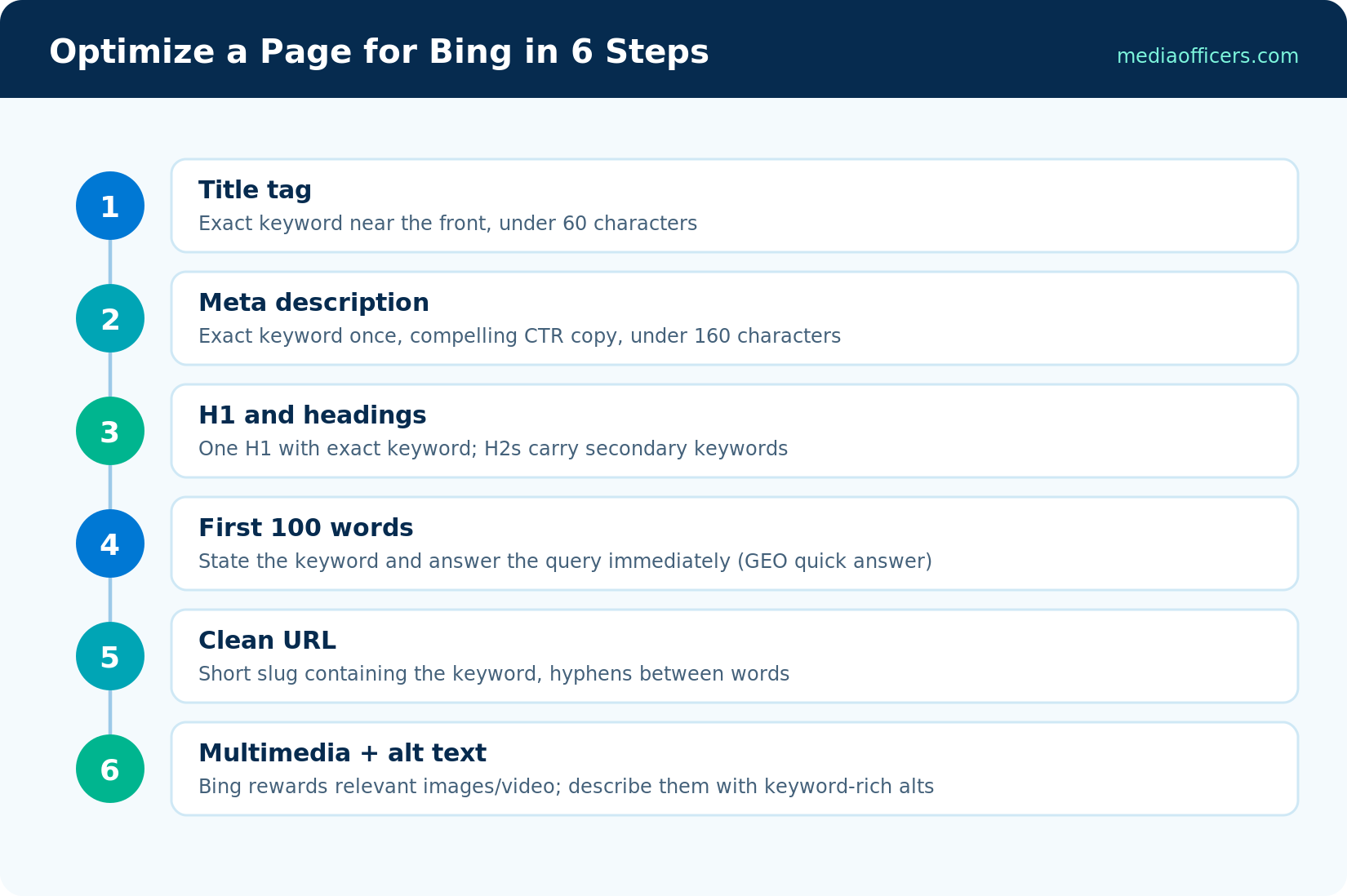
Work through all six points for every page you want ranking on Bing
1. Title tag: exact keyword, front-loaded
Keep it under 60 characters with the exact target keyword as close to the start as natural. 'Bing SEO Checklist: 12 Steps for 2026' beats 'Twelve Things We Learned About Optimizing for Microsoft Search.' Bing reads titles literally; give it exactly what searchers typed.
2. Meta description: keyword once, written for clicks
Under 160 characters, exact keyword once, and a reason to click. Bing bolds matched query terms in descriptions, so keyword presence directly increases visual prominence on the results page - which lifts CTR, which is itself a Bing engagement signal. A virtuous circle from one sentence of effort.
3. Headings: one H1, structured H2s
Exactly one H1 containing the exact keyword. Bing's SEO Reports (Bing Webmaster Tools Reports guide) actively flags multiple-H1 pages as errors - Bing cares about this more than Google does. Use H2s for section topics carrying secondary keywords from your map, phrased as the questions users ask where possible.
4. First 100 words: answer immediately
State the keyword and deliver a direct, complete answer to the query in the opening paragraph - the quick-answer pattern this very article uses. Bing weighs early keyword placement, and this same block is what Copilot lifts when it cites a page. One paragraph, two search engines' worth of benefit.
5. URL: short, keyword-bearing slugs
yoursite.com/bing-on-page-seo/ beats yoursite.com/blog/2026/07/post-id-4832/. Keyword-in-URL is a stronger signal on Bing than Google. Keep slugs short, lowercase, hyphen-separated - and never change published URLs without a 301 redirect.
6. Multimedia with descriptive alt text
Bing's guidelines explicitly reward rich media - relevant images, charts, and video improve rankings, and Bing's image and video search are far larger traffic sources relative to its size than Google's. Give every image descriptive, keyword-aware alt text (as the metadata table above does for this article's images). Alt text also feeds accessibility and AI-engine comprehension simultaneously.
How Bing Weighs On-Page Signals
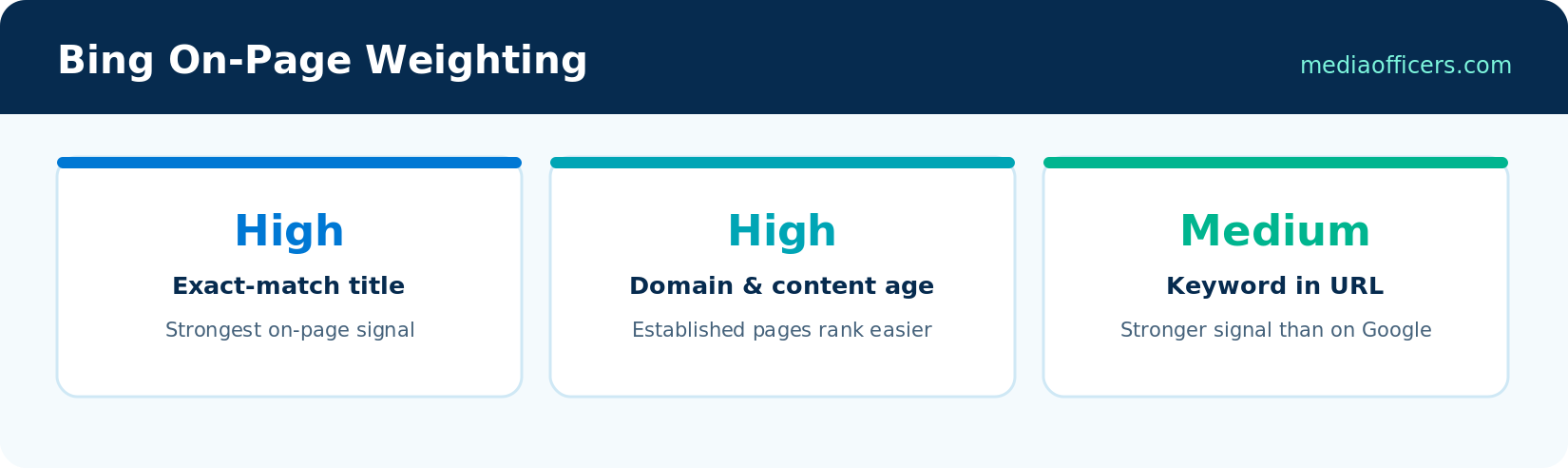
Relative weighting of Bing's on-page signals
If you can only do three things: fix titles first, then H1s, then opening paragraphs. Industry testing consistently finds the exact-match title is Bing's strongest on-page signal, followed by content depth and age. Note the age point - Bing trusts established URLs. Refreshing a five-year-old post (new stats, updated screenshots, honest lastmod, IndexNow ping) typically outperforms publishing the same material at a brand-new URL.
What Not to Do
- Don't keyword-stuff. Exact-match placement means precision in a handful of locations, not density. Bing penalizes stuffing like any modern engine.
- Don't spin variations. Creating near-duplicate pages for keyword variants triggers Bing's duplicate content filters - one strong page per topic.
- Don't hide text or abuse markup. Bing's spam detection is mature; schema should describe what is visibly on the page.
- Don't ignore mobile. Bing's audience is desktop-heavy, but its crawler still evaluates mobile-friendliness as a quality signal.
Internal Linking: The Multiplier Most Sites Skip
On-page optimization treats pages individually; internal linking makes them reinforce each other. Bing follows internal links to discover pages, and - reading anchors literally, as it does titles - uses anchor text to understand what the destination is about. Three rules serve you well. Link from your strongest pages to the pages you want lifted; a mention from your most-trafficked article passes meaningful weight. Use descriptive, keyword-bearing anchors: 'our Bing keyword research guide' rather than 'click here'. And build hub structure: this series does it deliberately, with every article linking its neighbors and the pillar, which is exactly the shape Bing's crawler maps most confidently.
A practical audit takes twenty minutes: list your ten most important pages, check how many internal links each receives (Site Scan reports this), and fix any target page with fewer than three inbound internal links. Orphaned pages - zero internal links - are frequently the same pages mysteriously missing from Bing's index.
A Note on Schema Markup
Structured data belongs in your on-page routine even though its ranking impact is indirect. Bing reads schema.org markup to build rich results - breadcrumbs, FAQs, ratings, events - and richer listings earn higher CTR, which is a direct Bing engagement signal. Minimum viable set for a content site: Organization and WebSite markup site-wide, Article markup on posts, FAQPage where you have genuine Q&A (every article in this series ships one), and BreadcrumbList for navigation. Validate with Bing's own URL Inspection, which reports markup errors alongside crawl status. Schema also happens to be one of the strongest predictors of AI citation - a theme Rank in Copilot & AI Search playbook takes up in full.
Frequently Asked Questions
Do exact-match keywords really still matter on Bing?
Yes. Bing's own webmaster guidance and consistent industry testing show literal keyword matching in titles, headings, and metadata carries more ranking weight on Bing than on Google, where semantic understanding dominates.
What is the ideal keyword density for Bing?
There is no magic percentage. Place the exact keyword in the six checklist locations and write naturally everywhere else.
Does Bing prefer long or short content?
Depth beats length. Bing rewards comprehensive coverage of the topic; 1,500 - 2,000 well-structured words with media outperforms both thin pages and padded epics.
Do images really help Bing rankings?
Yes - Bing explicitly favors multimedia-rich pages, and Bing image/video search delivers proportionally more traffic than Google's equivalents.
Should I optimize existing pages or write new ones?
Existing pages first. Bing weighs domain and content age, so a refreshed established URL usually ranks faster than a new one.
What's Next in the Series
On-page is half the ranking equation. Bing Ranking Factors covers the other half: Bing's off-page ranking factors - backlink authority, social signals, domain age, and the engagement metrics that decide close contests.

Written by
Rudhrah KeshavCo-Founder & Chief Revenue Officer (CRO)
Rudhrah Keshav is the Co-Founder & CRO at MediaOfficers. 16+ years SEO architect, published author of "AI Marketing for Indian Businesses" and "Local SEO" (Google Books / Amazon), featured in Yahoo Finance.


