
Every article in this series has been building to this one. The reason Bing SEO stopped being optional is not Bing's 5% market share - it is that Bing's index became the grounding layer for the fastest-growing search surfaces in the world: Microsoft Copilot across Windows and Office, Bing's own AI summaries, and ChatGPT's web search. Gartner projects organic traffic to websites will fall roughly 25% as discovery shifts to AI assistants. The sites that survive that shift are the ones AI engines cite. Here is how to become one of them.
Key Takeaways
- Copilot and ChatGPT search ground answers in Bing's index - classic Bing SEO (articles 1 - 8) is the entry ticket to AI citations.
- Princeton-led GEO research found citing sources, adding statistics, and including quotes lift AI visibility by 30 - 40%.
- A quotable 40 - 60 word answer at the top of each page is the single most liftable GEO element.
- FAQ and HowTo structured data are top-tier predictors of AI citation.
- Bing Webmaster Tools' AI Performance report (launched February 2026) makes GEO measurable for the first time.
How Content Gets Into an AI Answer
When a user prompts Copilot or ChatGPT with something answerable from the web, the AI runs searches against Bing's index, retrieves top-ranking candidate pages, extracts the passages that best answer the prompt, and composes a response citing some of those sources. Three gates, three disciplines: your page must rank (Bing SEO), contain an extractable passage (content structure), and be attractive to cite (authority and clarity). Miss any gate and you are invisible in the answer - which is why GEO is a layer on top of the previous nine articles, not a replacement for them.
The 6-Step GEO Playbook
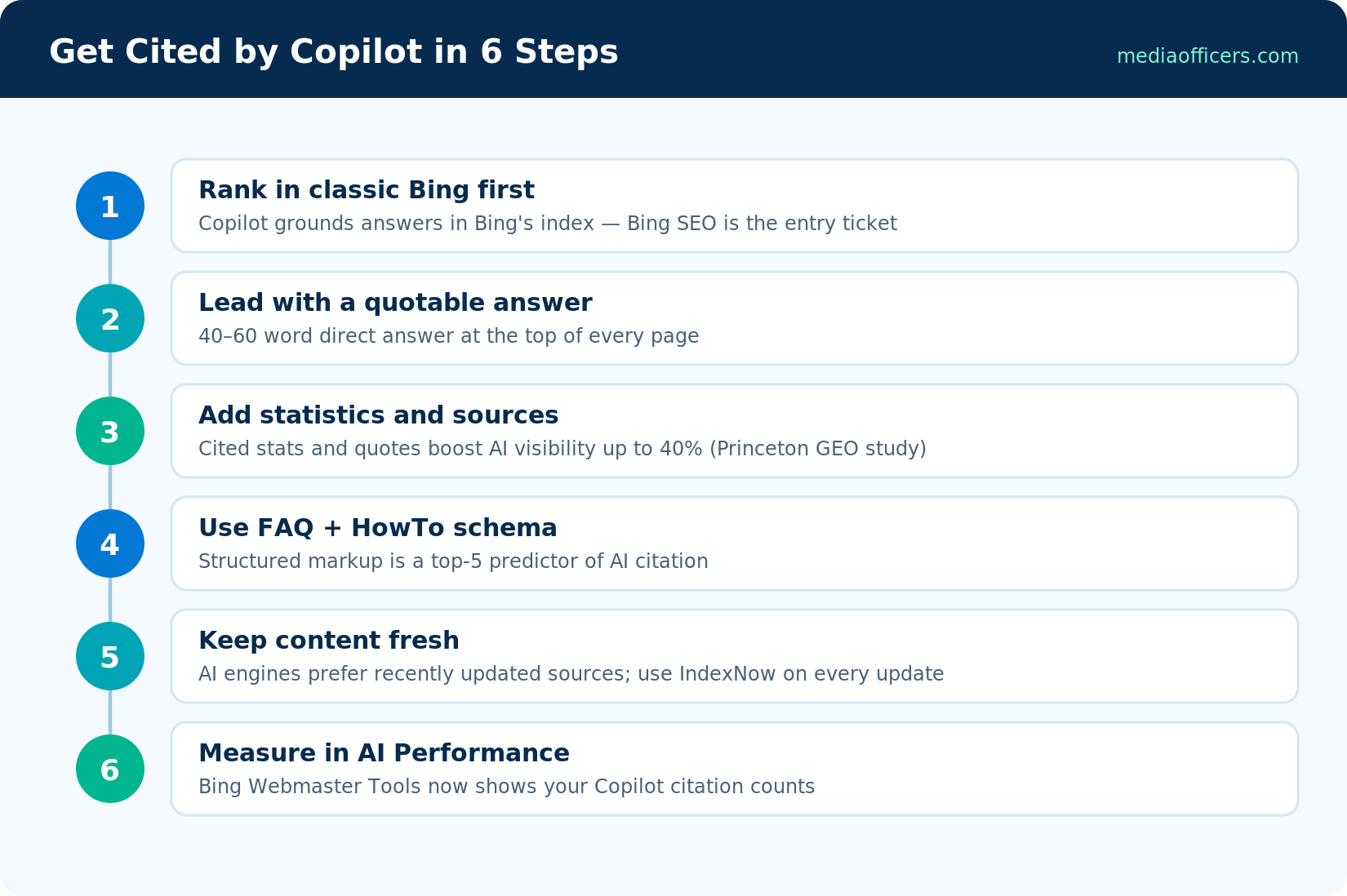
The complete pipeline from Bing rankings to Copilot citations
Step 1: Win classic Bing rankings first
AI retrieval overwhelmingly draws from pages already ranking well for related queries. Everything from this series applies: exact-match on-page work (On-Page SEO for Bing guide), authority signals (Bing Ranking Factors), clean indexing (articles 3 and 8). There is no GEO shortcut around being findable.
Step 2: Open with a quotable answer
Give every page a 40 - 60 word direct answer to its core question, right at the top - the Quick Answer pattern used throughout this series. AI models extract passages, and a self-contained, plainly worded answer block is the easiest possible extraction. Write it so it survives being quoted alone: no 'as we'll see below', no dangling pronouns.
Step 3: Load pages with citable evidence
The landmark GEO study out of Princeton, Georgia Tech, and IIT Delhi tested nine optimization techniques across thousands of queries. The winners: adding statistics, citing sources, and including expert quotations - each lifting visibility in AI answers by 30 - 40% versus unoptimized content. Numbers, named sources, and quoted expertise give the model concrete fragments worth attributing. Original data is even stronger: publish a survey, benchmark, or dataset no one else has, and you become the only possible citation for it.
Step 4: Structure for machines
FAQ and HowTo schema consistently rank among the strongest predictors of citation - structured markup hands the model pre-packaged question-answer pairs. Every article in this series ships with a ready FAQPage JSON-LD block; that is the pattern to replicate site-wide. Beyond schema: descriptive H2s phrased as questions, tables for comparisons, and lists for processes all raise extractability.
Step 5: Stay fresh - visibly
AI engines weight recency hard; a 2024 page loses citations to a 2026 page saying similar things. Refresh cornerstone content on a schedule, update dates honestly, and push every change through IndexNow (Bing Sitemaps & IndexNow guide) so Bing - and therefore Copilot - sees the new version within minutes.
Step 6: Measure in AI Performance
In February 2026 Microsoft shipped the AI Performance report in Bing Webmaster Tools - visibility into how often your content appears in Copilot, Bing AI summaries, and partner integrations, down to which URLs get referenced and how citation activity trends. No other major engine offers this. Work it into the week-4 slot of your monthly routine (Bing Webmaster Tools Reports guide): find your most-cited pages, reinforce them with fresher evidence, and replicate their structure across the pages that aren't cited yet.
Why This Is an Opportunity, Not a Threat
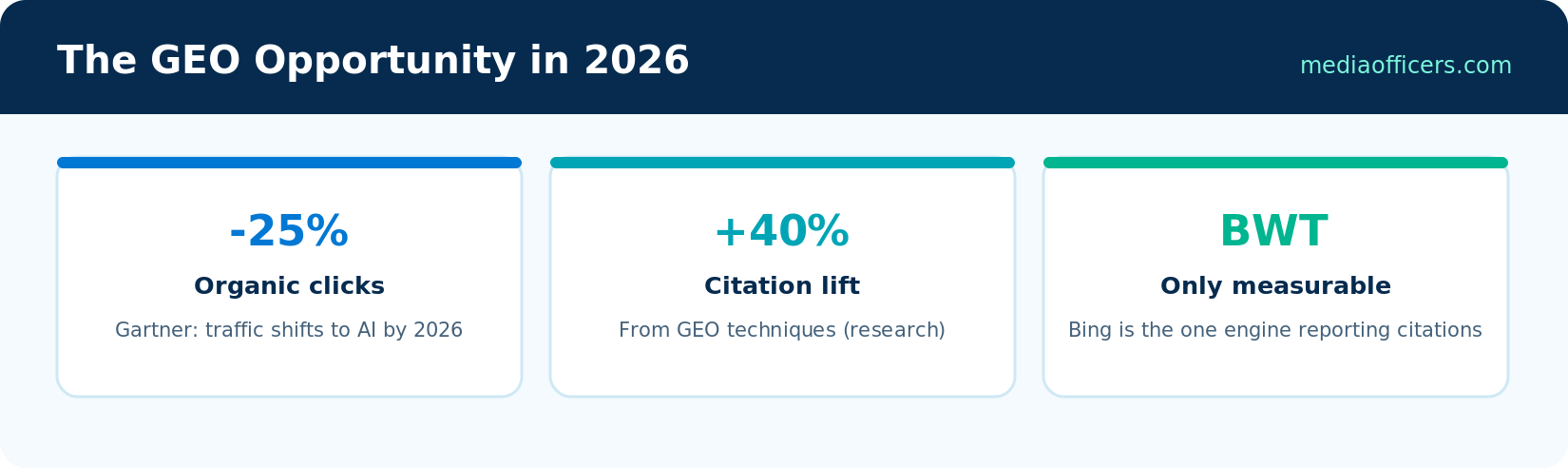
The numbers behind the AI search shift
The projected 25% decline in classic organic clicks lands hardest on sites that ignore AI surfaces. But citation traffic concentrates: AI answers typically cite two to five sources, not ten blue links. Being cited means capturing a larger share of a smaller click pool - and gaining something classic SEO never delivered, brand mentions read aloud inside the answer itself. Early movers in each niche are locking in that position now, and because GEO on Microsoft surfaces runs through Bing, the ten articles you have just read are the complete toolkit.
The Series in One Checklist
- Verify in Bing Webmaster Tools with GSC import (Bing Webmaster Tools Setup Guide); submit sitemaps and enable IndexNow (Bing Sitemaps & IndexNow guide).
- Build a keyword map from Bing's free tool, mining question queries (Bing Keyword Research).
- Optimize pages exact-match: title, H1, meta, URL, first 100 words, multimedia (On-Page SEO for Bing guide).
- Build authority: quality links, social distribution, freshness (Bing Ranking Factors); claim Bing Places if local (Bing Places & Local SEO guide).
- Run the monthly report routine (Bing Webmaster Tools Reports guide); fix crawl issues fast (Fixing Bing Indexing Issues guide).
- Layer on GEO: quotable answers, statistics, schema, freshness - and track citations in AI Performance (this article).
A 30-Day GEO Sprint
If you want a concrete starting plan: in week one, pick your five most-trafficked informational pages and add a quotable 40 - 60 word answer block to the top of each. Week two, work evidence into the same pages - at least three cited statistics and one named expert quote per page - and add FAQPage schema from real questions in your Bing keyword data. Week three, refresh anything older than a year on those pages, update the dates honestly, and push everything through IndexNow. Week four, check the AI Performance report for movement, note which pages earned citations, and queue the next five pages. One month, five pages, every GEO technique applied - and a measurable baseline to improve against.
Frequently Asked Questions
What is Generative Engine Optimization (GEO)?
GEO is the practice of structuring content so AI-powered engines - Copilot, ChatGPT, Perplexity, Bing AI summaries - retrieve, quote, and cite it when answering user prompts. SEO gets you clicked; GEO gets you quoted.
Does ChatGPT really use Bing?
Yes - ChatGPT's live web search is grounded in Bing's index, which is why Bing rankings influence ChatGPT citations.
How do I see if AI engines cite my site?
Bing Webmaster Tools' AI Performance report (public preview since February 2026) shows citation counts and referenced URLs across Copilot and Bing AI experiences. For other engines, test your target prompts manually and watch referral traffic.
Which GEO techniques work best?
Peer-reviewed testing found statistics, source citations, and expert quotes deliver the largest gains - up to 40% more AI visibility. FAQ/HowTo schema and quotable answer blocks compound those gains.
Will AI search kill SEO?
It is redistributing it. Retrieval still runs on search indexes, so ranking still matters - but the winners' circle per query is smaller. Sites that combine classic SEO with GEO capture outsized share; sites that do neither lose twice.
Ensure your entity mappings are correct by referencing our AI search optimization principles principles.
📌 Discussion & Community Insights: See the breakdown of structural search engine shifts on Rudhrah Keshav's X post.

Written by
Rudhrah KeshavCo-Founder & Chief Revenue Officer (CRO)
Rudhrah Keshav is the Co-Founder & CRO at MediaOfficers. 16+ years SEO architect, published author of "AI Marketing for Indian Businesses" and "Local SEO" (Google Books / Amazon), featured in Yahoo Finance.


