Address: Mediaofficers, Preet Colony, Near Baweja Nursing Home, Rupnagar, Punjab 140001
Phone: +919501504089
Phone: +918968951854
Email: hello@mediaofficers.com

The rapid adoption of artificial intelligence–driven search systems has significantly changed how users discover information online. Large language models (LLMs) such as ChatGPT, Gemini, Perplexity, and other generative AI platforms increasingly provide synthesized answers instead of traditional lists of web links. This transition has introduced a developing practice commonly referred to as Large Language Model Optimization (LLMO) – the process of structuring digital content to improve its likelihood of inclusion in AI-generated responses.
Search engine optimization (SEO) has historically focused on improving website visibility within search engine results pages (SERPs). However, the emergence of generative AI interfaces has shifted information retrieval from keyword-based ranking systems toward conversational answer generation.
Modern AI systems analyze multiple sources simultaneously and generate summarized responses for user queries. As a result, visibility is no longer limited to ranking positions but increasingly depends on whether content is selected, interpreted, and cited within AI-generated answers.
This evolution has led researchers and digital marketers to explore optimization strategies specifically aligned with large language model behavior.
Large language models are machine learning systems trained on extensive datasets containing web content, structured knowledge, and human-generated text. Unlike traditional search engines that display indexed pages, LLM-powered systems attempt to:
Examples of AI-assisted search environments include conversational assistants, AI overview systems, and answer engines integrated into modern search platforms.
These systems prioritize semantic relevance, factual consistency, and contextual authority rather than simple keyword matching.
Large Language Model Optimization refers to practices aimed at improving how digital content is interpreted and selected by AI systems during response generation.
Industry discussions surrounding related concepts include:
While terminology varies, the central objective remains consistent: enabling content to become machine-understandable and trustworthy for AI summarization processes.
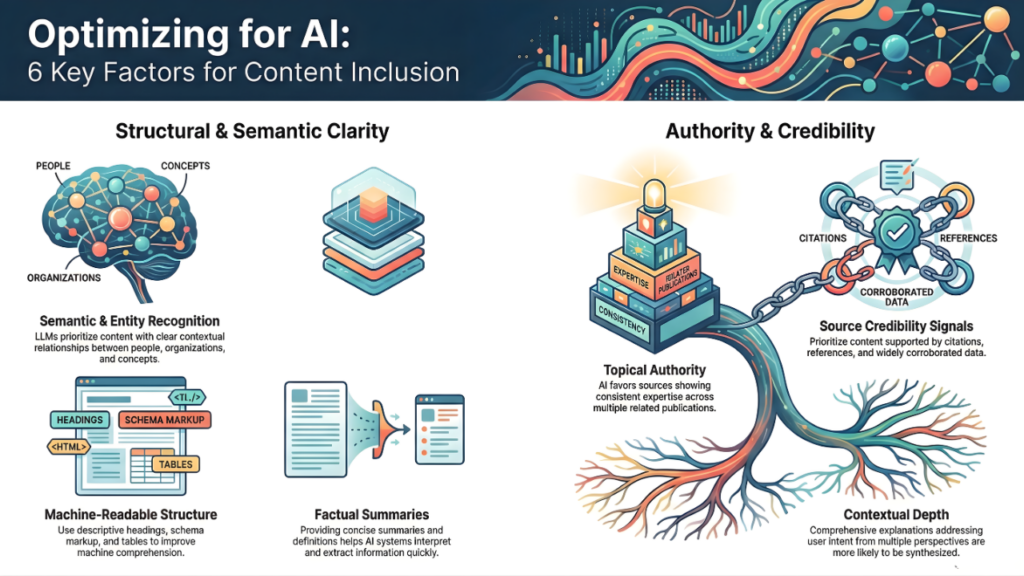
LLMs rely heavily on contextual relationships between entities such as people, organizations, concepts, and locations. Content structured around clearly defined topics improves interpretability.
AI systems tend to favor sources demonstrating consistent subject expertise across multiple related publications rather than isolated articles.
Use of structured formatting improves machine comprehension, including:
AI-generated answers often prioritize information supported by citations, references, or widely corroborated sources.
Comprehensive explanations that address user intent from multiple perspectives are more likely to be referenced during AI synthesis.
| Aspect | Traditional SEO | LLM Optimization |
|---|---|---|
| Primary Output | Ranked links | Generated answers |
| Optimization Target | Search algorithms | Language models |
| Ranking Factor | Keywords & backlinks | Context & authority |
| User Interaction | Clicking results | Conversational queries |
| Visibility | SERP position | AI citation or inclusion |
LLMO does not replace SEO but represents an extension of optimization practices adapted to AI-driven discovery systems.
Structured data enables clearer communication between web content and automated systems. Knowledge graphs, entity relationships, and standardized metadata contribute to improved machine interpretation.
As AI systems increasingly rely on structured understanding rather than isolated documents, knowledge representation has become a critical component of digital visibility.
Digital marketing professionals and researchers have begun examining how generative AI reshapes content discovery models. Studies and industry analyses suggest that AI-assisted search environments reward informational accuracy, transparency, and topical specialization.
Organizations are increasingly adapting publishing strategies to ensure compatibility with AI-driven search ecosystems.
Despite growing interest, LLM optimization remains an evolving field. Key challenges include:
Because AI outputs are probabilistic rather than deterministic, inclusion cannot be guaranteed through optimization alone.
As conversational interfaces become integrated into mainstream search experiences, optimization practices are expected to expand beyond webpages toward structured knowledge ecosystems.
Future developments may include:
Large Language Model Optimization is therefore viewed as a continuation of search evolution rather than a replacement of existing digital marketing methodologies.
Large Language Model Optimization (LLMO) refers to the practice of structuring digital content so it can be accurately understood and included in responses generated by AI systems powered by large language models. Unlike traditional SEO, which focuses on rankings, LLMO focuses on improving content visibility within AI-generated answers.
Traditional SEO aims to improve a website’s ranking in search engine results pages, while LLMO focuses on increasing the likelihood that content will be interpreted, summarized, or cited by AI-powered search and conversational systems.
AI-driven search experiences increasingly provide direct answers instead of lists of links. As users interact with conversational AI systems, content visibility depends on whether information is selected by large language models during response generation.
Large language models are used in AI assistants, conversational search interfaces, AI overview systems, and answer engines that generate summarized responses using information collected from multiple web sources.
Key factors include semantic clarity, topical authority, structured formatting, factual accuracy, entity recognition, and consistency across related content topics.
No. Large Language Model Optimization is generally considered an extension of SEO rather than a replacement. Traditional optimization practices such as high-quality content and technical accessibility remain important foundations.
Structured data helps AI systems interpret relationships between topics, entities, and information. Proper formatting improves machine readability, making it easier for AI models to understand and reference content.
Both concepts address optimization for AI-generated search experiences. GEO typically focuses on generative search engines, while LLMO emphasizes how large language models interpret and synthesize information.
No optimization method can guarantee inclusion. AI-generated answers depend on multiple factors such as model training, source credibility, contextual relevance, and query interpretation.
As AI-assisted search continues to evolve, optimization practices are expected to focus more on entity authority, knowledge representation, structured publishing, and trustworthy information sources.
The transition from link-based search results to AI-generated answers represents a fundamental shift in online information discovery. Large Language Model Optimization reflects ongoing efforts to adapt digital content for machine interpretation, contextual understanding, and trustworthy synthesis within AI systems.
As generative technologies continue to influence how users access information, understanding the relationship between structured content and AI visibility is likely to become an essential component of modern web publishing.


