Address: Mediaofficers, Preet Colony, Near Baweja Nursing Home, Rupnagar, Punjab 140001
Phone: +919501504089
Phone: +918968951854
Email: hello@mediaofficers.com

Many websites fail to rank on Google. This happens not because of poor content, but because of missing on-page SEO optimization. You can write an incredible, highly informative article, but if your page lacks proper optimization for search engines, it will struggle to secure a spot on the first page.
Search engines like Google analyze hundreds of on-page SEO factors to determine whether your page deserves a top position. They look at specific elements to understand exactly what your page is about and how much value it provides to the reader. These crucial ranking factors include proper keyword usage, overall content quality, logical page structure, seamless user experience, and strategic internal linking.
Ignoring these elements means leaving organic traffic on the table. Fortunately, optimizing your website is a straightforward process when you know exactly what to look for.
In this guide, we will walk through a complete on-page SEO checklist that actually improves rankings in 2026. This checklist is highly practical, beginner-friendly, and actively used by professional SEO agencies to drive massive organic growth.
On-page SEO refers to optimizing specific elements directly on your website pages to improve rankings in search engines. It focuses heavily on the technical and content-based factors that you can control directly within your website dashboard or code.
Examples of on-page SEO include:
Unlike off-page SEO, which focuses on external signals like acquiring backlinks from other websites, on-page SEO optimization strictly improves your own website’s structure and content quality. Search engines need these structural clues to categorize and rank your website appropriately.
Search engines rely heavily on on-page SEO signals to understand your content. When a search engine crawler visits your website, it scans your text, headings, and metadata to figure out the context of your page.
The benefits of proper optimization include:
According to industry studies, pages that follow strong on-page SEO techniques can improve their rankings significantly. Even small improvements like writing an optimized title tag or adding descriptive internal links can impact your rankings in a noticeable way.
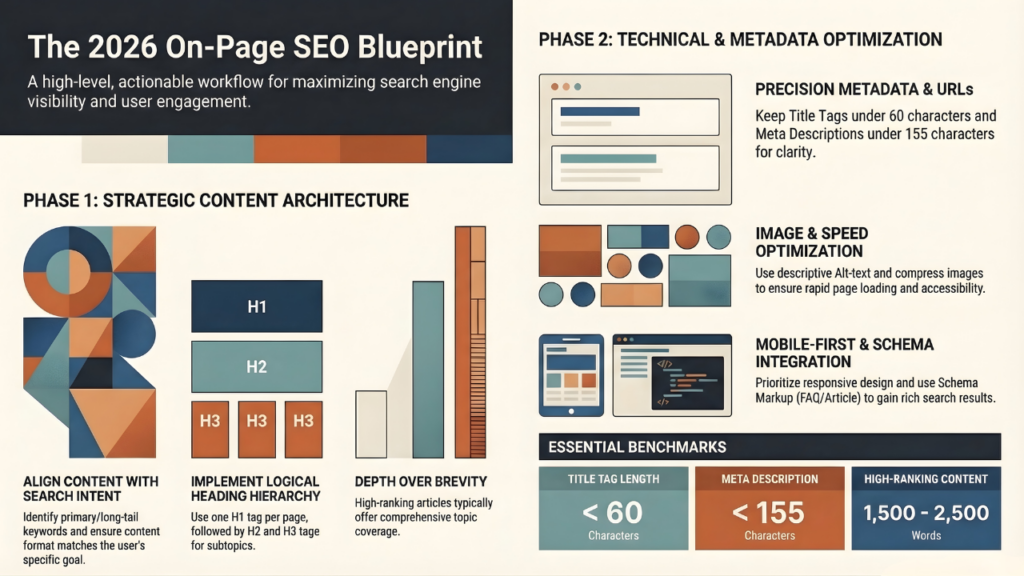
Below is a practical checklist used by professional SEO experts to ensure every published page has the highest possible chance of ranking.
Every SEO-optimized page starts with proper keyword research. Before you write a single word, you must understand exactly what your audience is searching for.
You need to identify:
There are several reliable tools you can use to find this data, including Google Keyword Planner, Ahrefs, SEMrush, and Ubersuggest.
Example:
Use these keywords naturally throughout your content so search engines understand your primary topic.
Your title tag is one of the most important on-page SEO factors. It tells search engines what your page is about and acts as the clickable headline in search results.
Best practices for title tags:
Example:
The first title is much clearer and far more engaging for users browsing search results.
Meta descriptions strongly influence click-through rates. While they are not a direct ranking factor, a well-written description convinces users to click your link instead of a competitor’s link.
Best practices for meta descriptions:
Example:
Learn the complete On-Page SEO Checklist used by experts to improve Google rankings, boost traffic, and optimize your website.
Your page URL should clearly explain what the page is about. Search engines and users alike prefer clean, readable web addresses.
An optimized URL is:
Example:
Search engines prefer clean URLs because they immediately convey the topic of the page.
Headings help search engines understand your content hierarchy. They break up large walls of text, making your article much easier for humans to read and for bots to crawl.
Best practices for headings:
Example structure:
This logical structure improves both readability and overall SEO performance.
Google ranks content that successfully satisfies user intent. If your page does not give users what they are looking for, they will bounce back to the search results, which hurts your rankings.
Types of search intent include:
For the keyword “On Page SEO Checklist,” users clearly want a step-by-step informational guide. Your content must clearly provide exactly that format.
Google consistently favors high-quality, comprehensive content. Writing thin content that barely scratches the surface of a topic will rarely result in a first-page ranking.
Best practices for content creation:
A typical high-ranking SEO article often contains anywhere from 1500 to 2500 words, depending on the complexity of the subject.
Internal links connect your web pages together. They are essential for a healthy website architecture.
Internal links help:
Example internal links to include in an SEO blog:
Always use descriptive anchor text when linking.
Example: learn more about WordPress SEO optimization.
Images also contribute directly to your SEO efforts. Search engines cannot “see” images, so they rely on text-based clues to understand visual media.
Best practices for images:
Example:
Page speed is a confirmed Google ranking factor. A slow website frustrates users and causes them to abandon your page entirely.
You can improve your website speed by:
Tools to successfully test your speed:
Over 60 percent of Google searches now come from mobile devices. Because of this, Google uses mobile-first indexing, meaning it evaluates the mobile version of your site before the desktop version.
Ensure your website features:
Schema markup is specialized code that helps search engines understand your content better. It provides explicit clues about the meaning of a page.
Benefits of schema include:
Recommended schema types for blogs:
Many beginners make specific mistakes that actively hurt their rankings. Understanding these pitfalls will save you time and frustration.
Avoid these common errors:
Fixing these basic issues can significantly improve your website rankings almost immediately.
You do not have to optimize your website blindly. These software tools make SEO optimization significantly easier and more accurate.
Popular SEO tools include:
These tools help marketers thoroughly analyze target keywords, locate technical site errors, monitor backlinks, and execute perfect content optimization.
Use this simple, condensed checklist before publishing any new article on your website.
Following this quick checklist consistently can dramatically improve your rankings over time.
SEO continues to evolve rapidly as technology advances. Marketers must stay adaptable to maintain their search visibility.
Key trends include:
Websites that focus entirely on producing genuinely helpful content and maintaining strong SEO fundamentals will seamlessly continue to dominate search results.
An on-page SEO checklist is a structured set of optimization steps used to improve individual webpages for both search engines and human users.
Google uses hundreds of ranking signals within its algorithm. However, the key on-page factors include titles, headings, content quality, internal links, and page speed.
On-page SEO is absolutely essential, but it works best when actively combined with off-page SEO strategies like building high-quality backlinks and establishing domain authority.
You should review and update your on-page SEO every few months, or whenever major search algorithms change, to ensure your content remains fresh and competitive.
Content quality and search intent optimization are widely considered the most important factors for achieving and maintaining high rankings.
Mastering on-page SEO is one of the most powerful, cost-effective ways to fundamentally improve your Google rankings.
By closely following this On-Page SEO Checklist, you can properly optimize your website structure, create incredibly search-friendly content, greatly improve your user experience, and successfully boost your organic traffic. Even small improvements in your titles, headings, and internal links can significantly impact your rankings. True SEO success comes entirely from consistent optimization and publishing high-quality content.
If you want professional help improving your website rankings, MediaOfficers offers expert SEO and digital marketing services. Trusted by over 150 businesses worldwide, our award-winning SEO specialists help brands rank higher on Google, generate targeted organic traffic, and dramatically increase leads and sales through data-driven strategies.
Visit MediaOfficers.com today to get your free SEO audit and grow your business with powerful, ROI-focused digital marketing strategies. 🚀


