Address: Mediaofficers, Preet Colony, Near Baweja Nursing Home, Rupnagar, Punjab 140001
Phone: +919501504089
Phone: +918968951854
Email: hello@mediaofficers.com

Every day, billions of searches happen on Google. Someone in Sydney looks up “best coffee near me.” A student in Chicago searches “how to write a thesis.” A small business owner in Mumbai types “how to get more customers online.” Within milliseconds, Google delivers a ranked list of results.
But how does Google decide which websites appear at the top and which ones get buried on page five where almost nobody looks?
Understanding how Google ranking works is one of the most valuable things you can do for your website. Whether you’re a business owner trying to attract more customers, a blogger hoping to grow your audience, or a marketer looking to sharpen your strategy, knowing what drives rankings puts you in control of your online visibility.
Google’s ranking system analyzes hundreds of signals to determine which pages best match a user’s search. These signals span content relevance, website authority, backlinks, user experience, and technical SEO. Together, they form a complex but learnable system.
This guide breaks it all down in plain terms, so you can walk away with a clear understanding of how Google ranking works and what you can actually do to improve yours.
Google ranking refers to the position a webpage holds in search engine results pages (SERPs) when someone types in a query. If you search “best digital marketing agency,” Google returns a list of websites ordered from most to least relevant. The site at position one gets the most clicks. The site at position ten gets significantly fewer.
Studies consistently show that the first page of Google captures the vast majority of organic clicks. Ranking on page two or beyond is, for most businesses, almost invisible.
This is why businesses invest heavily in SEO. A higher ranking means more visibility, more traffic, and ultimately more customers without paying for ads.
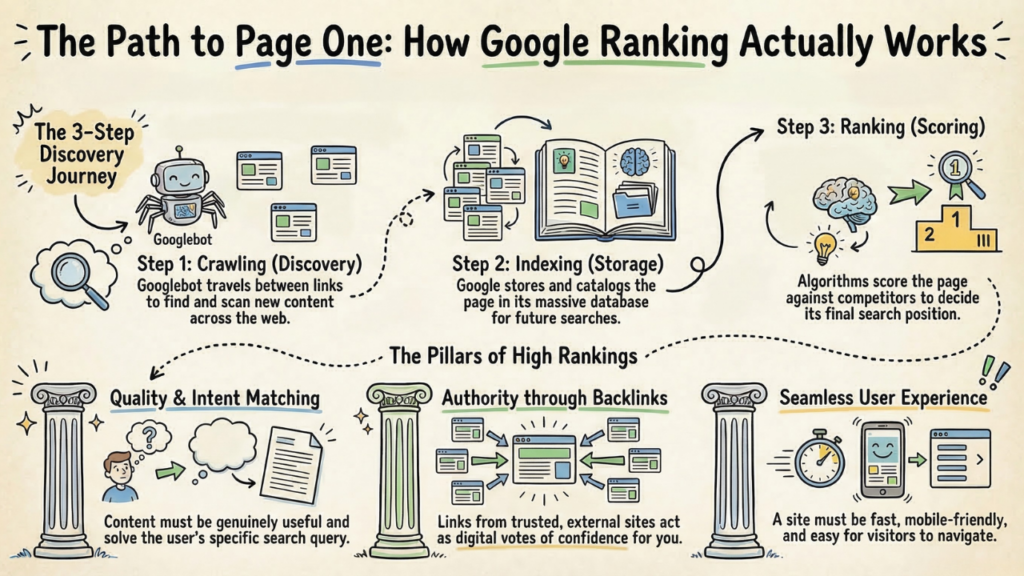
Before getting into ranking factors, it helps to understand what happens behind the scenes when Google encounters a webpage. There are three foundational stages: crawling, indexing, and ranking.
Google uses automated programs called Googlebot to explore the internet. These bots travel from link to link, scanning websites, sitemaps, and new pages to discover content. When a page is found, Google collects basic information about it.
If a website blocks these crawlers through technical settings, or has significant errors, Google may never find the page at all. No discovery means no ranking.
After crawling, Google analyzes the page more deeply and stores it in its massive database a process called indexing. During indexing, Google works to understand the page’s topic, keywords, images, structured data, and internal links.
Only indexed pages are eligible to appear in search results. A page that isn’t indexed simply doesn’t exist as far as Google is concerned.
Once a page is indexed, Google’s algorithm steps in to decide where it should appear when a relevant search occurs. Thousands of competing pages are compared, and each is scored across hundreds of factors relating to relevance, quality, and authority. The pages that score highest rise to the top.
Google uses more than 200 ranking factors, but some carry far more weight than others. Here are the ones that matter most.
Google’s primary goal is to match search results to what the user actually wants. Content that directly addresses the user’s query, uses relevant keywords naturally, and covers the topic thoroughly will always have an advantage.
For example, a search for “how Google ranking works” rewards pages that clearly explain the ranking process not pages that loosely mention it in passing.
Quality goes beyond just covering a topic. Google favors content that is helpful, well-structured, informative, and genuinely useful to the reader. Pages that answer questions clearly, organize information logically, and provide real value tend to outperform thin or generic content.
Google’s Helpful Content updates in recent years have made this even more critical. Content written for people not just for search engines is increasingly rewarded.
Backlinks – links from other websites pointing to yours remain one of the most powerful ranking signals. Google treats these links as votes of trust. When a high-authority website links to your page, it signals that your content is credible and worth referencing.
Quality matters far more than quantity here. A single backlink from a respected industry publication can be worth more than dozens of links from low-quality directories.
How visitors interact with your site tells Google a lot about its quality. Key signals include page loading speed, mobile-friendliness, bounce rate (how quickly people leave), and dwell time (how long they stay).
A website that loads slowly, looks broken on a phone, or frustrates users with poor navigation sends negative signals to Google regardless of how good the content is.
On-page SEO helps Google understand what your content is about. This includes optimizing title tags, meta descriptions, heading structure (H1, H2, H3), internal linking, and image alt text. These elements provide context clues that guide search engines to interpret your page’s topic accurately.
Technical SEO ensures your website is structured in a way that search engines can access and understand efficiently. This covers XML sitemaps, robots.txt configuration, page speed, structured data markup, and HTTPS security.
Even the best content can struggle to rank if Google encounters technical barriers when trying to crawl and index the site.
Ranking isn’t just about keywords it’s about understanding why someone is searching. Google categorizes search intent into four types:
Content that matches the right intent for a given keyword has a much stronger chance of ranking well.
Google doesn’t run on a single static algorithm. It updates its systems regularly sometimes through small daily tweaks, sometimes through major named updates that reshape the rankings landscape overnight.
Major updates often target low-quality content, manipulative backlinks, poor user experience, and keyword stuffing. Websites that rely on shortcuts or outdated tactics tend to suffer. Those that build their SEO on a foundation of helpful content, ethical link building, and technical best practices tend to weather updates and often benefit from them.
Staying informed about updates is part of any serious SEO strategy.
Knowing the ranking factors is only half the battle. Here’s how to put that knowledge into practice.
Every piece of content should solve a real problem or answer a genuine question. Comprehensive guides, detailed how-tos, and well-researched articles tend to attract both users and backlinks. Avoid padding articles with filler depth and clarity beat length every time.
Earning links from reputable websites accelerates your authority growth. Effective approaches include guest blogging on industry publications, digital PR campaigns, creating shareable research or data, and building genuine partnerships with complementary businesses. Avoid any tactics that involve buying links or participating in link schemes Google penalizes these.
Every page on your site should be optimized with a clear structure. Use your target keyword naturally in the title, headings, and body text. Write compelling meta descriptions that encourage clicks. Ensure your headings create a logical flow, and link to other relevant pages on your site to improve navigation and crawlability.
Site speed affects both rankings and user experience. Compress large images, enable browser caching, minimize unnecessary scripts, and invest in reliable hosting. Tools like Google PageSpeed Insights can pinpoint exactly what’s slowing your site down.
More than half of all Google searches happen on mobile devices. Google uses mobile-first indexing, meaning it primarily evaluates the mobile version of your site when determining rankings. Your website must load quickly and display correctly across all screen sizes.
Some misconceptions about Google ranking are surprisingly persistent. Here are a few worth clearing up:
Myth: Rankings are based on keywords alone. Keywords matter, but they’re just one signal among hundreds. Context, authority, user experience, and intent matching all play significant roles.
Myth: Backlinks alone guarantee high rankings. Backlinks are powerful, but a page with poor content or a bad user experience won’t hold a top position regardless of how many links it has.
Myth: More content automatically means higher rankings. Publishing more pages doesn’t translate to better rankings. A single high-quality, well-optimized page will consistently outperform ten thin, unfocused ones.
Google evaluates multiple signals together. Success comes from addressing all of them not just one.
Search technology is advancing rapidly, and Google’s ranking systems are evolving alongside it. Several trends are shaping what ranking looks like in the coming years:
The fundamentals remain the same: quality content, strong authority, and a well-structured website. These will carry any site through whatever changes come next.
Google ranks websites by analyzing hundreds of signals, including content relevance, backlinks, user experience, and technical SEO. Pages that best match a user’s search query and demonstrate quality and authority rank highest.
Google uses more than 200 ranking factors to determine where a webpage appears in search results.
SEO results typically take several weeks to several months, depending on your website’s authority, the competitiveness of your target keywords, and the quality of your optimization.
Yes. Backlinks remain one of the most influential ranking signals. Links from authoritative, relevant websites carry the most weight.
Content quality and relevance are widely regarded as the most critical factors. Without helpful content that matches search intent, other optimization efforts will have limited impact.
Understanding how Google ranking works is the foundation of any effective SEO strategy. Google evaluates content relevance, backlinks, user experience, and technical health and rewards websites that take all of these areas seriously.
SEO is a long game. Consistent effort, quality content, and smart optimization compound over time, delivering sustainable traffic that doesn’t disappear when an ad budget runs out.
If you’re ready to take your Google rankings seriously, MediaOfficers can help. With expertise across on-page SEO, off-page strategies, technical audits, and full-service digital marketing, the team at MediaOfficers works with businesses to build visibility that lasts. Visit MediaOfficers.com to get started with a free SEO audit today.