
SEO for doctors means ranking your clinic where patients actually look: the Google local pack for "dentist near me" searches, organic results for treatment-specific queries, and increasingly AI assistants that recommend providers. The formula is local SEO + treatment pages + reviews + medical E-E-A-T - and clinics that execute it typically see new-patient inquiries grow within 90 days.
This isn't theory for us. We took SmileArt Dental to #1 on Google for "sedation dentist Yukon Oklahoma" - a high-value keyword where a single ranking generates a steady stream of sedation cases. Here's the playbook.
Why Healthcare SEO Is Different
Google classifies medical content as YMYL ("Your Money or Your Life") and holds it to its strictest quality standards. That means generic content-farm tactics fail harder in healthcare than anywhere else - and clinics that demonstrate real expertise get outsized rewards. Three implications:
- Content must be medically accurate and ideally reviewed by the practitioner (with a named byline - "Reviewed by Dr. X, BDS, MDS").
- Trust signals - credentials, affiliations, reviews - carry more ranking weight.
- AI engines are equally conservative: they cite clinics with strong review profiles and authoritative content.
The 4-Part Clinic SEO Playbook
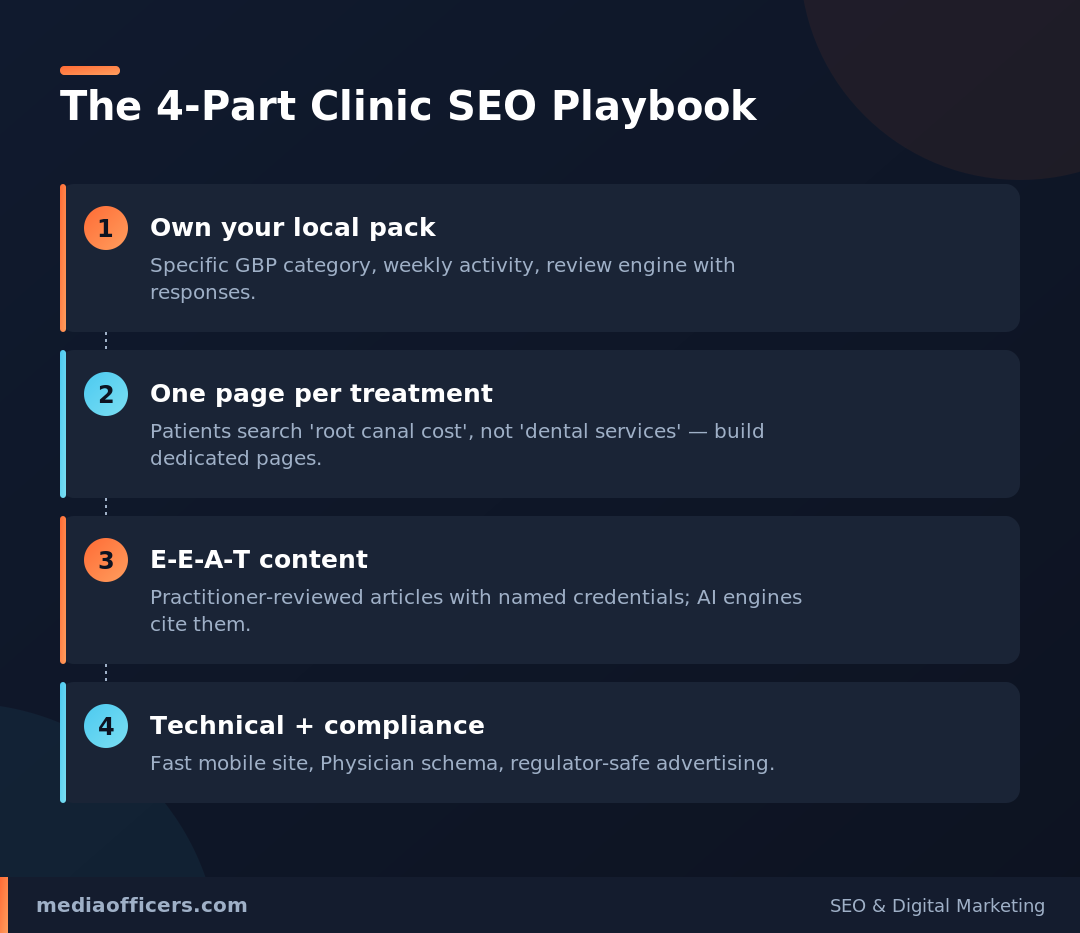
Part 1: Own your local pack
For "dentist near me" and "[specialty] + city" searches, the local 3-pack gets the calls. Priorities: a fully built Google Business Profile with the right primary category (e.g., "Dental implants provider," not just "Dentist"), weekly posts and fresh photos, and a review engine - ask every happy patient, respond to every review. Review velocity and keyword-rich patient reviews ("painless root canal") are the strongest local levers. Run our full local SEO checklist against your clinic.
Part 2: Build one page per treatment
The single biggest gap we find in clinic sites: one thin "Services" page listing everything. Patients don't search "dental services" - they search "root canal cost," "invisalign vs braces," "sedation dentistry for anxiety." Each high-value treatment needs its own page with: what the treatment is and who needs it, procedure steps and recovery, pricing or price ranges (pages with pricing outperform), FAQs patients actually ask, and before/after proof where regulations allow.
The SmileArt #1 ranking came from exactly this: a dedicated sedation dentistry page targeting the precise phrase anxious patients search, supported by local signals.
Part 3: Publish E-E-A-T content that AI engines cite
A monthly cadence of practitioner-reviewed articles ("How long do dental implants last?", "When does a cavity need a root canal?") does three jobs: ranks for research-stage searches, feeds AI assistants that patients now ask first ("is sedation dentistry safe?"), and builds the author-entity trust that boosts every other page. Always include the reviewing doctor's name and credentials.
Part 4: Technical + compliance hygiene
Fast mobile site (patients book on phones), Physician/Dentist + LocalBusiness schema, SSL, accessible design, and careful compliance - no fabricated testimonials, and follow your regulator's advertising rules (e.g., DCI/state boards in India, HIPAA-safe content practices in the US).
What Results Look Like
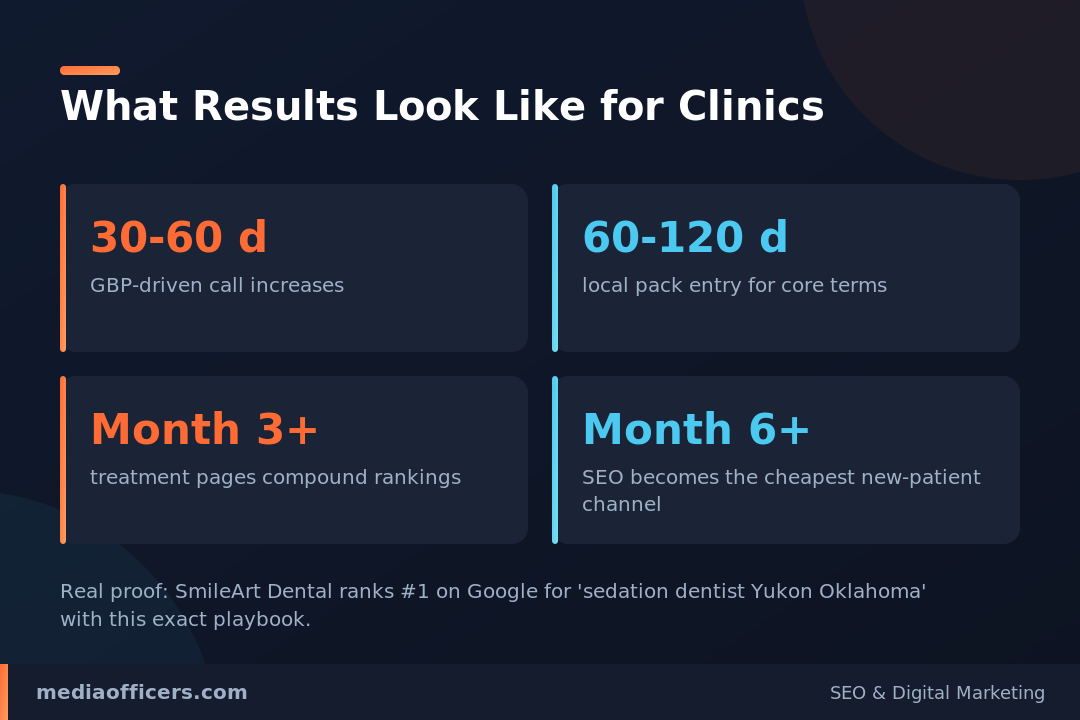 Healthcare SEO results timeline for clinics infographic">
Benchmarks from our healthcare clients: GBP-driven call increases in 30 - 60 days, local pack entry for core terms in 60 - 120 days, treatment-page rankings compounding from month 3, and by month 6+ the clinic's cost per new patient from SEO typically undercuts every paid channel. A single ranked high-value treatment page (implants, sedation, orthodontics) can pay for the entire annual SEO budget.
FAQs
How much does SEO cost for a dental clinic or medical practice? In India, ₹20,000 - ₹50,000/month for a single-location clinic. In the US/UK, $1,000 - $3,000/month. Multi-location practices and competitive specialties cost more. See our SEO pricing guide.
How long does dental SEO take to work? Local improvements in 1 - 2 months; competitive treatment keywords in 4 - 6 months. Clinics in smaller cities move faster than metro-area practices.
Is SEO better than Google Ads for doctors? They solve different problems: Ads deliver patients this week at a fixed cost per lead; SEO compounds until organic patients become your cheapest channel. Most growing clinics run Ads while SEO matures, then rebalance. Full comparison: SEO vs Google Ads.
Can doctors write their own SEO content? Clinicians make the best reviewers, not always the best writers. The efficient model: an SEO team drafts patient-friendly content, the doctor reviews and signs it. That byline is itself a ranking asset.
Do patient reviews really affect rankings? Yes - review quantity, recency, ratings, and owner responses are core local ranking factors, and review content influences which searches you appear for. They're also the #1 factor AI assistants weigh when recommending providers.
See how we rank clinics: SEO for Doctors · SmileArt Dental case study

Written by
Rudhrah KeshavCo-Founder & Chief Revenue Officer (CRO)
Rudhrah Keshav is the Co-Founder & CRO at MediaOfficers. 16+ years SEO architect, published author of "AI Marketing for Indian Businesses" and "Local SEO" (Google Books / Amazon), featured in Yahoo Finance.


